From Inception to Innovation: The Start of Mass Production

How Mass Production Shaped the Modern World
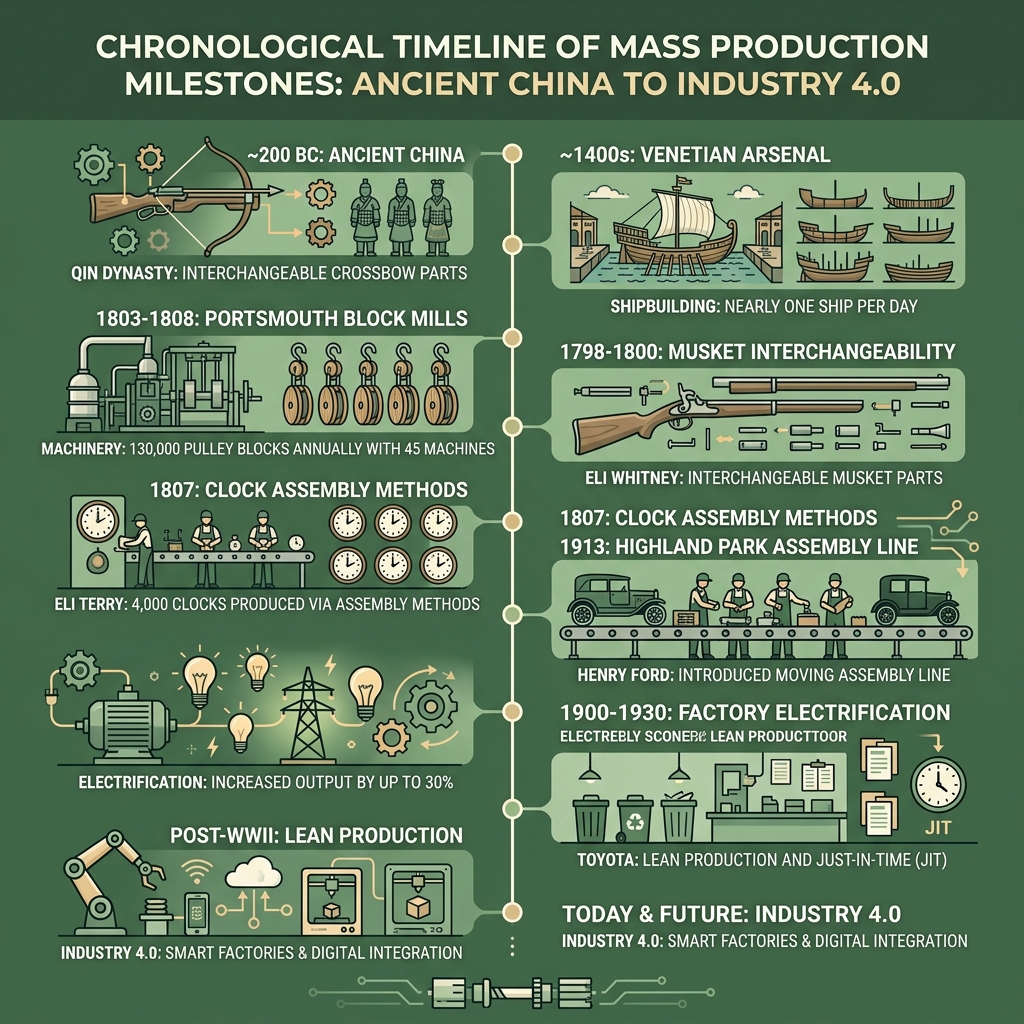
When did mass production begin is a question with a longer answer than most people expect. Here is a quick timeline of the key milestones:
| Era | Milestone |
|---|---|
| ~200 BC | Chinese Qin dynasty used interchangeable crossbow parts |
| ~1400s | Venetian Arsenal produced nearly one ship per day |
| 1803-1808 | Portsmouth Block Mills used 45 machines to make 130,000 pulley blocks per year |
| 1798-1800 | Eli Whitney demonstrated interchangeable parts for muskets |
| 1807 | Eli Terry fulfilled a contract for 4,000 clocks using early assembly methods |
| 1913 | Henry Ford introduced the moving assembly line at Highland Park |
| 1900-1930 | Factory electrification increased output by up to 30% |
| Post-WWII | Toyota pioneered lean production and just-in-time manufacturing |
In short, mass production did not begin at a single moment. Its roots stretch back thousands of years, but its modern industrial form took shape in the 18th and 19th centuries, and became dominant in the early 20th century.
The core idea has always been the same: produce large quantities of standardized goods at the lowest possible cost per unit. What changed over time were the tools, systems, and scale used to do it.
I'm Yoshihiro Hidaka, founder of Hidaka USA, Inc., a sheet metal fabrication company with over 30 years of experience supplying both prototype and mass production parts to the automotive industry — giving me a first-hand perspective on when did mass production begin to evolve into the precision-driven systems we rely on today. In the sections below, we'll trace that full journey, from ancient standardized parts to the modern assembly line and beyond.
Explore more about when did mass production begin:
- mass-produced meaning
- meaning of mass production
- the system of mass production in manufacturing developed rapidly
The Ancient Roots: When Did Mass Production Begin?
While we often associate factories with the 1900s, the conceptual seeds of mass production—standardization and division of labor—were planted in antiquity. If we look at the Bronze Age, we find evidence of casting molds used to create identical tools and weapons. However, the most striking early example comes from ancient China.
During the Warring States period and the Qin Dynasty, the Chinese military utilized mass-produced Chinese crossbow triggers. These bronze components were manufactured to such precise standards that parts from one crossbow could fit another—a feat of "interchangeability" thousands of years ahead of its time. Similarly, the famous Terracotta Army is believed to have been created using standardized molds on what functioned much like a stationary assembly line.
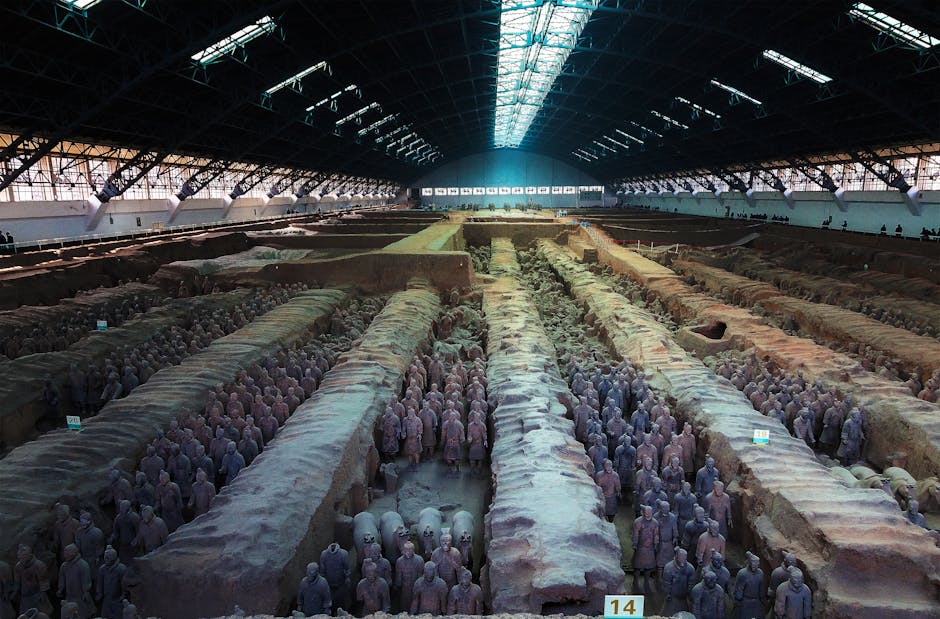
In the Mediterranean, the Carthaginians were known for mass-producing quinqueremes (warships) using a numbering system for parts, allowing them to build fleets with incredible speed. By the 15th century, the Republic of Venice took this even further. The Venetian Arsenal employed nearly 16,000 people and was essentially the world's first factory. They used a system of standardized parts and specialized workstations to produce nearly one ship every day.
The invention of movable type by Bi Sheng in China and later the Gutenberg press in Europe further revolutionized the "production" of information. By 1568, woodcuts show printers working in tandem, achieving roughly 3,600 pages per day through 14,000 repetitive hand movements. These early methods proved that breaking a complex task into smaller, standardized steps was the key to high-volume output.
The Industrial Revolution and the Birth of the American System
The transition from craft production (where one person makes a whole item by hand) to mass production required two things: power and precision. The steam engine, perfected by James Watt between 1765 and 1785, provided the power. Precision, however, came from the development of specialized machine tools.
In the early 1800s, the Portsmouth Block Mills in England became a landmark in industrial history. To supply the Royal Navy, Marc Brunel (with the help of Henry Maudslay, the "father of machine tools") established a production line to manufacture pulley blocks. Using 45 specialized machines, just 10 men could accomplish the work that previously required 110 skilled craftsmen. By 1808, they were producing 130,000 blocks annually. You can read more about this mechanical marvel at The Portsmouth blockmaking machinery.
This shift was supported by economic theory. In 1776, Adam Smith published The Wealth of Nations, where he famously described a pin factory. He noted that while one man might make 20 pins a day, ten men specializing in different parts of the process could make 48,000. This "division of labor" became the bedrock of the factory system.
| Feature | Craft Production | Mass Production |
|---|---|---|
| Worker Skill | Highly skilled artisans | Specialized, low-skill tasks |
| Tooling | General purpose hand tools | Specialized machinery/jigs |
| Parts | Hand-fitted (unique) | Interchangeable (standard) |
| Volume | Low | High |
| Unit Cost | High | Low |
When did mass production begin in the United States?
In the U.S., the journey often points back to 1798, when Eli Whitney contracted with the government to produce 10,000 muskets. While Whitney struggled with delivery—delivering only 500 by 1800—he famously demonstrated the concept of interchangeable parts to experts by assembling a musket from a pile of random components.
This "American System of Manufacturing" truly matured in the mid-19th century at places like the Springfield Armory. It wasn't just for guns; Eli Terry used these principles in 1807 to fulfill a contract for 4,000 wooden clocks, a volume unheard of at the time. By 1840, Chauncey Jerome was mass-producing 20,000 brass clocks annually. The key was standardized gauging—ensuring every part was identical so that no hand-filing was required during assembly.
The Ford Revolution and the Moving Assembly Line
While the "American System" gave us interchangeable parts, Henry Ford gave us "the line." Before 1913, cars were built by teams of men moving around a stationary chassis. It was slow and expensive. Inspired by the "disassembly lines" of Chicago meat-packing plants—where carcasses moved on overhead trolleys—Ford decided to reverse the process.
In 1913, at the Highland Park plant in Michigan, Ford introduced the first moving assembly line for magneto flywheels, cutting production time from 20 minutes to 5 minutes. By 1914, he applied this to the entire chassis. The results were staggering:
- Productivity: A 90% gain in efficiency.
- Speed: Assembly time for a Model T dropped from 12.5 hours to just 93 minutes.
- Volume: Production grew from 14,000 cars in 1909 to 585,000 by 1916.
Ford’s system required 32,000 specialized machine tools and a "neurotic" level of control. This led to the creation of the River Rouge complex, a marvel of vertical integration where raw iron ore entered one end and a finished tractor or car emerged from the other. To combat the high labor turnover caused by the mind-numbing repetition of the line, Ford famously introduced the $5 daily wage in 1914—doubling the average pay of the time and turning his workers into his best customers.
When did mass production begin to influence the automotive industry?
The automotive industry was the primary catalyst for modern mass production. After Ford's success, the "Fordism" model spread globally. However, it had limits. Ford’s insistence on a single, unchanging model (the Model T) eventually allowed competitors like General Motors to gain ground by offering variety and annual model changes. This tension between "efficiency" and "flexibility" continues to define the industry today.
The Evolution of Modern Manufacturing Techniques
As we moved into the 20th century, mass production didn't stop at the assembly line. Electrification played a huge role. Between 1900 and 1930, factories switched from steam-powered line shafts to individual electric motors. This simple change increased output by 30% because machines could be arranged based on the flow of work rather than their proximity to a power shaft.
Management also became a science. Frederick W. Taylor introduced "Scientific Management," using stopwatches to find the "one best way" to perform a task. Frank and Lillian Gilbreth took this further with motion studies, using film to eliminate "non-productive effort." While these methods boosted efficiency, they were often criticized for treating workers like machines.
In the post-WWII era, the "Toyota Production System" (TPS) changed the game again. Toyota realized that the rigid, high-volume Ford model created too much waste. They pioneered "Lean Production," focusing on "just-in-time" delivery and empowering workers to stop the line if they saw a defect. This shifted the focus from pure volume to quality and sustainability. You can see how these principles apply to modern industries in this McKinsey report on Lean production and sustainability.
Today, we are in the midst of "Industry 4.0." Technologies like CAD/CAM (Computer-Aided Design and Manufacturing), robotics, and 3D printing allow for "mass customization." At Hidaka USA, Inc., we use these advanced engineering analyses and 2D/3D laser cutting to bridge the gap between a single prototype and a full mass production run.
Frequently Asked Questions about the History of Mass Production
Who is considered the father of mass production?
While Henry Ford is the most famous figure due to the moving assembly line, the title is often shared. Eli Whitney is credited with popularizing interchangeable parts in the U.S., and Marc Brunel is recognized for creating the first fully mechanized production line in England. Mass production was a collective evolution of specialization and machine-assisted labor.
What was the first large-scale industrial mass production facility?
The Portsmouth Block Mills (1803) is widely considered the first. It used a sequence of 45 specialized machines to produce standardized pulley blocks for the British Royal Navy. It was the first time a complex wooden product was manufactured from start to finish using a coordinated system of machinery.
What are the main advantages and disadvantages of mass production?
- Advantages: Dramatically lower unit costs, high volume to meet global demand, and standardized quality. It has historically raised the standard of living by making goods like cars and appliances affordable for the average person.
- Disadvantages: High initial investment in machinery, inflexibility (it is hard to change a design once the line is set), and the potential for worker alienation due to repetitive, low-skill tasks.
Conclusion
From the bronze triggers of ancient China to the high-speed robotic lines of today, the story of when did mass production begin is one of constant human ingenuity. Each era added a new layer: standardization, then interchangeability, then the moving line, and finally digital automation.
At Hidaka USA, Inc., we carry this legacy forward in Dublin, Ohio. Whether we are working on a complex welding assembly for a motorsports vehicle or a high-volume run of metal parts for the automotive and mass-transit railcar industries, we combine the efficiency of mass production with the precision of modern engineering. Our ISO 9001 and AWS certifications are a testament to our commitment to the quality standards that have evolved over centuries of industrial progress.
If you are looking for a partner who understands both the history and the future of manufacturing, we are here to help. More info about mass production services can be found on our website, where we showcase our American-made quality and end-to-end production capabilities.