From Gilded Age to Modern Day: The Evolution of Mass Production

Why the System of Mass Production in Manufacturing Developed Rapidly During the Gilded Age
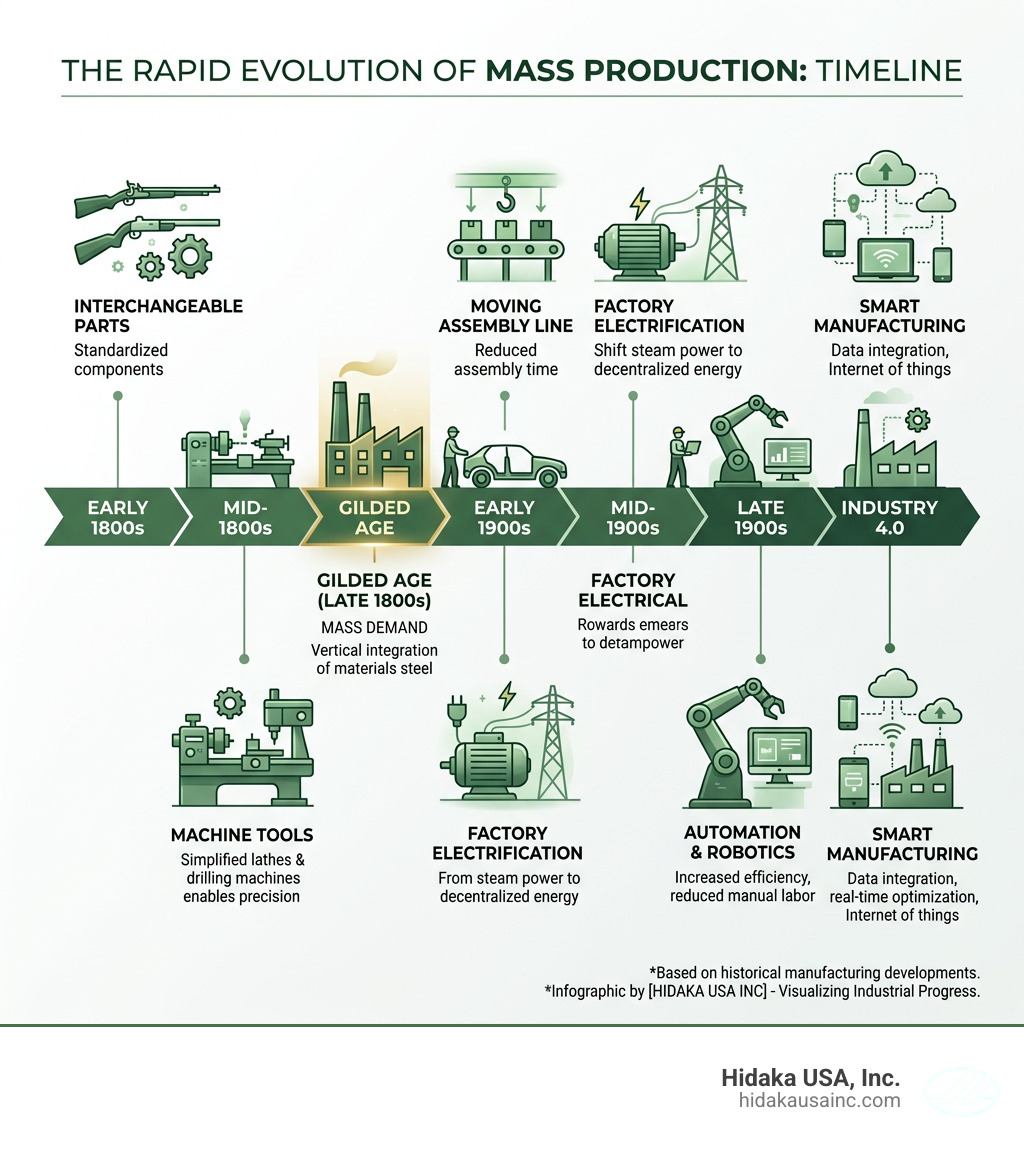
The system of mass production in manufacturing developed rapidly during the Gilded Age — the period of intense industrial growth in the late 19th century — driven by new technologies, cheap labor, and rising consumer demand. Here is a quick overview of how and why it happened:
FactorRole in Rapid DevelopmentGilded Age (late 1800s)Industrial expansion created massive demand for goods at scaleInterchangeable partsStandardized components replaced slow, hand-fitted craftsmanshipAssembly linesDivided complex tasks into simple, repeatable stepsMachine toolsEnabled precision manufacturing with less skilled laborFactory electrificationReplaced rigid steam-powered systems with flexible, efficient layoutsKey figuresHenry Ford, Andrew Carnegie, Marc Brunel, and Eli Whitney drove innovation
The shift was dramatic. Before mass production, a single skilled craftsman would build a product from start to finish. After it, thousands of workers — each performing one small task — could produce goods at a scale and speed that was previously unimaginable.
For example, at Henry Ford's plant in 1913, assembling a single chassis took 12.5 man-hours under the old system. Within a year, improvements to the moving assembly line cut that time to just 93 man-minutes.
I'm Yoshihiro Hidaka, founder of Hidaka USA, Inc., a sheet metal fabrication company with over three decades of experience supplying prototype and mass production parts to the automotive industry — an industry whose very foundation was built on the principles we'll explore here. Having witnessed how the system of mass production in manufacturing developed rapidly through the late 20th century and into the digital age, I'll walk you through its evolution from the Gilded Age to today.
During the Gilded Age, the United States underwent a seismic shift. This era wasn't just about gold-plated mansions; it was about the iron and steel that built them. Figures like Andrew Carnegie revolutionized the steel industry, creating massive monopolies that allowed for unprecedented vertical integration. By controlling everything from the iron ore mines to the steel mills, Carnegie ensured a steady flow of raw materials, which is a fundamental requirement for any mass production system to function.
The Gilded Age provided the perfect "nursery" for mass production. Large-scale infrastructure projects, such as the transcontinental railroads, created a massive internal market. To meet this demand, manufacturers had to abandon the slow, artisanal methods of the past. They began implementing Mass production | Description, History, Uses, & Limitations techniques that favored volume and speed. This was the moment when the "American System" truly matured, moving from small arms and clocks into the heavy industries that would define the 20th century.
Why the System of Mass Production in Manufacturing Developed Rapidly with Electrification
If the Gilded Age provided the demand, electrification provided the "juice." Before electricity, factories relied on a single massive steam engine. This engine turned a "line shaft" that ran the length of the ceiling, with leather belts dropping down to power individual machines. This was incredibly inefficient; if the main belt broke, the whole factory stopped. Furthermore, machines had to be crowded near the shaft, limiting how you could organize your workflow.
When factory electrification arrived in the late 19th and early 20th centuries, it changed everything. We moved to the "unit drive system," where each machine tool had its own electric motor. This allowed engineers to arrange machines according to the natural flow of the product, rather than the location of a overhead shaft.
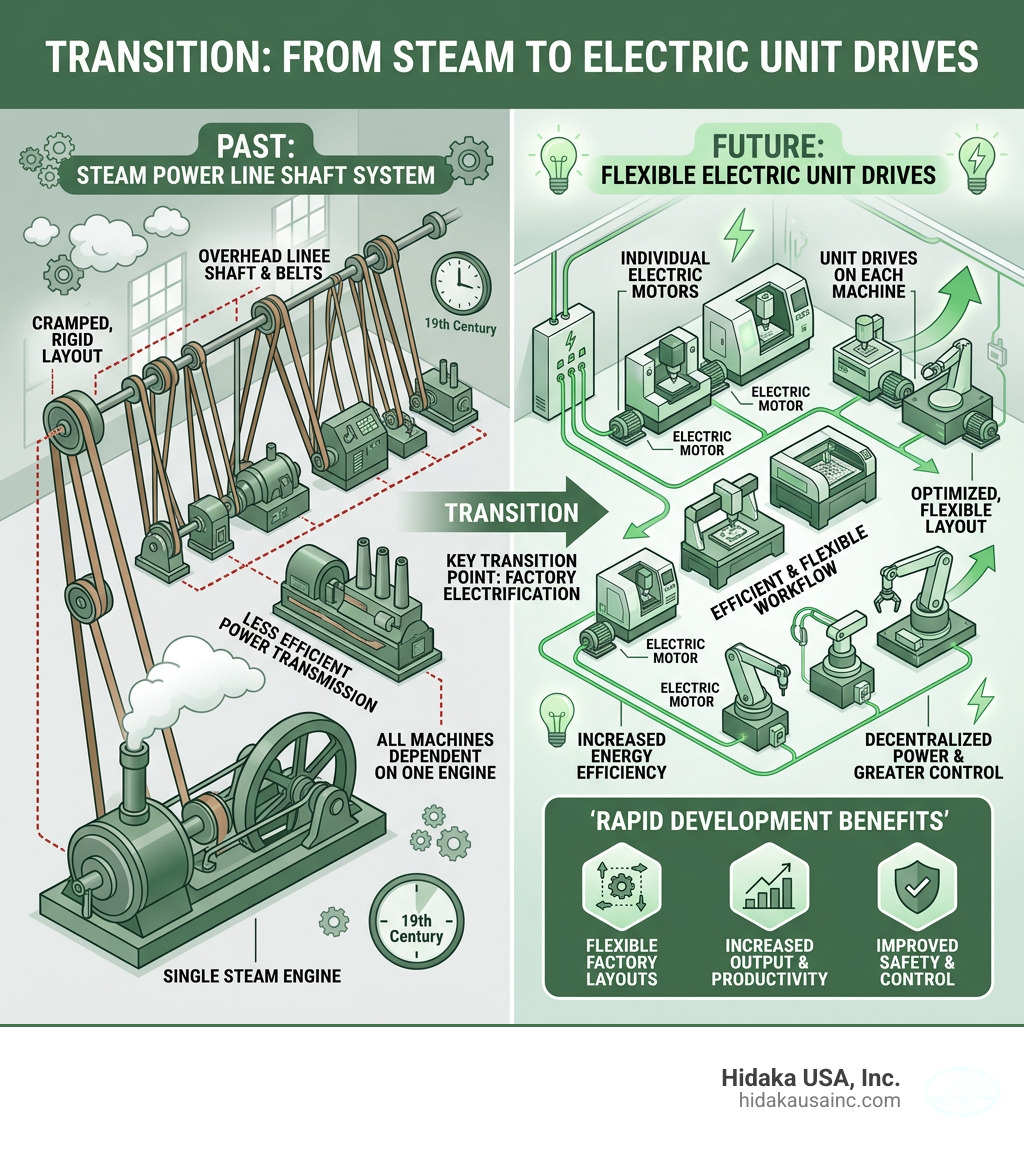
This flexibility was a key reason why the system of mass production in manufacturing developed rapidly. With electric power, we could implement "lights-out" manufacturing concepts in their infancy and significantly reduce energy costs. Statistics show that electrification often increased factory output by 30% almost overnight. At Hidaka USA, Inc., we see the modern legacy of this in our Dublin, Ohio facility, where our high-tech 2D and 3D lasers and hydraulic presses operate with a precision and layout efficiency that steam-age engineers could only dream of.
Core Principles: How Mass Production Differs from Traditional Craftsmanship
To understand why this system won, we have to look at what it replaced. Traditional craftsmanship was "bespoke." If you wanted a carriage, a master builder made the wheels, the frame, and the seat specifically for that one carriage. If a wheel broke later, you couldn't just buy a spare; a craftsman had to "fit" a new one to your specific axle.
Mass production flipped the script. We moved toward standardization and the division of labor. Instead of one person building a whole car, one person spends all day perfecting the installation of a single bolt. It sounds repetitive (and it is!), but it is incredibly efficient.
FeatureTraditional Craft ProductionModern Mass ProductionLabor SkillHighly skilled artisansSemi-skilled or unskilled operatorsToolingGeneral-purpose hand toolsSpecialized machinery and jigsPartsHand-fitted, uniqueStandardized and interchangeableVolumeLow (custom orders)High (continuous flow)Unit CostHighLow (economies of scale)FlexibilityHigh (easy to change design)Low (hard to re-tool)
The core of this system is the specialized machine. By using machines designed for one specific task, we take the "skill" out of the worker's hands and build it into the tool itself. This allows for high-volume output and a much lower cost per unit, making products like automobiles affordable for the average person.
How the System of Mass Production in Manufacturing Developed Rapidly Through Interchangeable Parts
The "holy grail" of mass production is the interchangeable part. While often credited solely to Eli Whitney, the American system of manufacturing was actually a collaborative effort involving many pioneers. Whitney’s 1798 contract for 10,000 muskets famously took eight years to deliver because he struggled to achieve true interchangeability.
Real progress happened at the U.S. Armories in Springfield and Harpers Ferry. Pioneers like Simeon North and John H. Hall developed the precision gauges and machine tools necessary to ensure that a trigger from one rifle would fit perfectly into another without any filing or "fitting."
This "Armory Practice" eventually leaked into private industry. Clockmakers like Eli Terry and Chauncey Jerome adopted these methods to produce thousands of clocks annually. By 1840, Jerome was mass-producing up to 20,000 brass clocks a year. This transition from "fitting" to "assembling" is exactly why the system of mass production in manufacturing developed rapidly; it removed the bottleneck of the master craftsman’s time.
The Ford Revolution and the Rise of the Assembly Line
While the "American System" laid the groundwork, it was Henry Ford who brought all the pieces together into a coherent and integrated operation. In 1913, at the Highland Park plant, Ford and his team introduced the moving-belt conveyor.
They started small, with the flywheel magneto. Previously, one worker took 18 minutes to assemble a magneto. By dividing the task into 29 individual steps performed along a moving belt, they cut that time to 13 minutes, and eventually to just 5 minutes.
Ford didn't just invent a machine; he invented a way of thinking. He realized that the work should come to the man, not the man to the work. This "flow production" was the final piece of the puzzle. By April 1914, thanks to the addition of a chain drive to move car chassis along the floor, the time required to assemble a Model T dropped from 12.5 man-hours to just 93 man-minutes.
Scaling Efficiency: From Man-Hours to Man-Minutes
The efficiencies gained by Ford were staggering. By focusing on comprising relatively simple, highly repetitive motion patterns, Ford could hire unskilled workers and train them in minutes.
This rapid development was supported by:
- Vertical Integration: Ford eventually owned his own rubber plantations, coal mines, and glass factories to ensure the integration of the entire supply chain.
- Work Synchronization: Every part of the factory had to move at the same speed. If the engine line moved faster than the chassis line, you ended up with a pile of engines and no cars to put them in.
- Mass Consumption: Ford famously paid his workers $5 a day—double the industry average—so they could actually afford to buy the cars they were building.
At Hidaka USA, Inc., we apply these same principles of synchronization and flow in our 95,000 square feet of manufacturing space. Whether we are producing a prototype or a mass-production run for a railcar manufacturer, we ensure that every step—from 3D laser cutting to final welding—is facilitated by careful planning to minimize waste.
From the American System to Industry 4.0
The journey didn't end with Ford. Throughout the 20th century, the system continued to evolve. We saw the rise of the Portsmouth Block Mills in England, where Marc Brunel used 45 specialized machines to produce 130,000 pulley blocks a year for the Royal Navy—a task that previously required 110 men but was now done by 10.
In the mid-20th century, the Toyota Production System introduced "Lean Manufacturing," which focused on eliminating waste (Muda). This added a layer of analytical rigor to mass production, proving that you could have high volume and high quality without massive inventories.
Today, we are in the midst of "Industry 4.0." This is the "Digital Thread" that connects a 3D CAD model directly to the factory floor. At Hidaka USA, Inc., we use advanced engineering analysis and CNC machinery to turn digital designs into physical metal parts with incredible speed.
The Digital Evolution of Rapid Manufacturing
In the modern era, the system of mass production in manufacturing developed rapidly because of software. We no longer spend months building manual jigs. Instead, we use:
- CAD/CAM Integration: Designs move seamlessly from computer screens to our laser cutters.
- Automated Design Analysis: Software can now tell us if a part is "manufacturable" before we even strike a piece of metal.
- Real-Time Data: We can monitor our hydraulic presses and welding stations in real-time to ensure assurance of quality.
This digital evolution allows us to handle the "customization" that 1920s factories couldn't. While Ford said you could have any color Model T as long as it was black, modern mass production at Hidaka allows for the variety and precision required by the motorsports and aerospace industries.
Frequently Asked Questions about Mass Production History
When and where did mass production originate?
While the Industrial Revolution in 18th-century England (think James Watt and his steam engine) was the catalyst, many point to the Venetian Arsenal in the 15th century as an early example, where ships were built using standardized parts on a "production line." However, the modern system truly crystallized with the Portsmouth Block Mills (1808) and the U.S. Armories in the early 19th century.
What were the societal impacts of rapid mass production?
The impacts were profound. It led to a massive rise in living standards by making goods cheaper. It also drove urbanization, as workers flocked to factory cities. Interestingly, the efficiency of mass production eventually allowed the workweek to decline from 70 hours in the early 1800s to the standard 40-hour week we see today.
What are the limitations of mass production systems?
The biggest challenge is inflexibility. A line designed to make one thing very well is often hard to "re-tool" for something else. This is why many companies now look for ways to alleviate this by using flexible robotics. Additionally, mass production requires accurate demand forecasting; if you produce 100,000 units that nobody wants, the "efficiency" becomes a massive loss.
Conclusion
From the smoky steel mills of the Gilded Age to the clean-room precision of modern robotics, the system of mass production in manufacturing developed rapidly to meet the needs of a growing world. It has transformed from a rigid process of "making many of the same thing" into a sophisticated, data-driven science.
At Hidaka USA, Inc., we are proud to carry this torch forward. Based in Dublin, Ohio, we combine the historical principles of the American System with the latest Industry 4.0 technology. Whether you need a single prototype to test a new design or a full mass-production run of complex metal assemblies for the automotive or mass-transit railcar industries, we have the ISO 9001-certified quality and the AWS-certified expertise to deliver.
We believe that the "American System" isn't just a history lesson—it’s our daily mission. By focusing on high-quality, American-made products and strict quality control, we ensure that your components are built to the highest standards of the modern age.