Mass Production: Unlocking Efficiency and Affordability

What Are the Advantages of Mass Production?
What are the advantages of mass production is one of the most important questions in modern manufacturing. In short, mass production makes goods faster, cheaper, and more consistent — benefiting both manufacturers and consumers.
Here is a quick overview of the key advantages:
| Advantage | What It Means |
|---|---|
| Lower cost per unit | Fixed costs are spread across more units, reducing the price of each one |
| Higher efficiency | Assembly lines and automation speed up production dramatically |
| Consistent quality | Standardized processes and preset machine parameters reduce human error |
| Scalability | Output can be increased to meet rising demand without starting from scratch |
| Faster distribution | High-volume output means products reach the market more quickly |
| Better resource use | Bulk purchasing and optimized workflows reduce waste |
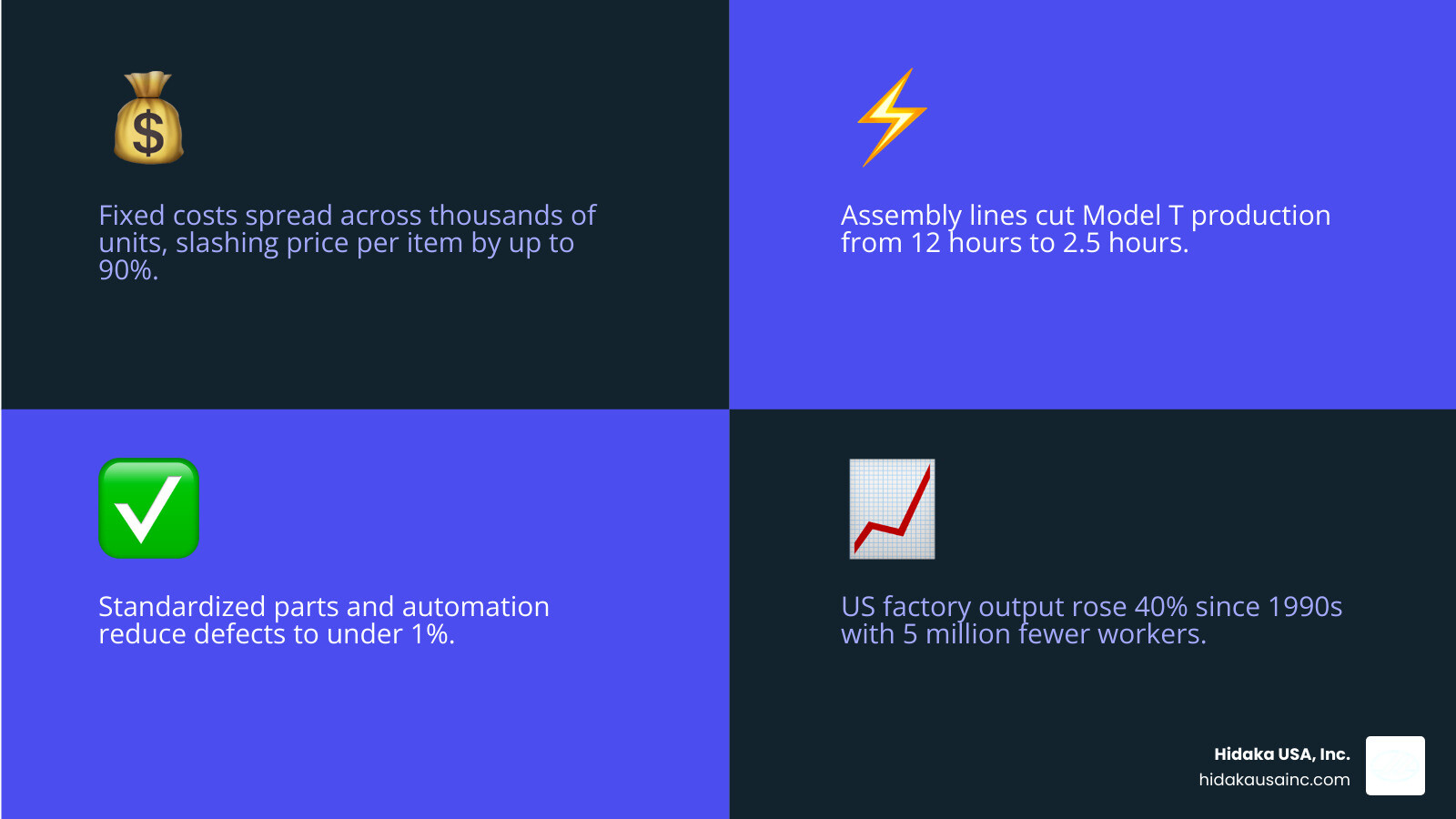
Mass production — also known as flow production or series production — is the manufacturing of large quantities of standardized products using assembly lines or automation. It became the backbone of modern industry during the Industrial Revolution and was revolutionized in 1913 when Henry Ford's moving assembly line cut Model T production time from over 12 hours down to just 2.5 hours. That single innovation made cars affordable to ordinary people for the first time, and the same principles continue to drive manufacturing efficiency today.
The U.S. now produces 40% more factory output than it did in the 1990s — with 5 million fewer workers. That is the power of mass production.
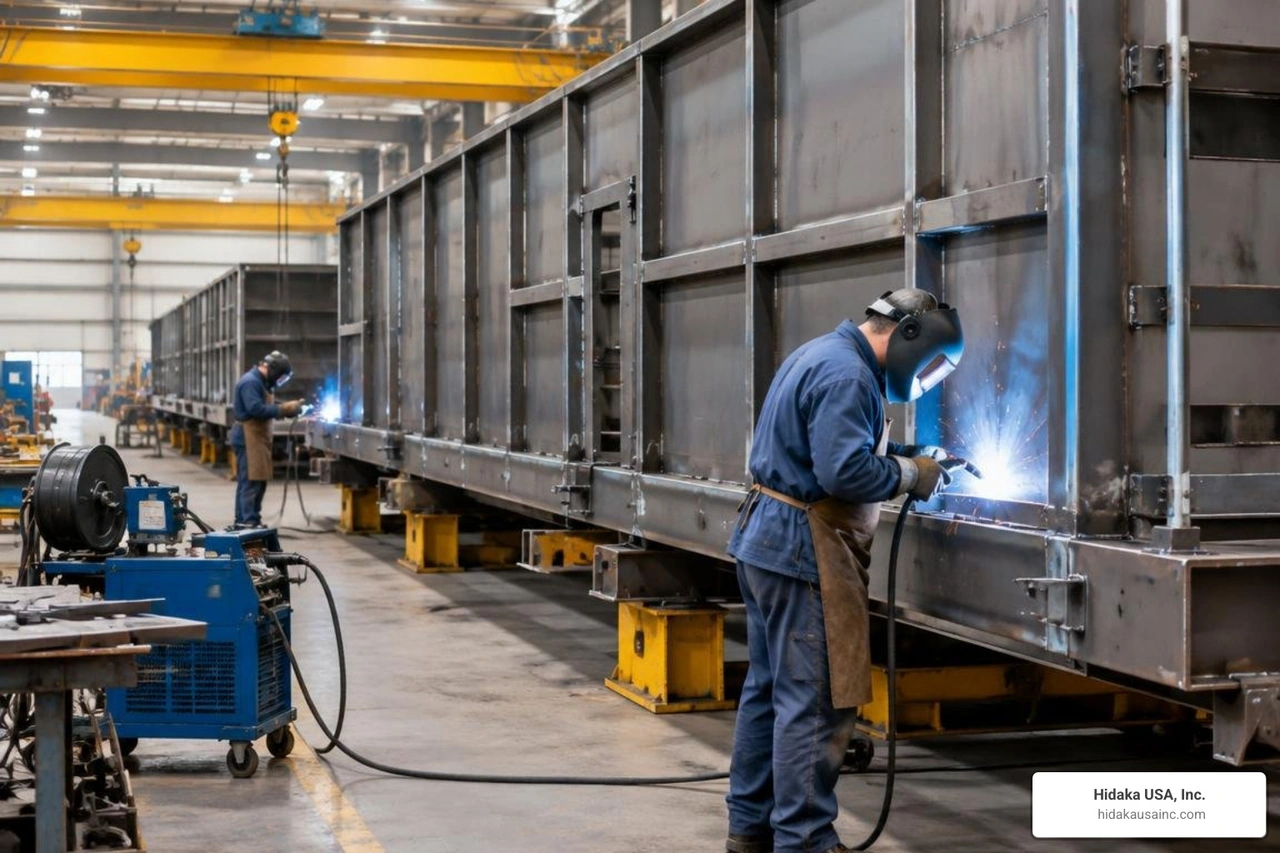
I'm Yoshihiro Hidaka, founder of Hidaka USA, Inc., and with over three decades of experience in automotive sheet metal fabrication and mass production, I have seen what are the advantages of mass production for manufacturers who need precision, speed, and reliability. In the sections below, I'll walk you through each of those advantages in detail.
Quick what are the advantages of mass production terms:
What are the Advantages of Mass Production?
When we look at the core of industrial history, the shift from artisanal craftsmanship to mass production changed everything. Before the 19th century, if you wanted a carriage, a clock, or even a pair of boots, a skilled craftsman had to make it by hand. This was slow, expensive, and every item was slightly different. One of the primary what are the advantages of mass production is the move away from this "one-off" model toward a system that maximizes every resource we have.
Economies of Scale
The biggest driver here is economies of scale. In simple terms, the more you make of something, the cheaper it becomes to produce each individual unit. This happens because we can spread the cost of expensive machinery, engineering, and facility overhead across millions of parts. For example, if we spend thousands of dollars on a custom hydraulic press die at our Dublin, Ohio facility, that cost is a burden if we only make ten parts. But if we make 100,000 parts, that tooling cost becomes negligible per unit.
Resource Optimization and Lower Unit Costs
Mass production allows us to optimize everything from raw material usage to floor space. By using The Moving Assembly Line and the Five-Dollar Workday philosophy, manufacturers learned that bringing the work to the worker—rather than having the worker move around the factory—slashes "non-productive effort." We aren't just saving money; we are saving time, which is the most valuable resource in manufacturing.
Market Accessibility and Standard of Living
Because mass production drives down prices, it makes high-quality goods accessible to the general public. It’s the reason most families can afford a reliable car, a smartphone, and modern appliances. This democratization of goods has historically raised the standard of living across the United States. When products are made in high volumes, they can be distributed rapidly to markets across the country, ensuring that supply meets demand without long waiting periods.
Achieving Lower Costs and Economies of Scale
To truly understand what are the advantages of mass production, we have to look at the math behind the curtain. It isn’t just about working harder; it’s about working smarter through amortization.
| Production Phase | Small Batch (100 units) | Mass Production (100,000 units) |
|---|---|---|
| Design & Engineering | High cost per unit | Very low cost per unit |
| Tooling & Setup | Significant burden | Minimal impact |
| Raw Materials | Standard pricing | Bulk discount pricing |
| Labor Efficiency | Lower (more manual) | Higher (automated) |
How Volume Drives Down the Price per Unit
The relationship between volume and cost is non-linear. The most dramatic price drops happen when you move from prototyping to the first few thousand units. This is where fixed costs—like the development of 3D CAD models and initial prototyping—are "absorbed" by the volume.
- Fixed Cost Distribution: Every project has "upfront" costs. In mass production, these are spread so thin that they barely affect the final price.
- Tooling Expenses: Advanced tools, such as the 2D/3D laser cutters we use at Hidaka USA, Inc., are capital intensive. Mass production justifies this investment by ensuring the machines are running constantly, maximizing their ROI.
- Component Sharing: Many high-volume manufacturers use the same internal parts across different models. This is a classic strategy in the Model T production history and remains a staple in the automotive industry today. By using interchangeable parts, we reduce the need for unique tooling for every single variation.
Raw Material Bulk Purchasing
When we buy steel or aluminum in massive quantities, we can negotiate significantly lower prices. These savings are passed directly down the line, contributing to the overall affordability of the finished product. In mass production, the marginal cost—the cost of producing one additional unit—is much lower than in any other manufacturing method.
Maximizing Efficiency and Production Speed
Efficiency is the heartbeat of any successful factory. One of the most visible what are the advantages of mass production is the incredible speed at which we can move from raw metal to a finished assembly.
Division of Labor
In a mass production environment, tasks are broken down into small, repetitive steps. Instead of one person trying to build an entire car frame, one person (or robot) specializes in a single weld or a single cut. This specialization means workers become incredibly fast and proficient at their specific task, reducing the margin for error and increasing throughput.
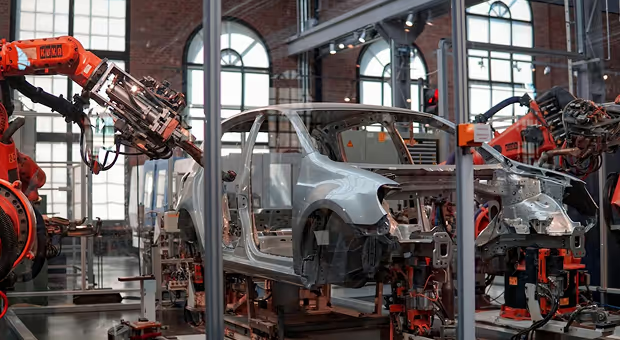
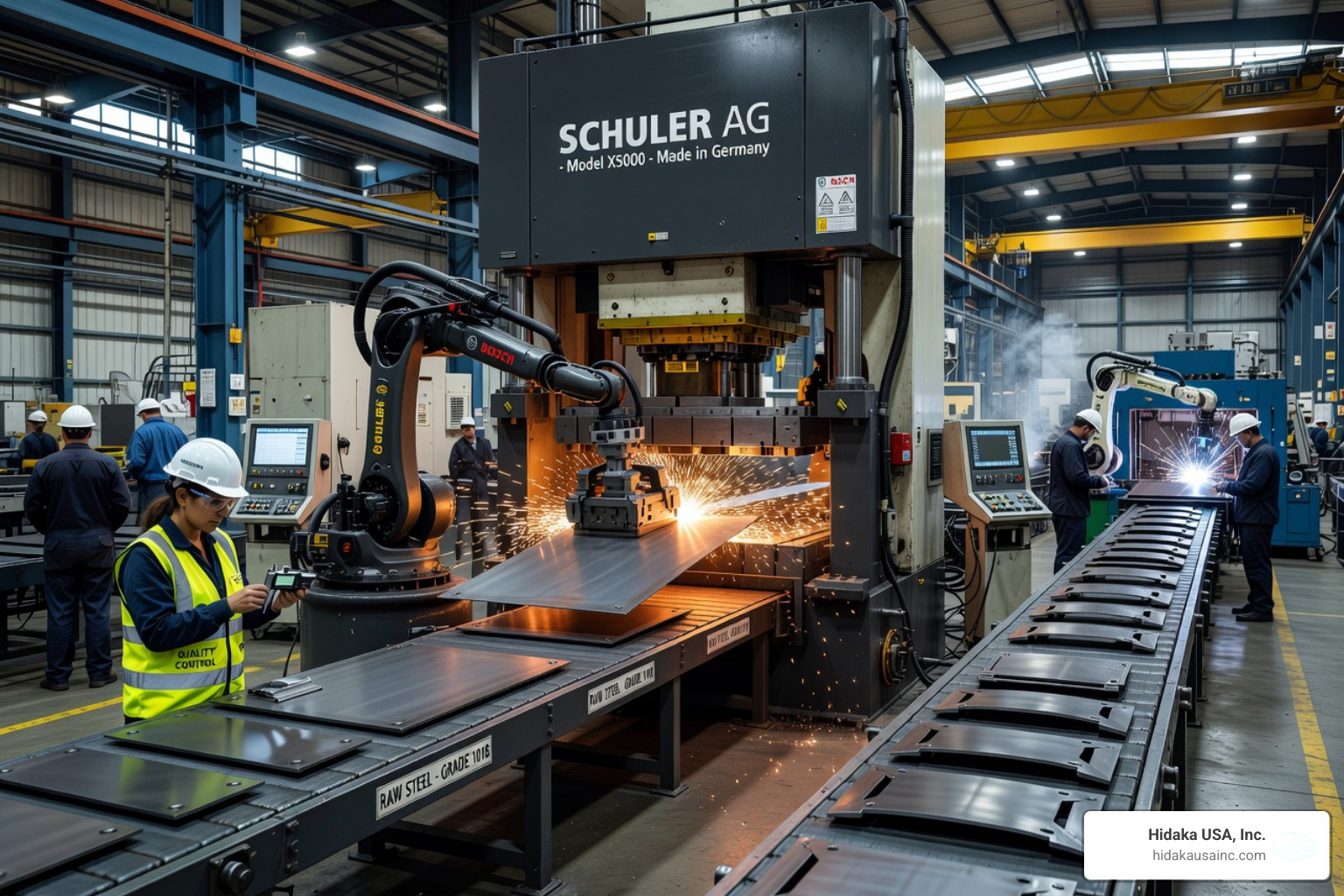
Specialized Machinery and Automation
Modern mass production relies heavily on specialized machinery that can perform tasks faster than any human. Take, for example, the Marshmallow Peeps production evolution. In 1954, it took 27 hours to make a single Peep by hand. Today, thanks to assembly line automation, it takes just six minutes, and the factory can produce 5.5 million units daily.
Enhancing Speed through the Advantages of Mass Production
At Hidaka USA, Inc., we use advanced engineering analysis to ensure our production flow is seamless. This "continuous flow" minimizes "work-in-progress" (WIP) time—the time a part spends sitting on a shelf waiting for the next step.
- Assembly Lines: By moving parts through a sequence of stations, we eliminate bottlenecks.
- Rapid Market Response: High-speed production allows companies to react quickly to market trends. If a specific car part is suddenly in high demand, a mass production facility can scale up output much faster than a job shop.
- Throughput Optimization: Whether it's an 144,000 eggs per hour robot or a high-speed hydraulic press, the goal is to keep the line moving. Every second saved is a victory for efficiency.
Ensuring Higher Precision and Consistent Quality
There is a common myth that "mass-produced" means "low quality." In reality, the opposite is often true. Because mass production relies on automation and standardized parts, the level of precision is often far higher than what can be achieved by hand.
Interchangeable Parts and Standardized Components
The foundation of modern quality is the interchangeable part. Pioneered by figures like Eli Whitney and perfected by the automotive industry, this concept ensures that every part is identical. If you are building a railcar or a performance motor vehicle, you need to know that every bolt and bracket will fit perfectly every single time.
Reduced Human Error
Humans are wonderful, but we get tired, we get distracted, and we have "off" days. Robots don't. Since the installation of the First Unimate Robot on an Assembly Line in 1961, automation has taken over the most repetitive and dangerous tasks. This leads to:
- Repeatability: The machine performs the exact same motion with the exact same pressure, millions of times.
- Tolerance Management: We can hold much tighter tolerances (often within microns) using CNC machining and laser cutting than a person could with manual tools.
Maintaining Quality as One of the Advantages of Mass Production
Quality control is baked into the mass production process. We use preset machine parameters and automated inspection systems to catch defects in real-time. For example, the iPhone assembly precision process involves 400 steps, many of which are dedicated solely to testing and validation.
By using statistical process control, we can monitor the "health" of our production line. If a machine starts to drift out of alignment by even a fraction of a millimeter, our sensors catch it before it produces a single scrap part. This consistency is why you can buy a car in Ohio and know it will perform exactly like the same model bought in California.
Frequently Asked Questions about Mass Production
How does mass production benefit the average consumer?
The primary benefit is affordability. Mass production lowers the barrier to entry for essential goods. Beyond price, it ensures product availability. You don't have to wait months for a craftsman to finish your order; the product is already on the shelf. Finally, it provides consistent standards. When you buy a mass-produced item, you know exactly what you are getting, backed by rigorous quality control systems.
Is mass production expensive to set up for new businesses?
Yes, mass production is capital intensive. The initial investment in specialized machinery, tooling, and facility space can be significant. However, for businesses with high-volume goals, the ROI is unparalleled. The high upfront cost is an investment in a lower "cost-per-part" long term. At Hidaka USA, Inc., we help bridge this gap by offering both prototyping and mass production services, allowing our clients to refine their designs before committing to high-volume tooling.
What industries rely most on mass production today?
- Automotive: This is where the modern assembly line was born and remains the gold standard for mass production.
- Electronics: Smartphones, laptops, and appliances require the extreme precision that only automated lines can provide.
- Pharmaceuticals: Ensuring every pill has the exact same dosage requires highly standardized, high-volume manufacturing.
- Food and Beverage: From bottled water to breakfast cereal, mass production ensures safety and consistency at a massive scale.
Conclusion
Understanding what are the advantages of mass production helps us appreciate the complexity and efficiency of the modern world. By leveraging economies of scale, maximizing production speed through automation, and maintaining rigorous precision, manufacturers can deliver high-quality products that are affordable for everyone.
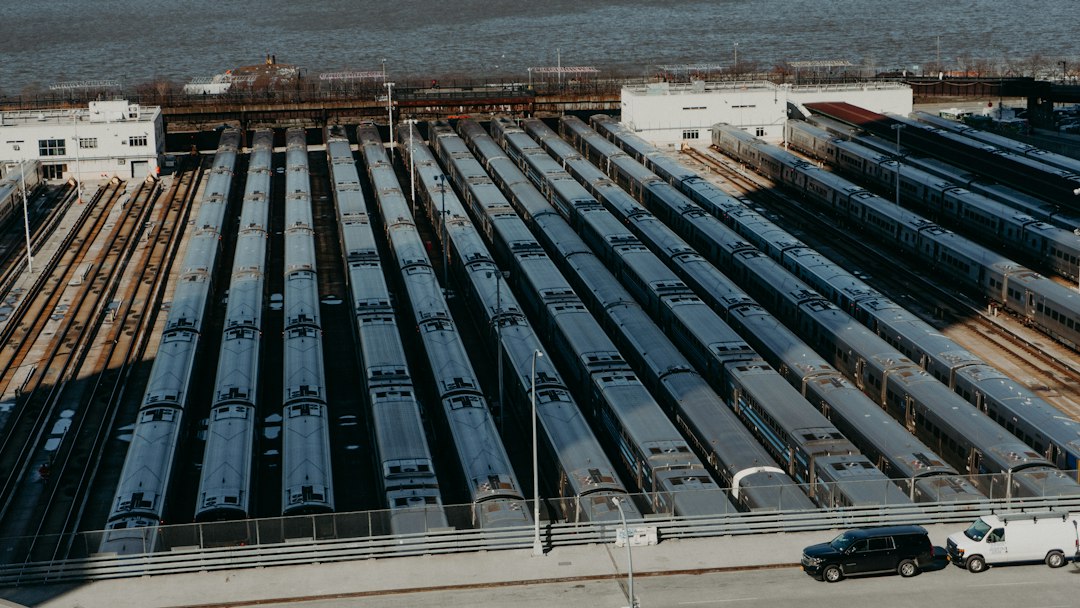
At Hidaka USA, Inc., we are proud to continue this tradition of American manufacturing excellence from our base in Dublin, Ohio. Whether it's for the automotive, mass-transit railcar, or motorsports industries, we combine advanced engineering with high-volume capabilities to ensure our clients get the best of both worlds: innovation and scalability.
If you are looking for a partner to take your project from a single prototype to full-scale manufacturing, we are here to help. Our ISO 9001-certified facility and AWS-certified welding team are ready to unlock the efficiency of mass production for your business.
Learn more about mass production services and how we can help you achieve your production goals with precision and speed.