Why Quality Housing Assemblies are the Secret to Long-Lasting Railcars

Why Railcar Housing Assemblies Production Determines Service Life
Railcar housing assemblies production should start with a controlled process: engineer the housing and underframe for expected loads, fabricate components to approved drawings, verify welds and critical fasteners, then document inspection results before final assembly. This approach protects structural strength, supports reliable operation, and makes defects easier to find before a railcar enters service.
Quality housing assemblies do more than hold parts together. They transfer loads between the car body, underframe, trucks, couplers, and payload. For heavy-haul or specialized railcars, the design must also account for axle loading, dynamic forces, crash-related loads, and stable performance when the car is empty or lightly loaded. When those demands are ignored, small fabrication variances can become fatigue cracks, loose fasteners, or premature wear that shortens the railcar's useful life and raises maintenance costs.
Modern production combines proven fabrication controls with digital records. Visual work instructions can guide technicians through changing build variants, while connected torque tools can confirm that fasteners meet required values and create traceable assembly records. Welding, nondestructive examination, spring testing, load checks, and dynamic modeling provide further evidence that a railcar assembly is ready for service. Together, these controls give rail operators confidence that every housing assembly will perform consistently under repeated loads, harsh weather, and years of continuous transit duty.
I am Yoshihiro Hidaka, founder of Hidaka USA, Inc., with decades of experience growing a sheet metal fabrication operation from prototype work into mass-production supply for demanding industries. That background in precision fabrication, repeatable processes, and delivery discipline informs this guide to railcar housing assemblies production.
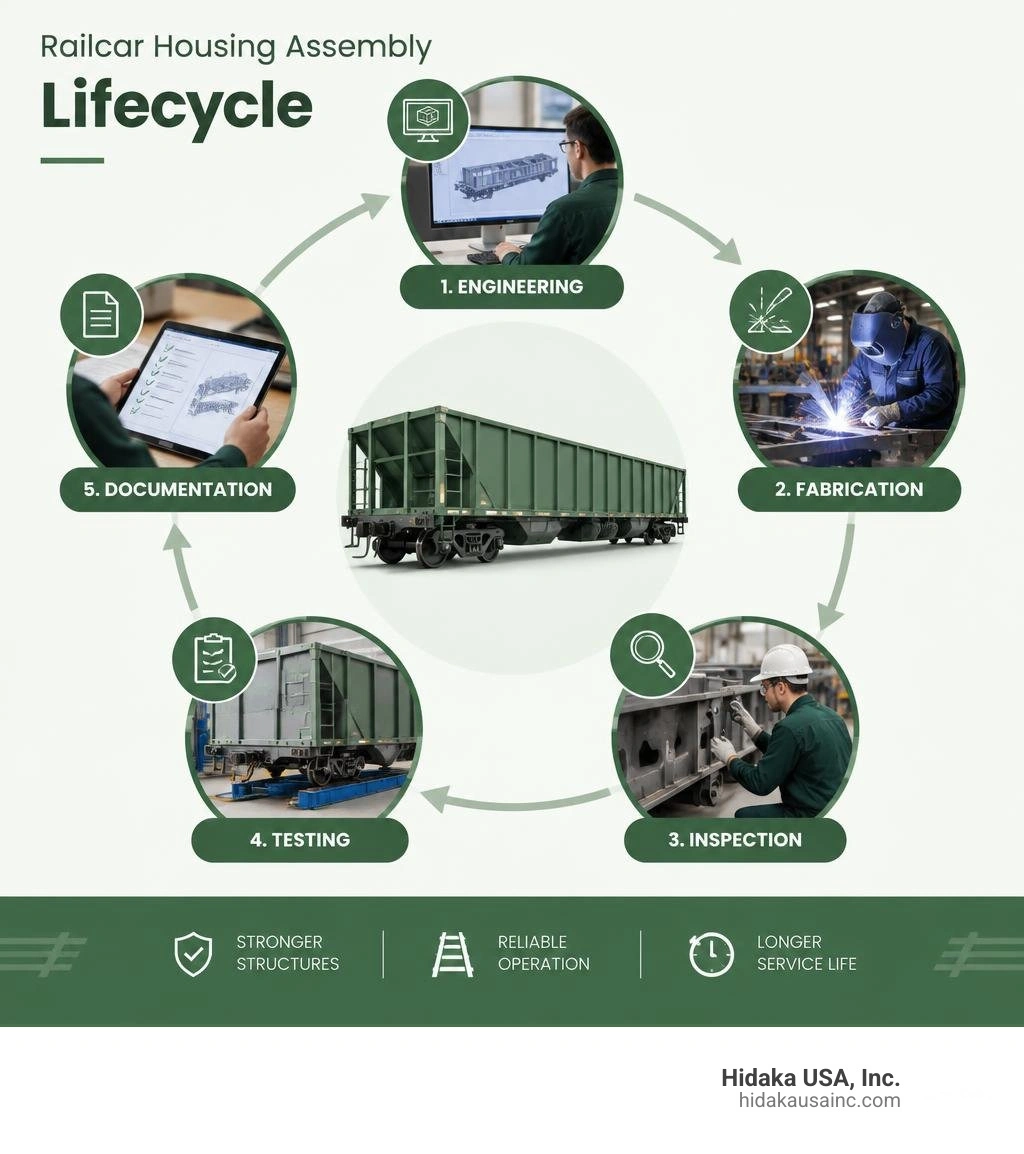
Essential railcar housing assemblies production terms:
Engineering Standards in Railcar Housing Assemblies Production
Underframe engineering forms the structural backbone of any rail vehicle. Housing assemblies must endure relentless cyclic fatigue, longitudinal draft and buff loads, and lateral dynamic forces during transit. Meeting strict safety baselines requires tight collaboration across engineering and fabrication disciplines to satisfy regulatory frameworks without sacrificing manufacturability.
Every housing assembly decision affects how the completed railcar behaves over millions of load cycles. Engineers evaluate material thickness, weld placement, fastener patterns, and subassembly interfaces against expected service conditions before production begins. This early analysis reduces the risk of field failures and helps fabrication teams build components that fit correctly the first time.
Structural Integrity, AAR S-2043 Compliance, and Axle Configurations
When railcars transport ultra-heavy or hazardous materials—such as high-level radioactive cargo—standard structural assumptions no longer apply. Builders must comply with the Association of American Railroads (AAR) Standard S-2043 alongside AAR S-2044 for safety appliances. These performance specifications demand extraordinary crashworthiness, rigid dynamic stability, and conservative axle distribution.
For example, the specialized 12-axle Atlas railcar was engineered to carry massive payloads like the HI-STAR 190 XL cask, which weighs roughly 480,000 pounds. Early dynamic assessments demonstrated that an 8-axle setup would fall short of S-2043 stability criteria; expanding the underframe to a 12-axle layout achieved a total truck capacity of 858,000 pounds (based on a 71,500 lbs/axle limit) and satisfied a conservative interchange load limit of 789,000 pounds (65,750 lbs/axle).
Achieving these tight tolerances depends on precision manufacturing, where high-strength components undergo precision railcar stamping to form robust underframe channels. Insights from the Midwest High-Speed Rail Supply Chain report highlight that domestic manufacturing hubs must maintain repeatable material consistency to satisfy these high-integrity rail standards. A manufacturing partner that combines stamping precision with documented quality controls can help railcar builders meet S-2043 requirements without adding unnecessary weight or complexity to the assembly.
Dynamic Modeling and Test Load Validation
Before cutting metal, structural designs undergo extensive finite element analysis (FEA) and dynamic simulation. Engineers calculate the mass moment of inertia across three dimensions to predict how laden and tare assemblies react to curving, hunting, and track irregularities.
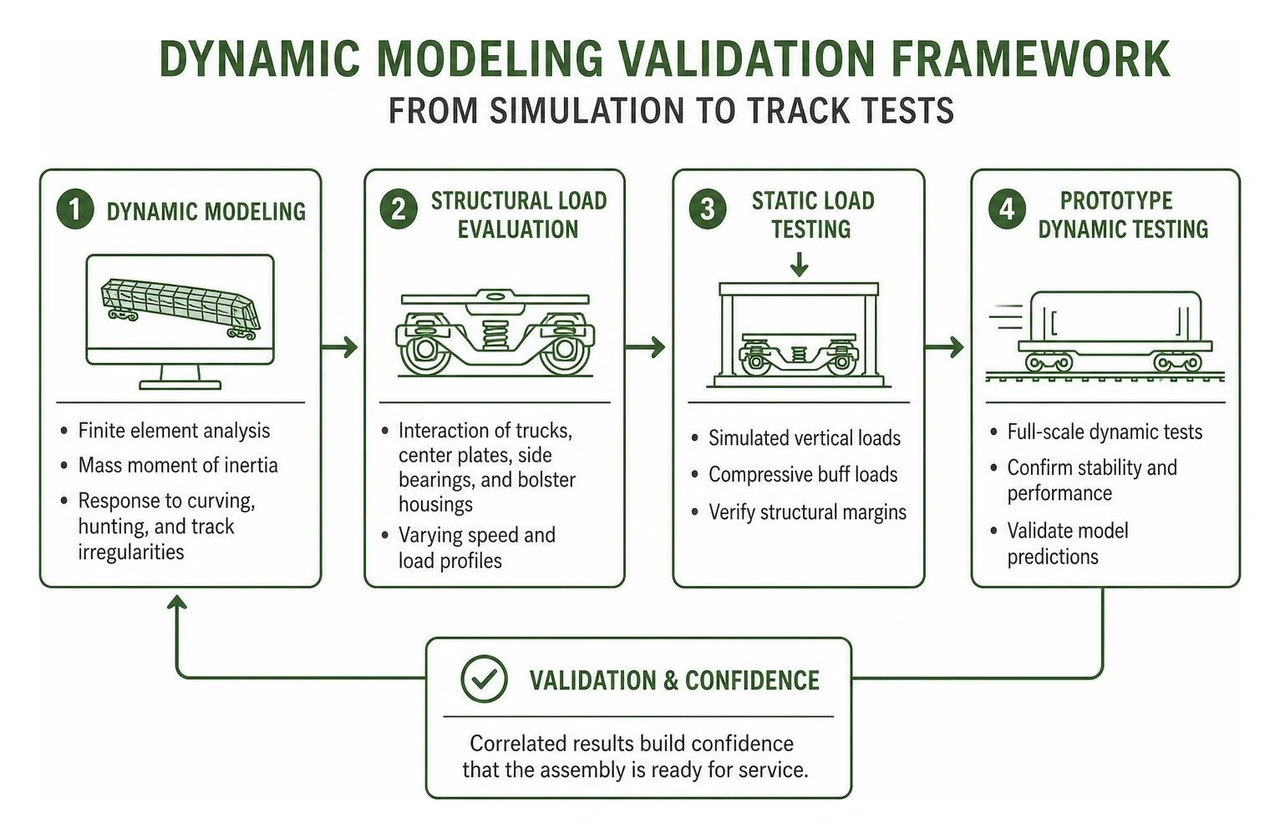
Dynamic modeling evaluates the interaction between trucks, center plates, side bearings, and bolster housings under varying speed and load profiles. Static load tests apply simulated vertical and compressive buff loads to confirm structural margins before full-scale prototype testing, preventing field failures and expensive redesign loops. These validation steps are especially important for housing assemblies that connect the underframe to suspension and coupler systems, where a modeling error can create stress concentrations that compromise long-term service life.
Key Fabrication and Assembly Methods for Critical Housings
Fabricating heavy-duty transit housings requires high-strength materials, specialized jigs, and modular subassemblies. By joining steel underframe bolsters with structural shell elements, fabricators create rigid assemblies capable of absorbing immense coupler loads and impact energies.
Successful housing fabrication depends on more than welding skill. Shops must control material traceability, fit-up tolerances, heat input, and post-weld inspection to produce assemblies that meet engineering intent. Modular construction helps by breaking large railcar structures into manageable subassemblies that can be checked independently before final integration.
Precision Welding, NDE Inspection, and Spring Testing
Welded joints on bogie frames, side sills, and bolster pockets experience severe multi-axial stresses. To prevent fatigue cracking, manufacturers rely on AWS certified prototype welding techniques alongside automated high volume welding assembly lines.
Every critical joint undergoes nondestructive examination (NDE), including magnetic particle testing for surface and near-surface anomalies and ultrasonic testing to verify full weld penetration. These inspection methods catch defects that visual checks alone cannot detect, which is essential for welds that carry repeated dynamic loads. In addition, suspension spring packs undergo load-deflection testing to verify uniform spring rates, ensuring balanced load distribution across every wheelset. Consistent spring behavior prevents uneven wear on housings, bolsters, and truck components, extending the interval between major overhauls.
Interchangeable Cradle Interfaces, Pin Blocks, and Ballast Management
Modern heavy-payload railcars must often handle diverse cargo profiles. The Atlas railcar accommodates up to 17 different cask payloads through standardized, removable cradles mounted to permanently attached deck interfaces and end-stop pin blocks.
When empty, the railcar structure weighs 229,000 pounds (200,000 pounds for the car body plus 29,000 pounds for the pin blocks and cradle interface). Because empty or lightly loaded cars can suffer from unstable hunting oscillations, dynamic stability requires precise ballast management. Strategically placed ballast redistributes tare weight across the bolster subassemblies, ensuring the railcar tracks safely when traveling unloaded. Fabricating these interchangeable retaining mechanisms requires high precision metal assemblies with tight machining tolerances. Each cradle mounting point must align precisely with the deck interface, so pin retention, cradle seating, and load transfer remain consistent across every payload configuration.
Digital Quality Control in High-Mix Rail Manufacturing
Railcar housing manufacturing frequently operates in high-mix, low-volume environments. Accommodating varied commuter, freight, or specialized transport configurations demands advanced assembly verification, error-proofing, and comprehensive data capture.
In high-mix production, a single facility may build several railcar variants in one week. Each variant can have different fastener counts, torque values, weld locations, and inspection requirements. Digital quality tools help operators manage that complexity without relying on memory or paper records, reducing the risk of missed steps and undocumented changes.
Implementing Connected Tools in Railcar Housing Assemblies Production
Threaded fasteners hold critical truck, bolster, and housing components together. A single joint failure can lead to catastrophic derailment, making torque verification an essential quality gate.
Leading rail assembly plants deploy smart Wi-Fi-enabled torque wrenches to measure and record torque-angle tightening curves. Each connected tool records up to 1,000 data points daily. These readings stream directly to central quality management systems, aligning with quality control ISO standards to guarantee full fastener traceability and create permanent digital audit trails. When a torque tool detects an out-of-spec condition, the operator can correct the joint immediately rather than discovering the problem during final inspection or after the railcar enters service.
Scaling Digital Work Instructions for Railcar Housing Assemblies Production
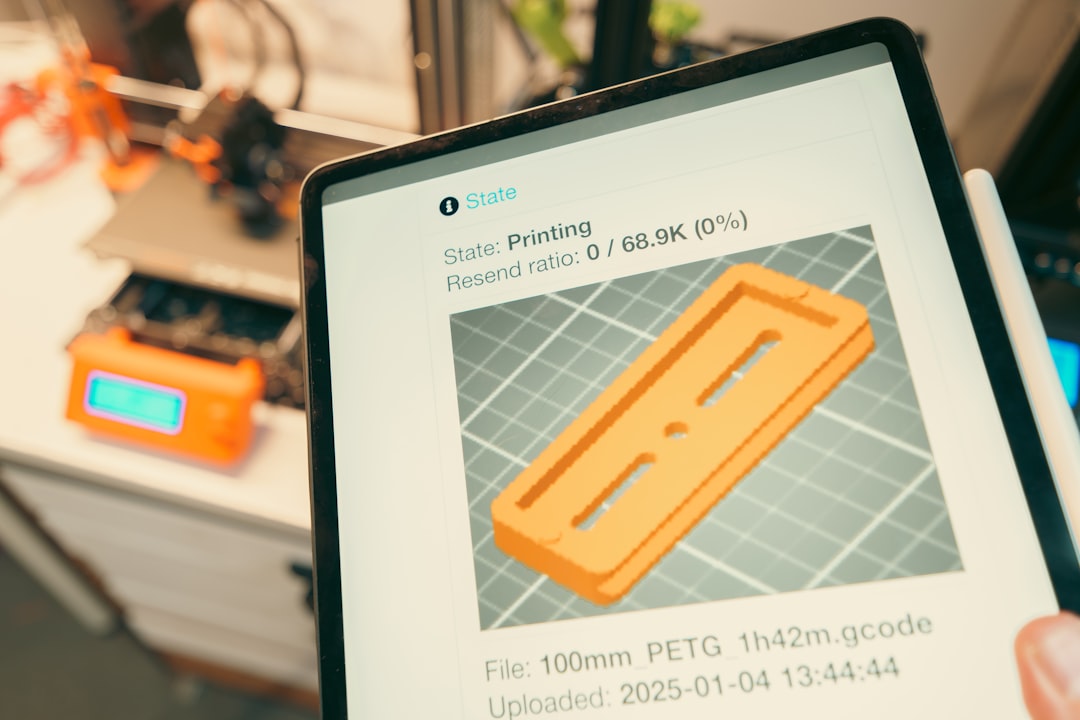
To eliminate human error during complex assembly sequences, manufacturers utilize tablet-based visual work instructions. Technicians receive interactive, step-by-step guidance tailored to the specific variant on the line.
Digital work instructions guide operators through correct bolt tightening sequences, component orientations, and routing paths. Because instructions are version-controlled and updated centrally, every station receives the latest revision without outdated printouts circulating on the floor. As regional manufacturing initiatives expand—supported by programs like the State Investing More Than $2.5 Million to Support Business Expansion Projects in Ohio—investing in digital worker guidance ensures that growing facilities maintain repeatable takt times and minimize assembly defects across fluctuating production schedules. That repeatability matters most for housing assemblies, where small sequencing errors can affect clamp load distribution and long-term structural performance.
Frequently Asked Questions About Railcar Assemblies
How do cradle attachment interfaces ensure payload interchangeability across railcar variants?
Cradle attachment interfaces use standardized deck mounting patterns and heavy-duty end-stop pin blocks. By keeping the mounting footprint uniform, railcars can secure various removable cradles designed for different payload shapes without modifying the main underframe structure.
What role does wireless torque tracking play in railcar assembly compliance?
Wireless torque tools capture exact torque and angle curves for every threaded fastener and transmit the records instantly to quality databases. This eliminates manual logging errors, provides proof of regulatory compliance, and protects builders against liability by confirming proper joint clamping.
Why is dynamic ballast balancing essential for empty and lightly loaded railcars?
Empty railcars have a higher center of gravity relative to their wheelbases and less wheel-rail contact force. Without ballast redistribution, light cars can experience truck hunting, wheel climb, or dynamic instability at higher speeds. Correct ballasting maintains wheel loading within safe dynamic operating limits.
Conclusion
Building long-lasting railcar housing assemblies requires a disciplined manufacturing approach that links advanced engineering with shop-floor execution. From FEA validation and AAR S-2043 compliance to precision welding and connected IoT assembly tools, every step ensures that railcars operate safely under extreme cyclic demands.
At Hidaka USA, Inc., we apply over three decades of engineering expertise, ISO 9001 quality controls, and AWS-certified fabrication processes to deliver reliable, American-made components. Whether supporting initial prototypes or full-scale mass production, our Dublin, Ohio facility provides the advanced tooling, laser cutting, and forming capabilities required for modern transit infrastructure.