Precision Matters: A Guide to Metal Prototype Laser Cutting

Why Prototype Laser Cutting Services Are Essential for Metal Part Development
Prototype laser cutting services are a fast, precise method for producing custom metal parts from a digital design file before committing to full-scale production.
Key benefits at a glance:
- Speed: Lead times as fast as 1 day for small quantities
- Precision: Tolerances of ±0.005" or better on metal parts
- No tooling required: Parts cut directly from CAD files, reducing setup cost
- Material flexibility: Works with steel, aluminum, stainless steel, copper, brass, and more
- Scalability: The same design file used for a prototype can move directly to production
For automotive manufacturers, this means design issues can be caught and corrected before expensive tooling is made — saving time, money, and production delays.
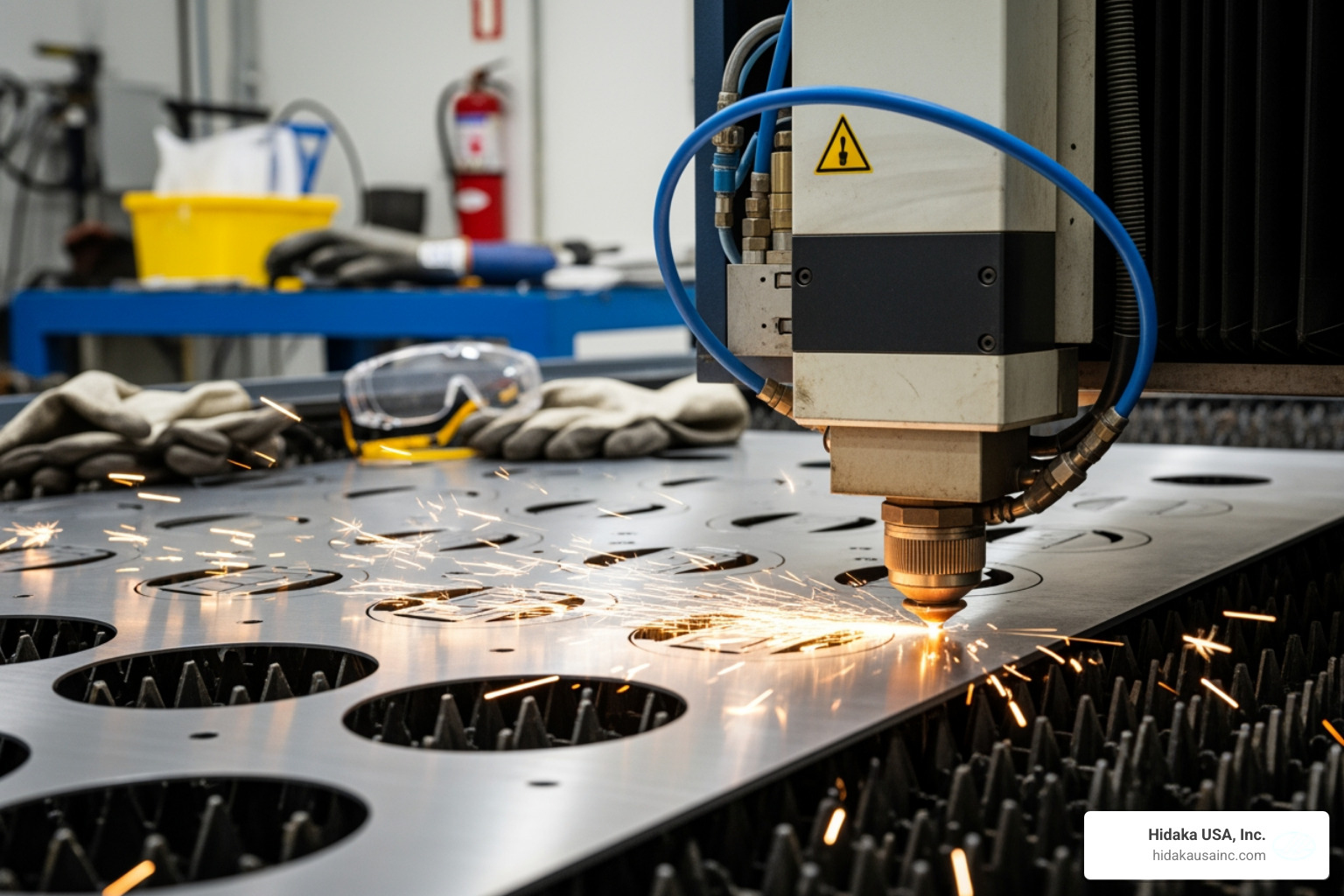
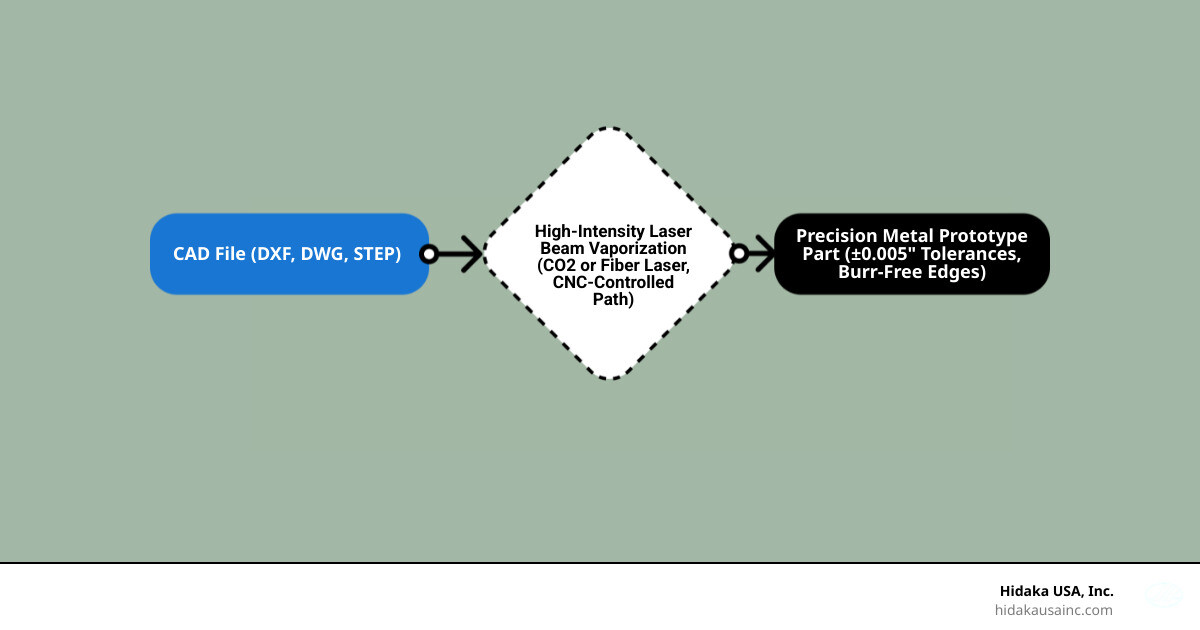
Laser cutting uses a focused beam of electromagnetic energy to vaporize material along a programmed path. The process is fully CNC-controlled, which means every cut follows the digital design with high repeatability. Whether you need a single bracket or a small batch of mounting plates, the process stays the same.
The result is a physical metal part that accurately represents the final production component — ready for functional testing, fit checks, and design validation.
I'm Yoshihiro Hidaka, founder of Hidaka USA, Inc., where I have spent over three decades delivering prototype laser cutting services and sheet metal fabrication solutions to the automotive industry and beyond. My experience building precision prototype parts from the ground up gives me a practical perspective on what it truly takes to get a design from CAD to a production-ready component.
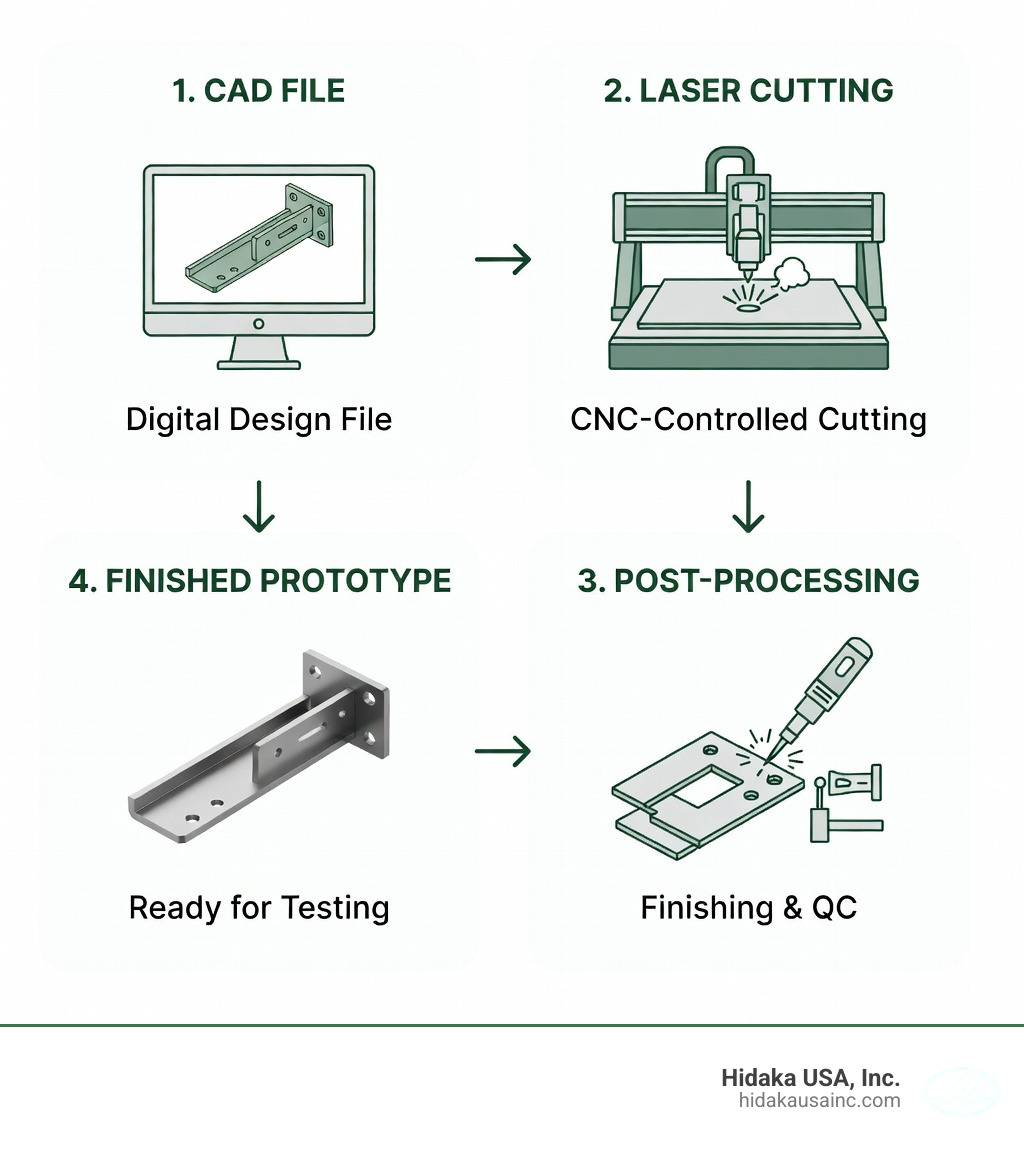
How prototype laser cutting services Accelerate Product Development
In the traditional manufacturing world, creating a metal prototype often involved "hard tooling"—creating expensive stamping dies or specialized molds that could take weeks, if not months, to produce. If the design changed by even a few millimeters, that tooling became a very expensive paperweight.
Prototype laser cutting services change that dynamic entirely through subtractive manufacturing. Instead of pressing a shape into metal, we use a high-intensity laser beam to vaporize material. This "beam vaporization" process is driven directly by Computer-Aided Design (CAD) files. This means we can go from a digital concept to a physical part in your hands in a matter of hours.
The CAD-to-Part Revolution
Because there is no physical "blade" or "die" touching the metal, there is no mechanical force applied to the workpiece. This allows us to cut incredibly intricate designs that would be impossible with traditional shears or punches. When we talk about iterative design, we mean that you can test a bracket on Monday, find a clearance issue, tweak the CAD file, and have a revised version cut by Tuesday morning. This "tooling-free" production is the secret weapon of modern engineering departments in Dublin, Ohio, and across the globe.
Safety and Material Integrity
When working with various metals, safety and material integrity are paramount. We always ensure that every material processed in our facility is accompanied by a Safety Data Sheet (SDS). This document provides critical information on the chemical properties of the metal and any potential fumes generated during the vaporization process, ensuring our technicians and your final parts meet the highest safety standards.
The Role of CO2 and Fiber Lasers in Prototyping
Not all lasers are created equal. In prototype laser cutting services, we primarily utilize two technologies: CO2 and Fiber lasers. Understanding the difference is key to choosing the right process for your specific metal prototype.
- CO2 Lasers: These use a gas mixture (mostly carbon dioxide) stimulated by electricity. They operate at a wavelength that is highly effective for cutting, scoring, and engraving. CO2 lasers are versatile and have historically been the workhorse for thicker mild steel. However, they can struggle with "reflective" metals like copper or brass, as the beam can actually bounce back into the machine.
- Fiber Lasers: These represent the cutting edge of the industry. Fiber lasers use a solid gain medium (optical fibers doped with rare-earth elements). They have a much shorter wavelength, which results in a higher energy density. This allows them to cut through reflective metals with ease and achieve incredible speeds on thinner gauges.
In our experience, fiber lasers are often the preferred choice for automotive and motorsports prototypes because they offer superior efficiency and can handle the wide variety of alloys used in high-performance engineering.
Key Advantages of prototype laser cutting services
Why do the world’s leading automotive and mass-transit companies rely on laser cutting for their prototypes? It comes down to a few undeniable benefits:
- Precision Tolerances: We can routinely achieve dimensional accuracy of ±0.005” or better. This level of precision is vital when you are testing the "fit and finish" of a component that must integrate into a complex assembly.
- Edge Quality: Unlike plasma cutting, which can leave a rough "dross" or slag, laser cutting produces clean, square edges. On materials like stainless steel, the edge is often so clean it requires zero post-processing.
- Minimal Waste: Because the laser beam is so narrow (often less than 0.2mm), we can "nest" parts very tightly on a single sheet of metal. This maximizes material utilization and keeps costs down.
- Low Setup Costs: There is no need to build custom jigs or fixtures for most flat-cut parts. We simply load the sheet, upload the file, and press "start."
Material Selection and Technical Specifications
Choosing the right material is half the battle in prototyping. At Hidaka USA, Inc., we work with a vast array of metals to ensure your prototype matches the mechanical properties of your intended production part.
MaterialCommon Thickness RangeTypical ToleranceBest Laser TypeMild Steel0.020" to 0.750"±0.005"CO2 or FiberStainless Steel0.015" to 0.500"±0.004"Fiber (for speed)Aluminum Alloys0.020" to 0.375"±0.005"FiberCopper & Brass0.010" to 0.250"±0.005"Fiber OnlyTitanium0.020" to 0.250"±0.005"Fiber
Achieving Precision with prototype laser cutting services
Precision in laser cutting isn't just about the machine; it's about managing the physics of light and heat. When the laser hits the metal, it creates a "Heat-Affected Zone" (HAZ). This is a small area near the cut where the metal's properties might change slightly due to the temperature.
Modern CNC precision allows us to compensate for "Kerf"—the width of the material that is vaporized by the beam. Think of it like the thickness of a saw blade. If your part needs to be exactly 100mm wide, and the laser kerf is 0.2mm, our software automatically adjusts the beam path to 100.2mm to ensure the final piece is perfect.
Limitations and Design Constraints
While we'd love to say lasers can do anything, there are a few "physics-based" rules to keep in mind:
- Tapering Effects: On very thick materials (over 0.5 inches), the laser beam can "diverge" slightly, meaning the bottom of the cut might be a tiny bit wider than the top.
- Reflectivity Issues: As mentioned, copper and brass require specialized fiber lasers to prevent machine damage.
- Minimum Hole Diameters: A good rule of thumb is that the smallest hole you can cut should be at least equal to the thickness of the material. If you're cutting 1/4" steel, trying to cut a 1/16" hole can result in a "melted" look rather than a clean circle.
Laser Cutting's Strategic Advantages for Prototyping
When you're in the middle of a development cycle, the "strategic" advantage of laser cutting is that it bridges the gap between a "cool idea" and a "functional part."
Why Laser Cutting Excels for Metal Prototypes
For industries like motorsports and aerospace, a prototype isn't just for looking at—it's for breaking. You need to know if that suspension bracket will hold up under load. Laser cutting allows us to use production-grade materials (like 4130 Chromoly or 6061-T6 Aluminum) from the very first iteration. This ensures the structural integrity of the prototype is identical to the final product.
Furthermore, the speed of production means you can perform functional testing on five different design variations in the time it would take to machine just one.
Key Performance Metrics: Laser Cutting's Edge
- Speed: Laser cutting can move at hundreds of inches per minute on thin gauges.
- Cleanliness: Most parts come off the machine "burr-free," meaning they aren't sharp or covered in metal shavings.
- Repeatability: Whether we cut 1 part or 500, the CNC control ensures part #1 is identical to part #500.
Design Guidelines and File Preparation for Success
To get the most out of prototype laser cutting services, your digital files need to be "laser-ready." We primarily work with vector graphics, which are mathematical descriptions of lines and curves.
Preferred File Formats
- DXF/DWG: The industry standard for 2D flat patterns.
- STEP/STP: Excellent for 3D models (we can extract the flat patterns for you).
- AI/SVG: Often used for artistic or branding elements, but must be converted to real-world scales.
Pro-Tips for File Prep
- Close Your Loops: Ensure every shape is a closed path. If a line doesn't quite meet the start point, the laser won't know where to stop, and the part won't "drop" from the sheet.
- Layer Management: Use different colors or layers to indicate different operations. For example, use Red for "Cut Through" and Blue for "Etch/Engrave."
- Avoid Overlapping Lines: If you have two parts sharing a line in your drawing, the laser might try to cut that line twice, which can cause excessive heat and warping.
- Text and Logos: If you want text cut out, the centers of letters like "O" or "D" will fall out unless you use a "stencil" font with small bridges (tabs) to hold the centers in place.
Frequently Asked Questions about Laser Prototyping
What is the typical turnaround time for laser-cut prototypes?
Standard lead times for most projects are between 3 to 5 business days. However, for urgent automotive or railcar projects, we often offer 24-hour or 48-hour rush services for in-stock materials. The biggest factor in turnaround time is usually material availability; if we have the steel or aluminum on the floor in Dublin, OH, we can move very quickly.
Are there minimum order quantities for professional services?
One of the best things about laser cutting is that there are typically no minimum order quantities. We are just as happy to cut a single specialized bracket for a motorsports team as we are to cut a pilot run of 500 parts for a mass-transit project. While there is usually a base "setup fee" to cover file preparation and machine calibration, you aren't forced into buying thousands of parts you don't need yet.
What post-processing options are available for metal parts?
A "flat" laser-cut part is often just the beginning. At Hidaka USA, Inc., we offer a full suite of secondary operations:
- Deburring: Using vibratory tumblers or manual tools to ensure every edge is smooth.
- Bending: Using hydraulic press brakes to turn 2D flats into 3D brackets or enclosures.
- Welding: Our AWS-certified welders can join components into complex assemblies.
- Surface Finishing: Options like powder coating, anodizing, or plating to protect the metal from corrosion.
Conclusion: Partnering for Precision
In the world of metal part development, precision isn't just a goal—it's a requirement. Whether you are developing a new component for a mass-transit railcar or a high-performance part for the automotive aftermarket, prototype laser cutting services provide the flexibility and accuracy you need to succeed.
At Hidaka USA, Inc., we've built our reputation on "American-made" quality and strict adherence to ISO 9001 and AWS standards. From our 95,000-square-foot facility in Dublin, Ohio, we provide the end-to-end engineering analysis and production capabilities that take your project from a rough sketch to a market-ready assembly.
We understand that in prototyping, every millimeter and every hour counts. By combining advanced 2D and 3D laser cutting with decades of engineering expertise, we help you navigate the complexities of metal fabrication so you can focus on what you do best: innovating.
If you’re ready to see how precision laser cutting can accelerate your next project, our team is here to help. From initial design feedback to final quality control, we ensure that "Precision Matters" isn't just a slogan—it's the standard for every part we produce.
For more information about our prototyping services and how we can support your specific industry needs, visit us at https://hidakausainc.com/.