Why Your Supply Chain Needs ISO 9001 Right Now

Why ISO 9001 Is the Global Standard for Supply Chain Quality
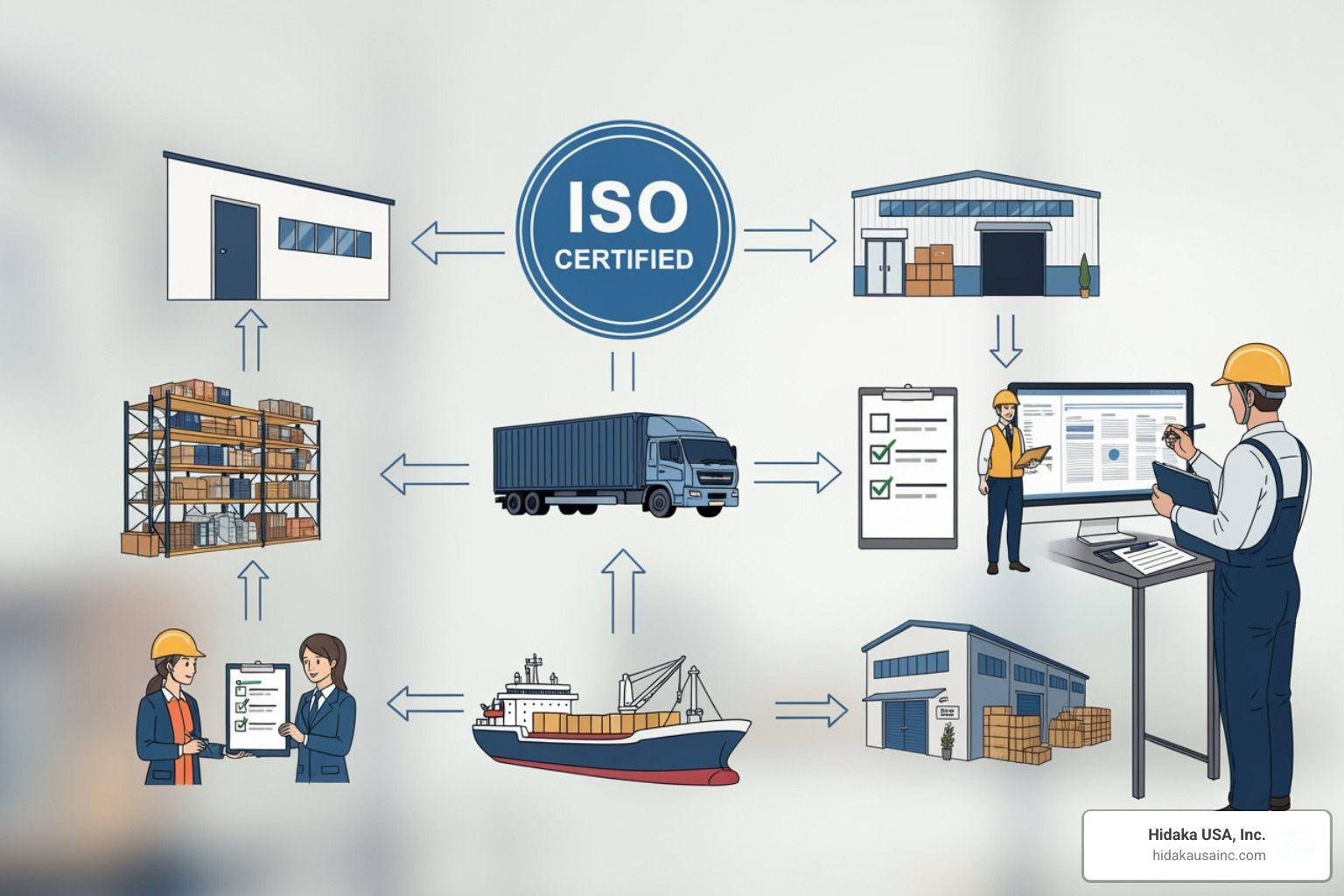
ISO 9001 supply chain management is a structured approach to controlling the quality of everything that enters and exits your production process — from raw materials and components to subcontracted services and outsourced processes.
Here is a quick overview of what ISO 9001 means for supply chains:
| Key Area | What ISO 9001 Requires |
|---|---|
| Supplier Selection | Define clear criteria for choosing qualified suppliers |
| Supplier Evaluation | Assess and monitor supplier performance on an ongoing basis |
| External Provisions | Control all externally provided processes, products, and services (Clause 8.4) |
| Documentation | Retain records as evidence of conformity |
| Continuous Improvement | Take corrective actions and drive performance improvements |
| Risk Management | Proactively identify and mitigate supply chain risks |
ISO 9001 is implemented by organizations in 176 countries and is recognized as the global benchmark for Quality Management Systems (QMS). It exists to give both buyers and suppliers confidence that products and services consistently meet agreed requirements.
For automotive manufacturers in particular, supply chain failures are not a minor inconvenience — they can halt production lines, damage customer relationships, and erode hard-earned reputations. Procurement often accounts for up to 70% of a company's total expenditure, which means even small disruptions upstream can have serious consequences downstream.
ISO 9001 provides the framework to prevent those disruptions before they happen.
I'm Yoshihiro Hidaka, founder of Hidaka USA, Inc., with over three decades of experience in automotive sheet metal fabrication and ISO 9001 supply chain management for both prototype and mass production environments. The insights in this guide draw directly from what I have seen work — and fail — in real supply chains serving the automotive industry.
Understanding the ISO 9001 Supply Chain Framework
To understand how an ISO 9001 supply chain functions, we have to look past the paperwork and see it as a living system. At its core, the Quality Management System (QMS) isn't just about what happens inside our four walls in Dublin, Ohio; it’s about ensuring that every gear in the global machine turns in sync.
The most critical part of this framework for supply chain professionals is Clause 8.4: Control of externally provided processes, products, and services. In the older versions of the standard, we talked mostly about "purchasing." Today, the language is broader. It covers raw materials, components, and even the "outsourced" processes—like specialized heat treating or plating—that are performed by a partner but impact your final product.
Research into ISO 9001 and Supply Chain Integration Principles Based Sustainable Development suggests that when we integrate these quality principles, we aren't just checking boxes. We are building a foundation for the "Triple Bottom Line"—economic, environmental, and social success. By requiring suppliers to meet these standards, we create a "technical language" of trust that allows for strategic growth. When a supplier understands our quality language, the friction of onboarding and verification drops significantly.
Verifying Supplier Conformity in an ISO 9001 Supply Chain
How do we know a supplier actually does what they say they do? This is where the "Chain of Trust" comes in. In a globalized economy, we rely on accreditation. The International Accreditation Forum (IAF) ensures that a certification body in one country meets the same high standards as one in another. In fact, the IAF and ILAC arrangements cover economies representing 96% of global GDP.
When we evaluate a supplier's ISO 9001 status, we look for:
- Accreditation: Is their certificate backed by a recognized body?
- Scope: Does their certification actually cover the specific parts or services they are providing to us?
- Third-Party Audits: Are they being regularly checked by independent experts?
As noted in the ISO publication Delivering supply chain confidence, 80% of global trade involves some element of testing, inspection, or certification. By verifying these claims, we gain the buyer confidence needed to invest in long-term partnerships rather than just transactional purchases.
Building Stronger Supplier Relationships
One of the biggest myths about ISO 9001 is that it’s a "gotcha" system designed to penalize suppliers. In reality, it’s the opposite. It fosters mutual accountability. When both the buyer and the seller operate under the same set of rules, transparency becomes the default setting.
How ISO 9001 Supports Stronger Supplier Relationships highlights that during times of uncertainty—like the recent global logistics delays—the strength of these relationships is what keeps production moving. Shared standards mean there are fewer misunderstandings about tolerances, lead times, or documentation. We aren't just "buying parts"; we are collaborating on continuous improvement. If a defect occurs, the focus isn't on blame; it's on the "root cause analysis" required by the standard to ensure it never happens again.
Mastering Clause 8.4: Controlling Externally Provided Processes
Clause 8.4 is the "command center" for your ISO 9001 supply chain. It dictates that we must ensure externally provided processes conform to requirements. This means we can't just point the finger at a supplier if something goes wrong; the standard says the responsibility for the final quality rests with us.
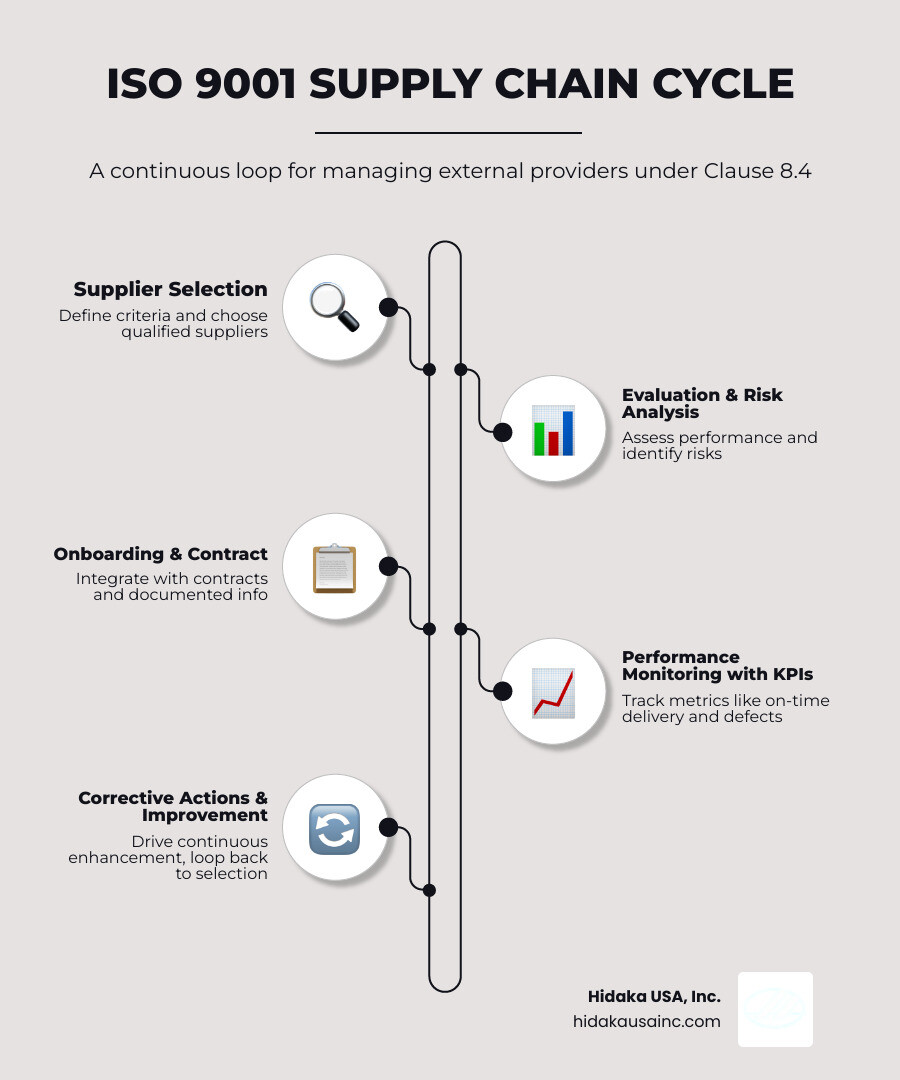
To master this, we use a four-stage cycle:
- Selection: Choosing suppliers based on their ability to meet our specific technical and quality needs.
- Evaluation: An initial deep dive into their processes, financial stability, and historical performance.
- Monitoring: Ongoing checks on every shipment—are they on time? Are the parts within spec?
- Re-evaluation: A periodic "health check" to decide if the supplier still earns their place on our Approved Supplier List (ASL).
| Selection Method | Confidence Level | Best Use Case |
|---|---|---|
| Self-Declaration | Low | Low-risk, non-critical office supplies |
| Second-Party Audit | Medium | Specialized custom tooling where we need to see their shop floor |
| Accredited Certification | High | Critical automotive components and mass production materials |
We must retain "documented information" (the modern term for records) of these activities. If an auditor asks why we use a specific supplier, we need to show the data that justifies that choice.
Steps for Effective Supplier Management under ISO 9001
Managing a modern supply chain requires more than a spreadsheet. It requires a proactive strategy.
- Risk Analysis: Before onboarding, we quantify risks. What happens if this supplier’s factory loses power? What if their raw material costs spike? We use frameworks like ISO 31000 to score these risks and identify controls.
- Structured Onboarding: Use a standard checklist. Do they have the right equipment? Are their technicians trained? Do they understand our "Quality Policy"?
- Performance Scorecards: We track KPIs like "On-Time Delivery" and "Parts Per Million (PPM) Defect Rate."
- Communication & Tools: Modern software solutions—dashboards and document management systems—help us see trends in real-time. If a supplier's quality starts to dip, the dashboard flags it before it becomes a crisis.
- Corrective Actions: When a non-conformity is found, we issue a Corrective Action Request (CAR). This isn't just a complaint; it's a formal process that requires the supplier to prove they've fixed the systemic issue.
Mitigating Risks and Building Resilience with ISO 9001
The "lean" supply chains of the past were efficient but fragile. Today, we focus on resilience. ISO 9001:2015 introduced "Risk-Based Thinking" through the Annex SL structure. This shifted the focus from reactive "preventive action" to proactive planning.
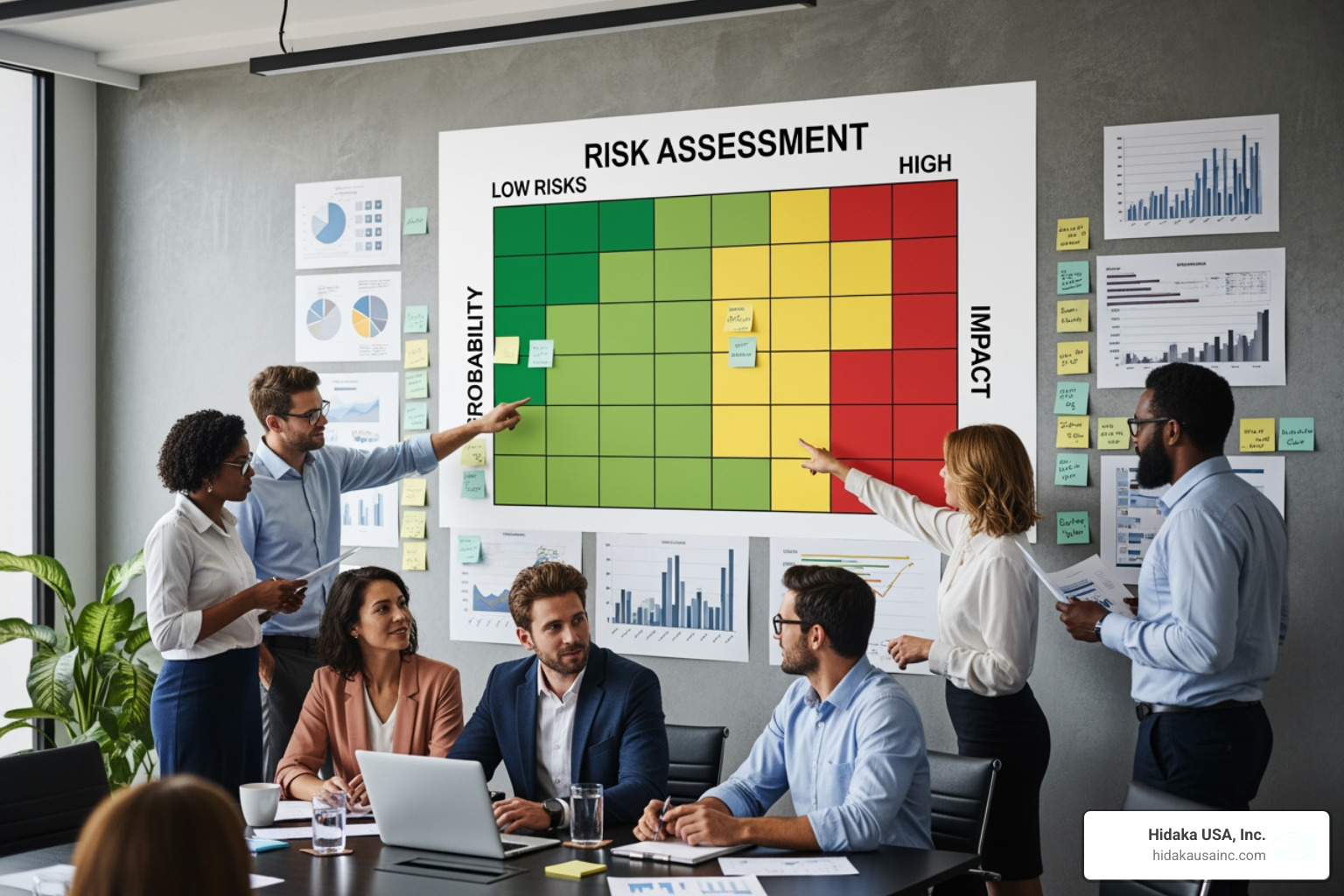
In our Ohio facility, we don't just wait for a disruption; we plan for it. This involves:
- Geographical Diversification: Not putting all our eggs in one basket. If one region faces a lockdown or natural disaster, we have alternate sources ready.
- Business Continuity (ISO 22301): While ISO 9001 focuses on quality, it integrates perfectly with ISO 22301, which focuses on keeping the lights on. We identify critical products and create "targeted responses" for potential failures.
- Internal Accountability: Every team member, from the shop floor to the executive suite, is trained to spot potential supply chain risks.
KPIs for Measuring ISO 9001 Supply Chain Performance
"What gets measured, gets managed." To keep our ISO 9001 supply chain healthy, we track several key performance indicators:
- Lead Time: The time from order placement to delivery. Shorter lead times mean we can be more agile for our customers.
- Defect Rate (PPM): How many parts out of a million are non-conforming? High-quality automotive work demands near-zero.
- On-Time Delivery (OTD): In a "Just-In-Time" (JIT) environment, being five minutes late is the same as being five hours late.
- Cost of Poor Quality (COPQ): Measuring the financial impact of scrap, rework, and returns.
- Waste Minimization: Aligning with sustainability goals by reducing excess packaging and transport emissions.
Strategic Benefits: Efficiency, Sustainability, and Industry Impact
Implementing an ISO 9001 supply chain isn't just a defensive move; it’s a competitive advantage. It directly impacts the "Triple Bottom Line."
- Economic: Reduced waste and fewer defects lead to higher profit margins. In fact, standards and accredited conformity assessment contribute an estimated GBP 6.1 billion to UK exports annually; similar benefits are seen here in the U.S. market.
- Environmental: By selecting suppliers with efficient processes, we reduce our overall carbon footprint.
- Social: ISO 9001 requires us to ensure our suppliers have competent, engaged people. This promotes fair labor practices and safer working environments throughout the chain.
Integrating ISO 9001 with ISO 14001 and ISO 45001
The beauty of the modern ISO structure is that it allows for "Holistic Excellence." We don't have to run three separate systems.
- ISO 14001 (Environmental): Helps us manage waste and energy use in the supply chain.
- ISO 45001 (Occupational Health & Safety): Ensures our suppliers aren't taking risks with their employees' lives to meet our deadlines.
- ISO 27001 (Information Security): As supply chains become more digital, protecting our intellectual property and CAD files is vital.
By performing "Integrated Audits," we can verify quality, safety, and environmental compliance all at once, saving time and resources.
Frequently Asked Questions about ISO 9001 Supply Chain Management
How do I demonstrate compliance during an audit?
When the auditor arrives, they aren't just looking for a "yes" or "no." They want evidence. To demonstrate control over your ISO 9001 supply chain, you should have the following ready:
- The Approved Supplier List (ASL): A current list of who you are allowed to buy from.
- Evidence of Selection: Records showing why a new supplier was added (e.g., their ISO certificate, a trial run of parts, or an on-site audit report).
- Communication Records: Purchase orders that clearly state technical specifications, packaging requirements, and delivery dates.
- Verification Data: Incoming inspection logs showing that you checked the parts before they hit the production line.
- Performance Reviews: Minutes from "Management Review" meetings where supplier performance was discussed and acted upon.
What are common implementation challenges?
It’s not always easy. Some common hurdles include:
- Resource Allocation: Small suppliers may struggle with the documentation requirements. We overcome this by providing clear templates and guidance.
- Leadership Support: If the bosses don't care about quality, the shop floor won't either.
- Data Silos: Information gets stuck in the purchasing department and doesn't reach the quality team. Using integrated software helps bridge this gap.
- Global Complexity: Managing a supplier in another time zone and language is hard. This is why the "universal language" of ISO standards is so valuable.
How does ISO 9001 transform the automotive and pharmaceutical sectors?
In these high-stakes industries, ISO 9001 is the baseline.
- Automotive: We often use IATF 16949, which is built on top of ISO 9001. It adds even stricter requirements for "Advanced Product Quality Planning" (APQP) and "Production Part Approval Process" (PPAP). Tier 1 suppliers now take on more responsibility for verifying the entire sub-tier chain.
- Pharmaceuticals: The focus is on traceability and "Good Manufacturing Practices" (GMP). Every raw material must be traceable back to its origin to ensure patient safety.
Conclusion
At Hidaka USA, Inc., we have seen how a commitment to an ISO 9001 supply chain transforms a business from a simple parts maker into a trusted strategic partner. Whether we are working on a complex automotive prototype or a high-volume mass production run for the rail industry, our QMS is the heartbeat of our operation here in Dublin, Ohio.
By holding ourselves and our suppliers to these international standards, we ensure that every laser-cut edge, every weld, and every assembly meets the rigorous demands of our customers. Quality isn't just a department; it's the way we do business.
Explore our assets and capabilities to see how our ISO 9001-certified processes can support your next project.