An Essential Guide to Sheet Metal Stamping

Sheet Metal Stamping: What It Is and Why It Matters
Sheet metal stamping is a manufacturing process that uses presses and custom dies to transform flat metal sheets into precise, functional shapes through cold forming and permanent deformation.
Quick answer:
QuestionAnswerWhat is it?A process that presses flat metal into shapes using dies and pressesHow does it work?A punch forces sheet metal into a die, permanently deforming itCommon materialsSteel, aluminum, stainless steel, copper, brass, titaniumKey techniquesProgressive die, deep draw, fourslide, transfer die stampingMain industriesAutomotive, aerospace, electronics, medical devicesWhy use it?High speed, repeatability, and cost-efficiency at scale
Sheet metal stamping is one of the most widely used manufacturing processes in the world. It is a $215 billion global industry (as of 2024) and continues to grow at over 4% annually. From car doors and aircraft brackets to surgical instruments and kitchen appliances, stamped metal parts are found in almost every product category.
The process works across a wide range of thicknesses — typically 0.001 in. to 0.625 in. — and can be adapted for simple single-operation parts or highly complex multi-feature components produced at speeds exceeding 1,500 strokes per minute.
I'm Yoshihiro Hidaka, founder of Hidaka USA, Inc., where I've spent over three decades providing sheet metal stamping solutions — from early-stage prototypes to full-scale mass production — primarily for the automotive industry. In this guide, I'll walk you through everything you need to know to understand and apply sheet metal stamping effectively.
What is Sheet Metal Stamping and How Does it Work?
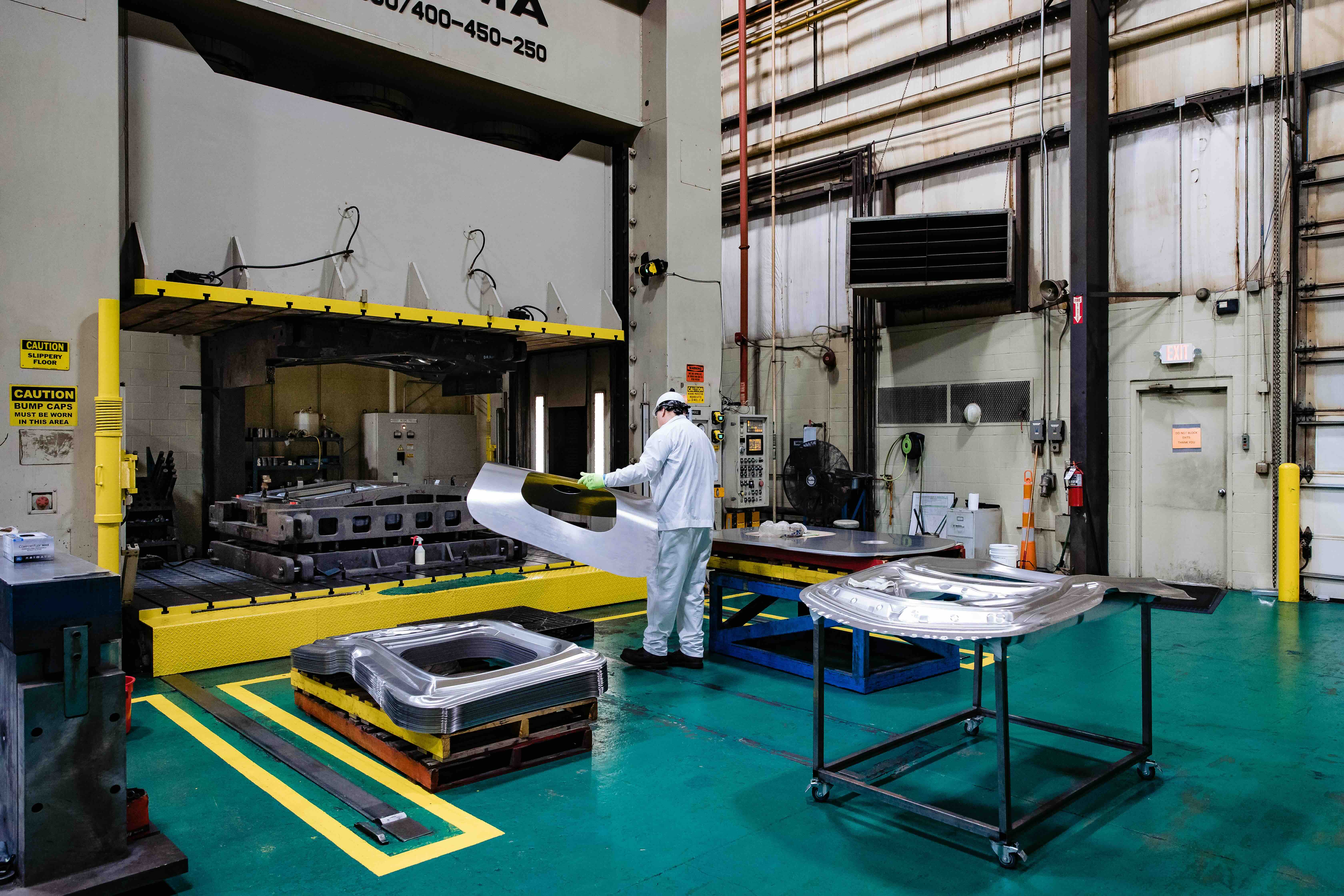
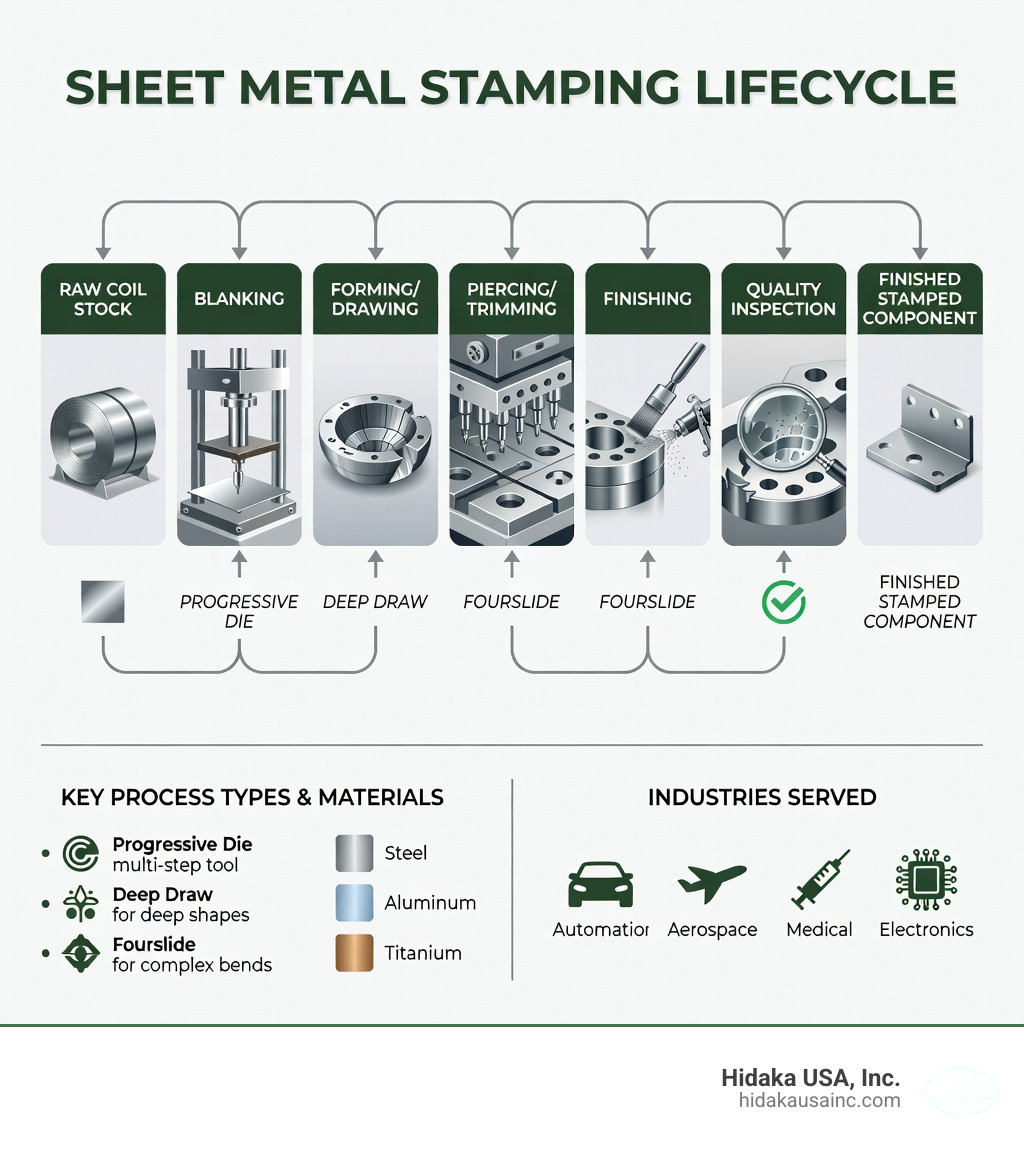
At its core, sheet metal stamping is like industrial-strength origami, but instead of paper, we use steel, and instead of hands, we use massive machines called presses. The process involves placing flat sheet metal—in either blank or coil form—into a stamping press. Inside the press, a tool and die surface shape the metal into a new, permanent form.
The Power of the Press
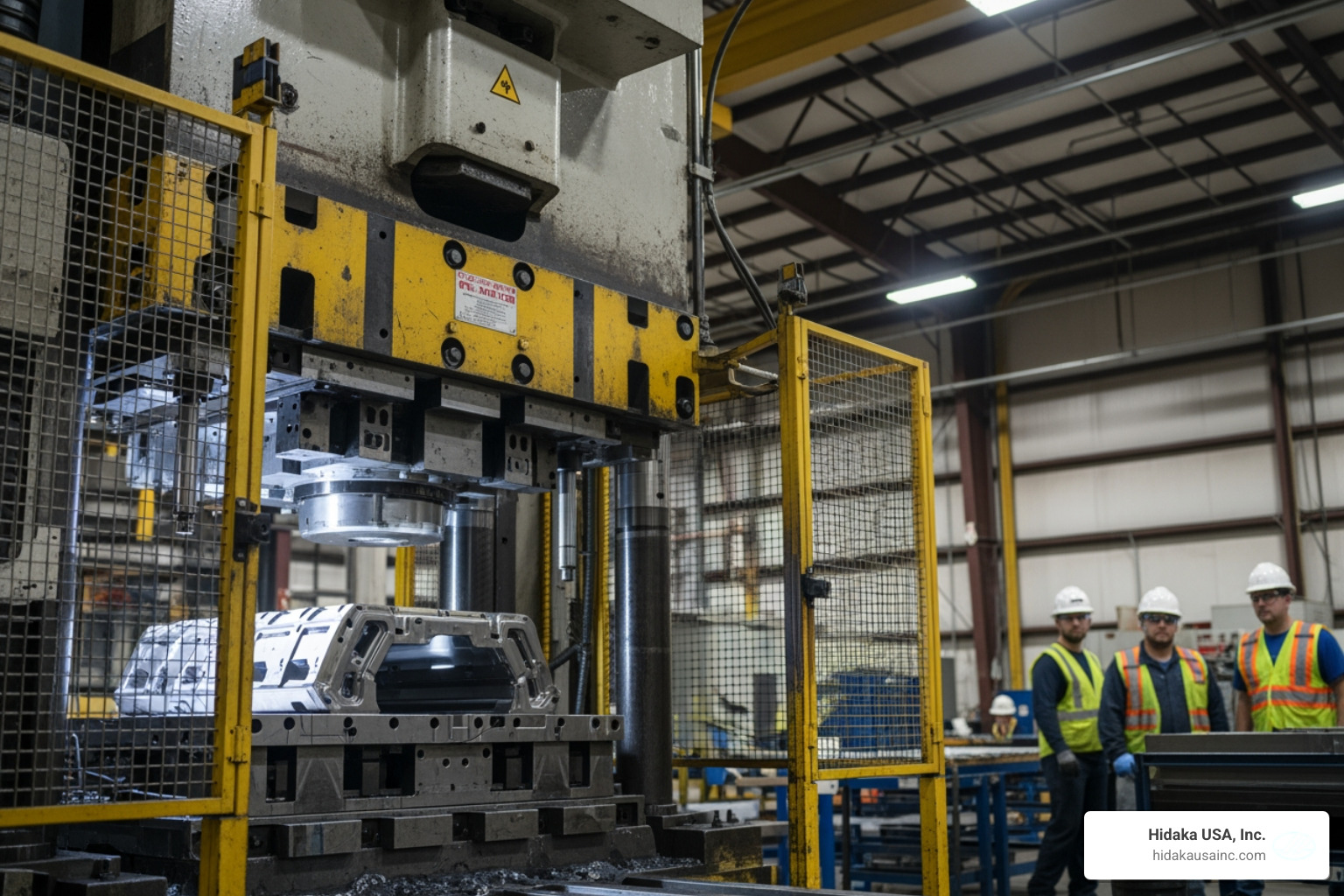
To get metal to move the way we want, we need serious force. Stamping presses range in tonnage from 10 tons for small, delicate parts to a staggering 50,000 tons. To put that in perspective, 50,000 tons is equal to 100 million lbs. of force!
We generally categorize these machines into two main types:
- Mechanical Presses: These use a motor-driven flywheel to store and release energy. They are the "sprinters" of the industry, with some high-speed models exceeding 1,500 strokes per minute. They are ideal for high-volume blanking and shallow drawing.
- Hydraulic Presses: These use fluid pressure to move the ram. They are the "weightlifters," providing full power throughout the entire stroke. This makes them perfect for complex deep drawing where we need to control the flow of the metal carefully.
FeatureMechanical PressHydraulic PressForce Range20 to 6,000 tons20 to 10,000+ tonsStroke Speed20 to 1,500 strokes/minGenerally slower, more controlledBest ForHigh-speed blanking, shallow drawsDeep drawing, complex formingStroke Length5 to 500 mm10 to 800 mm
The Anatomy of a Die
The "magic" happens within the custom dies. A die set usually consists of two halves: the male punch and the female die. When the press slams them together, the metal trapped in between is forced to take the shape of the die.
Common operations performed include:
- Blanking: Cutting the rough outline of the part from the sheet.
- Piercing: Punching holes or slots into the part.
- Forming: Bending the metal into 2D or 3D shapes.
- Drawing: Stretching the metal into deep, hollow shapes (like a stamped bright finish stainless steel sink).
Core Techniques and Material Selection
Not every part is made the same way. Depending on how complex your design is and how many thousands (or millions) of parts you need, we choose a specific technique.
Common Stamping Operations
- Bending: Creating straight-line folds.
- Flanging: Bending the edge of a part to create a rim.
- Embossing: Creating raised or sunken designs in the sheet.
- Coining: Squeezing the metal to achieve very tight tolerances or surface details.
- Ironing: Thinning the walls of a drawn part to make them uniform (common in soda cans).
Progressive Die and Deep Draw Processes
For high-volume production, progressive die stamping is the gold standard. In this setup, a coil of metal is fed through a series of stations within a single die. Each "stroke" of the press performs a different operation—maybe a hole is pierced at station one, a bend is made at station two, and the final part is cut at station three. Because the metal stays attached to the strip until the very end, we can run these at incredibly high speeds, often exceeding 1,000 strokes per minute.
Deep draw stamping is a bit different. We call it "deep" when the depth of the part exceeds its diameter. This is how we make things like fire extinguishers, oil filters, and kitchen sinks. It requires the metal to flow plastically into the die cavity without tearing. Deep drawing often involves multiple "reductions" to reach the final depth.
The Role of Materials in Sheet Metal Stamping
The material you choose dictates how the die must be designed. We work with everything from "soft" metals like copper to "superalloys" used in aerospace.
- Steel & Stainless Steel: The most common. Mild steel is affordable and easy to form, while the stainless steel 300 series is prized in the medical and food industries for its corrosion resistance.
- Aluminum Alloys: Perfect for when you need strength without the weight. This is why it's so popular in automotive body panels and aerospace.
- Titanium: Used for high-performance aircraft and medical implants because it is incredibly strong and biocompatible.
- Copper & Brass: Excellent for electronics due to their conductivity.
Material thickness is a major factor. While we typically work between 0.001 in. and 0.625 in., the force required grows exponentially with thickness. For example, to cut a 10-inch circle out of 0.125-inch thick mild steel, you need about 157,000 lbs. of pressure—that’s like stacking 13 elephants on top of the punch!
The Advantages of High-Volume Sheet Metal Stamping
Why do industries like automotive and aerospace rely so heavily on sheet metal stamping? It comes down to three things: speed, cost, and consistency.
Efficiency and Repeatability
Once a custom die is built and "dialed in," it can produce identical parts for years. This level of repeatability is impossible with manual fabrication. In the history of metal stamping, the industry exploded when bicycle and car manufacturers realized they could replace expensive, slow-machined parts with stamped versions that were just as strong but much cheaper to produce.
Choosing Custom Sheet Metal Stamping for Your Project
When should you make the leap to custom stamping? We usually look at the Estimated Annual Quantity (EAQ). Because the "hard tooling" (the dies) can be expensive to design and build, you need enough volume to "pay back" that initial investment.
However, for complex geometries that require tight tolerances, stamping is often the only way to get the job done efficiently. Beyond the press, we also handle secondary finishing to ensure your parts are ready for assembly:
- Deburring: Removing sharp edges left by the cutting process.
- Powder Coating: Applying a durable, protective finish.
- Cleaning and Surface Treatment: Ensuring the metal is free of oils and ready for its final environment.
Frequently Asked Questions about Sheet Metal Stamping
What are the most common defects in stamping and how are they prevented?
Metal has a "memory," and it doesn't always want to stay in the shape we give it.
- Springback: The tendency of metal to partially return to its original shape after bending. We prevent this by "over-bending" the part in the die.
- Wrinkling and Thinning: Usually caused by improper tension during a draw.
- Tearing: When the metal is stretched beyond its limit.
To prevent these, we use Finite Element Analysis (FEA) or stamping simulation software. This allows us to "test" the metal's behavior digitally before we ever cut a single piece of tool steel. We also maintain an optimum clearance (usually 20-25% of the stock thickness) between the punch and die to ensure clean cuts without excessive burrs.
How do custom dies and hard tooling function?
Custom dies are made from hardened tool steel or carbide inserts to withstand the millions of pounds of pressure they face daily.
- Punch and Die Alignment: If these are off by even a fraction of a millimeter, the tool will "crash," causing thousands of dollars in damage.
- Shear Factor: By grinding the face of a punch at an angle (adding "shear"), we can reduce the tonnage required to cut the metal by up to 50%.
- Maintenance: Dies require regular sharpening. We typically sharpen the edges when the radius reaches 0.125 mm to ensure the parts stay within tolerance.
What quality certifications should a stamping company hold?
Quality isn't just a buzzword; it's a requirement. A reliable partner should hold ISO 9001 certification, which ensures a consistent quality management system. For specialized industries, AS9100 (aerospace) or AWS (welding) certifications are critical. We use tools like CMM (Coordinate Measuring Machines) and Statistical Process Control (SPC) to track every batch and ensure that the 50,000th part is just as perfect as the first one.
Conclusion
Sheet metal stamping is the backbone of modern manufacturing, providing the precision and scale needed to power our world. At Hidaka USA, Inc., we’ve been perfecting this craft since 1989. Based in Dublin, Ohio, our 95,000-square-foot facility is designed to take you from a rough prototype to high-volume mass production without missing a beat.
Whether you are in the automotive, motorsports, or mass-transit railcar industry, we focus on high-quality, American-made products backed by strict ISO 9001 standards. If you're ready to see how our advanced engineering and mass production services can bring your project to life, we are here to help.