Sheet Metal Fabrication: Don't Get Bent Out of Shape Over the Basics

What Is Sheet Metal Fabrication? A Clear Starting Point
Sheet metal fabrication is the process of cutting, bending, and assembling flat metal sheets into finished parts or structures. It is one of the most widely used manufacturing processes in the world.
Quick answer:
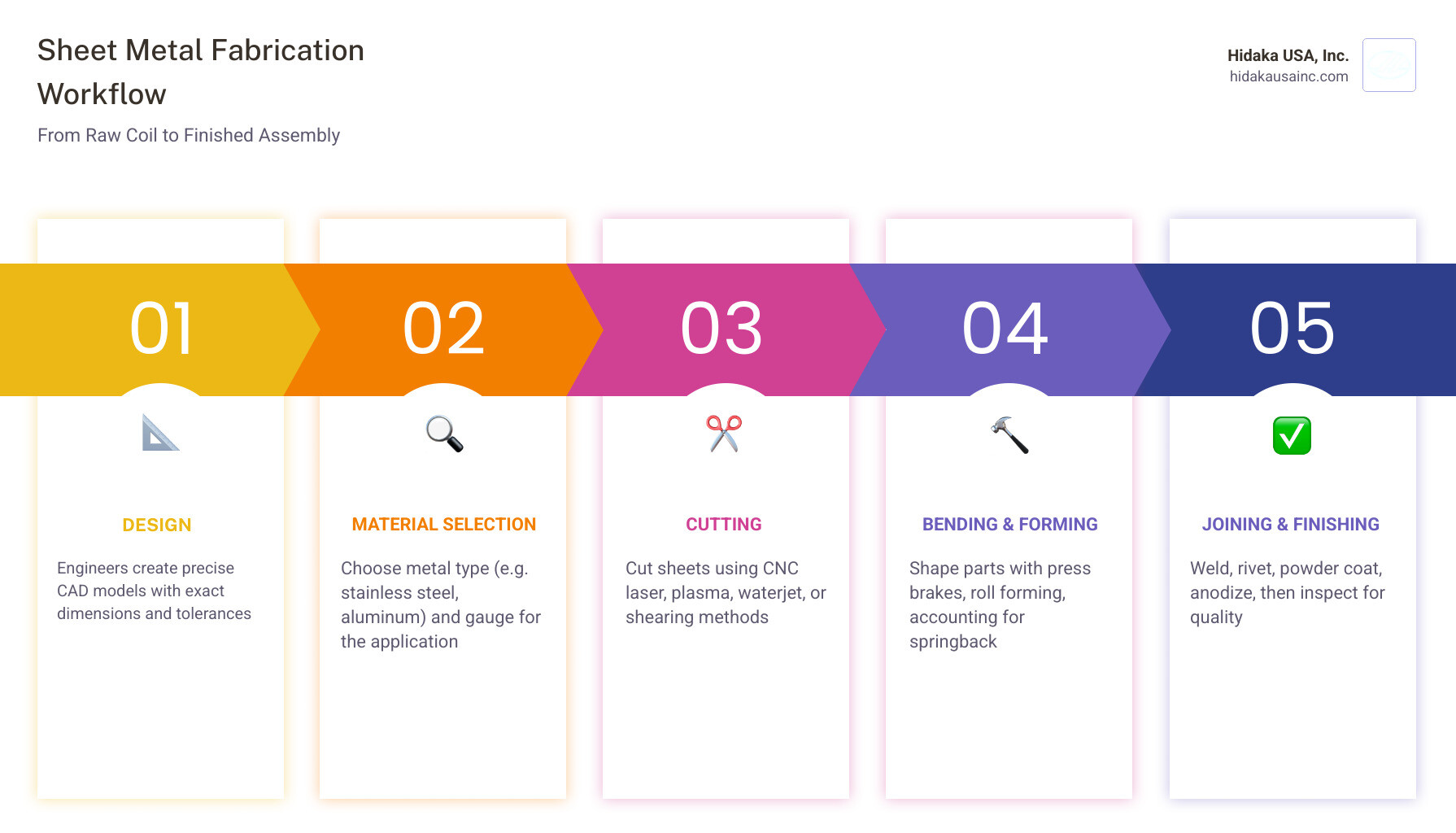
StepWhat HappensDesignEngineers create CAD models with exact dimensionsMaterial SelectionMetal type and gauge are chosen for the applicationCuttingSheets are cut using laser, plasma, waterjet, or shearingBending & FormingParts are shaped using press brakes or roll formingJoiningPieces are welded, riveted, or fastened togetherFinishingSurface treatments like powder coating or anodizing are appliedInspectionParts are checked for dimensional accuracy and structural integrity
Sheet metal is defined by its thickness: foil is thinner than 0.006 inches, sheet metal ranges from 0.006 to 0.25 inches, and anything thicker is classified as plate. This guide focuses on the sheet range, which covers the vast majority of fabricated metal parts you see every day — from car body panels and HVAC ductwork to aerospace components and electronic enclosures.
The industry has come a long way. Leonardo da Vinci sketched an early sheet metal rolling technique as far back as 1485. Today, CNC machines, fiber-optic lasers, and robotic welding systems handle work that once took days of manual labor.
For automotive manufacturers in particular, sheet metal fabrication is not just a process — it is a critical link in the production chain. Tight tolerances, reliable delivery, and consistent quality are not optional. They are the baseline.
I'm Yoshihiro Hidaka, founder of Hidaka USA, Inc., and I have spent over three decades in sheet metal fabrication, starting with automotive prototype supply and expanding into mass production across multiple industries. In this guide, I'll walk you through everything you need to know — from raw material selection to finished part delivery.
Understanding the Core of Sheet Metal Fabrication
At its heart, Sheet Metal Fabrication is a value-added process. We take a raw, flat material and, through a series of "cold working" steps, transform it into a three-dimensional object. Unlike casting or forging, which often involve molten metal or extreme heat to change the metal's state, sheet metal work primarily happens at room temperature. This allows the metal to maintain certain mechanical properties while we manipulate its shape.
The history of sheet metal is surprisingly ancient. While we often think of it as a modern industrial marvel, humans have been hammering metal into thin sheets for millennia—think of ancient Egyptian jewelry or medieval plate armor. However, the true turning point came in 1485 when Leonardo da Vinci produced a sketch of a rolling mill. This revolutionized how we could achieve uniform thickness, paving the way for the Industrial Revolution and, eventually, the high-tech metal fabrication we perform today in our Dublin, Ohio facility.
To talk like a pro, you first need to know your categories. We don't just call everything "metal." The industry uses specific terms based on thickness:
CategoryThickness Range (Inches)Typical UsesFoil< 0.006"Packaging, heat shields, electronicsSheet Metal0.006" to 0.25"Car bodies, enclosures, appliances, ductworkPlate> 0.25"Structural beams, heavy machinery, ship hulls
Common Materials in Sheet Metal Fabrication
Choosing the right material is the first big decision. You wouldn't use heavy steel for a lightweight drone part, and you wouldn't use soft copper for a structural truck frame. Here is a breakdown of what we commonly use:
- Stainless Steel: The go-to for corrosion resistance. Grade 304 is the most common, offering great formability and weldability. Grade 316 is the "marine grade," containing molybdenum to resist chlorides (perfect if your part will be near salt or harsh chemicals).
- Aluminum: Lightweight and naturally resistant to rust. We often work with 5052-H32 for its excellent marine-grade corrosion resistance and 6061-T6 for structural applications where strength-to-weight ratio is king.
- Copper and Brass: These are excellent conductors of electricity and heat. They are often used in electronics or for decorative architectural flourishes because they look fantastic when polished.
- Titanium: When you need the strength of steel but the weight of aluminum, titanium is the answer. It’s common in aerospace and high-performance motorsports.
All these materials must meet strict ASTM standards to ensure that the "Grade 304" we buy today behaves exactly like the "Grade 304" we bought last month. Consistency is the secret ingredient in quality fabrication.
Standard Gauges and Tolerances
In the United States, we still use a "gauge" system to measure thickness, which can be a bit confusing for newcomers. Here is the funny thing about gauges: the higher the number, the thinner the metal. For example, 10-gauge steel is about 0.1345 inches thick, while 20-gauge steel is only 0.0359 inches.
It is also important to note that the gauge system differs between ferrous metals (like steel) and non-ferrous metals (like aluminum and copper). Because of this potential for confusion, many modern shops—ourselves included—prefer to specify thickness in decimal inches or millimeters to ensure absolute dimensional accuracy.
When we talk about tolerances, we are talking about the "wiggle room" allowed in a design. In precision Sheet Metal Fabrication, we often work with tolerances as tight as +/- 0.005 inches for laser cutting and +/- 1 degree for bending. Achieving this requires high-end equipment and a deep understanding of how different metals "behave" when they are stressed.
The Step-by-Step Fabrication Process
Turning a flat sheet into a complex automotive assembly is a lot like "industrial origami." It follows a logical flow where each step builds on the precision of the one before it.
- Design & CAD Modeling: Everything starts on a computer. Engineers use Computer-Aided Design (CAD) software to create 3D models. This isn't just a drawing; it’s a digital blueprint that accounts for material thickness and bend allowances.
- Material Selection: Based on the design's requirements for strength, weight, and environment, the appropriate metal and gauge are selected.
- Cutting: The flat shapes (called "blanks") are cut from the large sheets or coils.
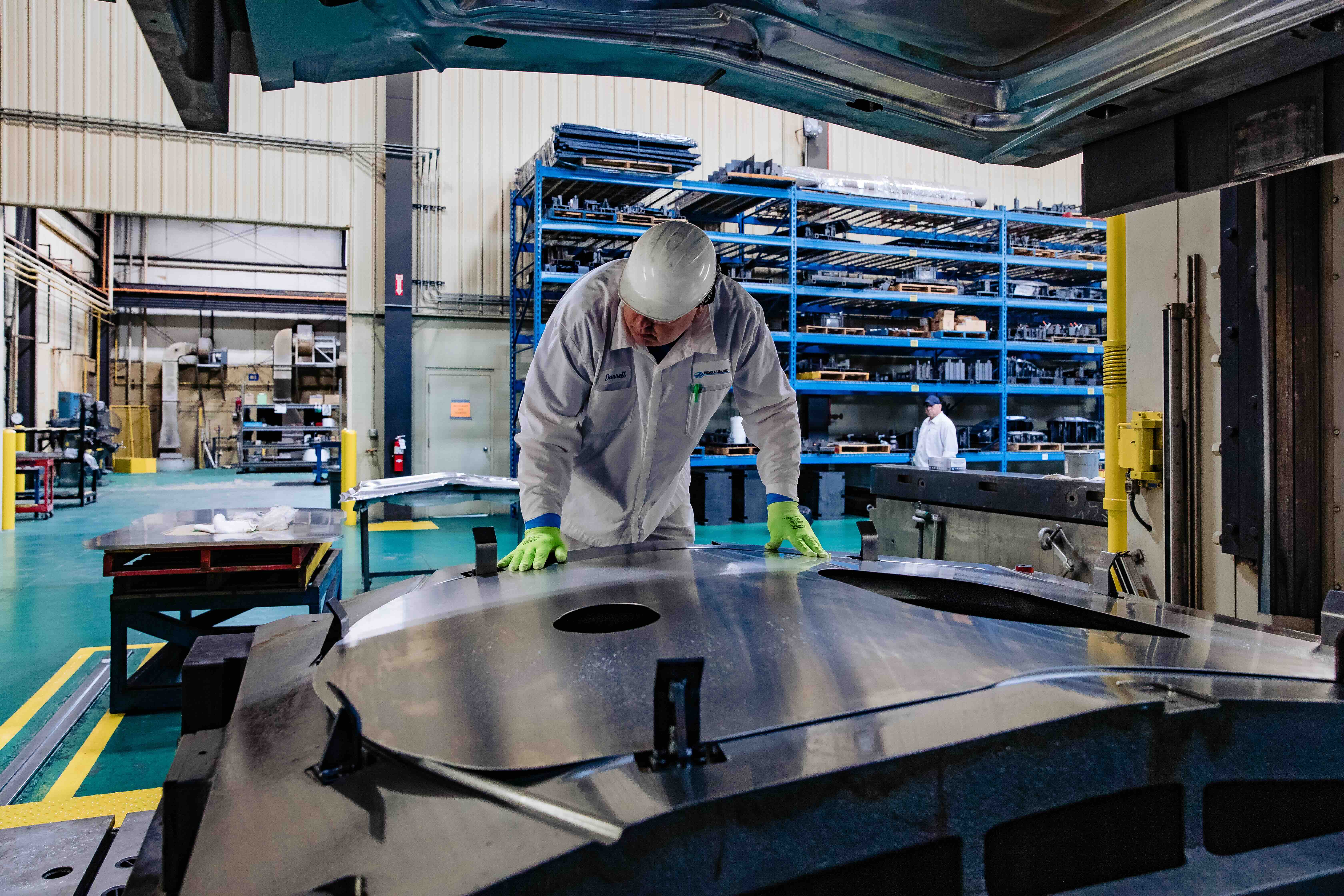
- Forming/Bending: This is where the part becomes 3D. Using massive pressure, we fold the metal along specific lines.
- Assembly/Joining: Individual parts are welded, riveted, or fastened together to create the final structure.
- Finishing: The metal is cleaned and coated to protect it from the elements and make it look professional.
Precision Cutting Techniques for Sheet Metal Fabrication
Cutting is the foundation. If the initial blank is wrong, nothing else will fit. We use several different "flavors" of cutting depending on the job:
- CNC Laser Cutting: The gold standard for precision. We use fiber lasers to slice through metal with incredible speed and a tiny "kerf" (the width of the cut). It is perfect for complex patterns and leaves a clean edge that often requires no further cleanup.
- Plasma Cutting: This uses a high-velocity jet of ionized gas. It is generally faster for very thick materials but can leave a slightly rougher edge than a laser. Research into laser vs plasma cutting shows that while plasma is cost-effective for heavy industrial parts, laser wins for precision and thin-gauge accuracy.
- Waterjet Cutting: This uses water mixed with an abrasive (like garnet) at ultra-high pressure. Because it doesn't use heat, it’s the best choice for materials that might warp or change properties when exposed to a laser’s heat.
- Shearing: Think of this as a giant pair of industrial scissors. It’s great for making straight cuts on large sheets quickly.
Bending and Forming Methods
Bending is where the magic happens. The most common tool here is the press brake. It uses a "punch" (the top part) and a "die" (the bottom part) to press a fold into the metal.
Modern advancements like seven-axis bending allow us to create incredibly complex shapes in a single setup. However, bending isn't as simple as just pushing the metal. We have to account for two critical factors:
- Springback: When you bend a piece of metal, it wants to "spring" back toward its original flat shape slightly once the pressure is released. We have to over-bend the part by a few degrees so that when it relaxes, it lands at the perfect angle.
- K-Factor: When metal bends, the inside of the bend compresses and the outside stretches. There is a "neutral axis" in the middle that stays the same length. The K-factor is the ratio that helps us calculate exactly how much the metal will stretch so we can size the flat blank correctly.
Joining, Assembly, and Surface Finishing
Once we have our individual pieces cut and bent, it’s time to put the puzzle together. This is where the structural integrity of the part is truly established.
Welding and Assembly
Welding is the most common joining method in Sheet Metal Fabrication. At Hidaka USA, we utilize several types:
- MIG (Metal Inert Gas): Fast and great for thicker materials or long seams.
- TIG (Tungsten Inert Gas): Offers the highest level of control and produces very clean, beautiful welds. It is our preferred method for thin aluminum or stainless steel.
- Spot Welding: Common in automotive work, this uses electrical resistance to join two overlapping sheets at specific points. It’s incredibly fast and efficient.
One major challenge in welding is warping. Because welding involves intense heat, the metal can expand and contract, leading to a twisted part. We prevent this by using custom fixtures to hold parts in place, employing "staggered" welding patterns, and sometimes using post-weld straightening techniques.
Beyond welding, we also use mechanical fasteners like rivets, screws, and "PEM" nuts (threaded inserts that are pressed into the metal) to allow for parts that can be disassembled later.
Post-Processing and Quality Control
A part isn't finished just because it’s assembled. It needs to be protected. Common finishes include:
- Powder Coating: A dry powder is applied electrostatically and then cured under heat. It creates a thick, durable "skin" that is much tougher than conventional paint.
- Anodizing: Specifically for aluminum, this electrochemical process thickens the natural oxide layer, making it harder and more corrosion-resistant. It can also add vibrant colors.
- Sandblasting: This cleans the surface and creates a uniform "matte" texture, often used as a prep step for coating.
Quality control is where we separate the amateurs from the pros. We track our operational excellence through metrics like rejection rates and on-time delivery. In our shop, we aim for a rejection rate of less than 0.001%. This is achieved through rigorous dimensional inspection using CMM (Coordinate Measuring Machine) arms and laser scanners that compare the physical part to the original CAD model.
Modern Automation and CNC Technology
Technology has turned Sheet Metal Fabrication into a high-speed, high-precision industry.
- Robotic Welding: Robots don't get tired and they don't have "off days." They provide perfect consistency across thousands of parts.
- Lights-Out Manufacturing: Some of our laser cutting systems can run overnight without a human operator, loading and unloading sheets automatically.
- Setup Reduction: We’ve seen setup times in the industry drop from 10 minutes to just 10 seconds through process optimization. This allows us to handle small-batch prototypes and massive production runs with equal efficiency.
Design for Manufacturability (DFM) Best Practices
The best way to save money and ensure quality in Sheet Metal Fabrication is to design the part correctly from the start. We call this Design for Manufacturability, or DFM.
Here are the "golden rules" of DFM:
- The 4T Rule: Keep holes and slots at least four times the material thickness away from any bend. If a hole is too close to a bend, it will deform into an egg shape when the metal is folded.
- Uniform Radii: Try to use the same bend radius for every fold in the part. This allows the operator to use one set of tools, reducing setup time and cost.
- Bend Allowance: Always account for the fact that metal stretches. If you don't calculate the bend allowance correctly, your finished part will be slightly too big or too small.
- Nesting Software: We use advanced software to "nest" parts on a sheet of metal, much like a game of Tetris. This maximizes material utilization and reduces scrap, which is better for your budget and the environment.
Tips for Cost-Effective Design
- Simple Geometry: The more complex the shape, the more it costs. If you can achieve the same function with a simpler design, do it.
- Standardized Tooling: Designing your part to use standard punch sizes and bend radii means we don't have to buy or make custom tools for your job.
- Assembly Planning: Sometimes, redesigning a 9-piece assembly into a single complex piece can eliminate 18 spot welds and reduce manufacturing cycle time by 57%.
- Prototype Testing: Always build a prototype before committing to a mass production run. It is much cheaper to fix a mistake in a 3D-printed or single-unit metal prototype than it is to fix 10,000 finished parts.
Frequently Asked Questions about Sheet Metal
What is the difference between sheet metal and plate?
As a general rule, anything 0.25 inches (6mm) or thicker is considered plate. Anything between 0.006 inches and 0.25 inches is sheet metal. Plate is typically used for heavy structural applications, while sheet metal is used for enclosures, panels, and more intricate components.
How does CNC technology impact fabrication costs?
CNC (Computer Numerical Control) technology significantly lowers costs for high-volume production. While the initial programming takes time, the actual production is incredibly fast and consistent. It reduces labor costs, minimizes scrap through better material nesting, and eliminates human error.
Which welding method is best for thin aluminum sheets?
TIG welding is generally the best choice for thin aluminum. It provides the most control over the heat, which is vital because aluminum has a high thermal conductivity and a low melting point—it’s very easy to "burn through" if you aren't careful.
Conclusion
Sheet Metal Fabrication is a blend of ancient craftsmanship and futuristic technology. Whether we are working on a single prototype for a new motorsports component or mass-producing thousands of parts for the automotive industry, the principles remain the same: precision, quality, and reliability.
At Hidaka USA, Inc., we have been perfecting these processes since 1989. From our 95,000-square-foot facility in Dublin, Ohio, we provide end-to-end services that take your project from a rough sketch to a high-quality, American-made reality. Our ISO 9001 and AWS certifications are a testament to our commitment to excellence, but our real pride comes from the long-term relationships we build with our clients.
If you are ready to see how precision fabrication can transform your next project, we are here to help.