Rapid Prototyping Processes: In Depth Guide

Understanding the Main Types of Rapid Prototyping Processes
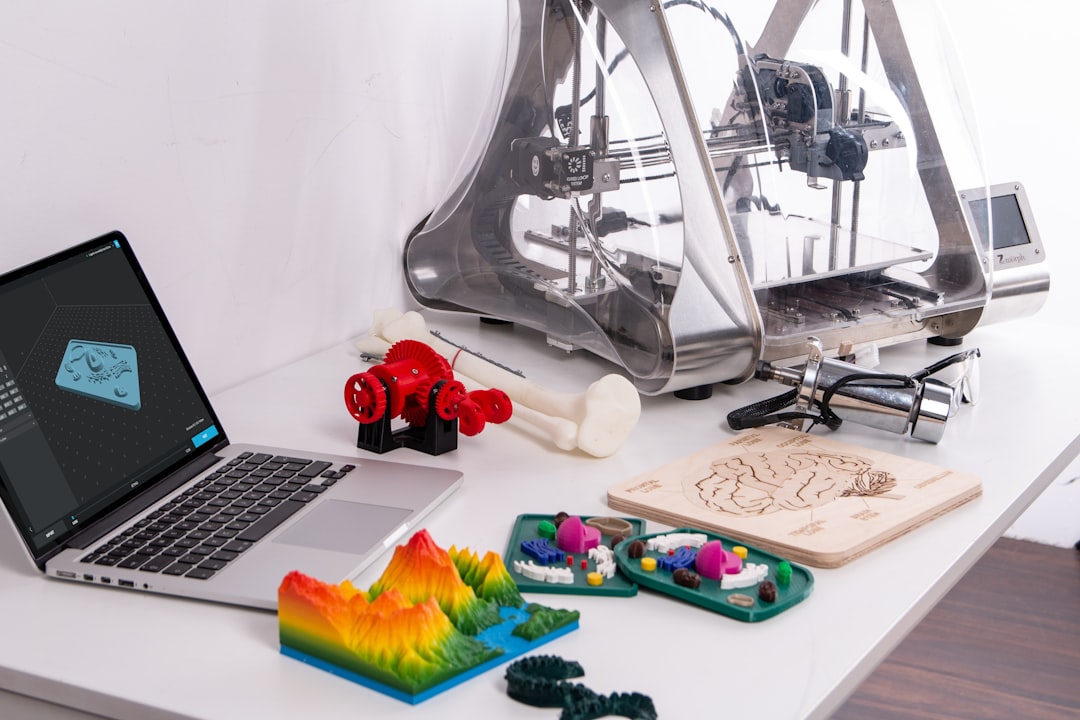
Rapid prototyping processes are techniques used to quickly turn a 3D digital design into a physical part or model for testing and validation. Here is a quick overview of the most common methods:
| Process | Type | Best For |
|---|---|---|
| Stereolithography (SLA) | Additive | High-detail visual models |
| Selective Laser Sintering (SLS) | Additive | Complex functional parts |
| Fused Deposition Modeling (FDM) | Additive | Concept models, low cost |
| Direct Metal Laser Sintering (DMLS) | Additive | Functional metal prototypes |
| CNC Machining | Subtractive | High-strength, tight-tolerance parts |
| Vacuum Casting | Casting | Small production runs |
| Injection Molding (rapid tooling) | Molding | Near-production plastic parts |
Each method has different strengths depending on your material needs, required accuracy, and how far along you are in the design process.
Rapid prototyping differs from traditional prototyping in one key way: speed. Traditional methods often required the same costly tooling and setup used for final production. That made early-stage testing slow and expensive. Rapid prototyping removes that barrier by working directly from CAD data, allowing teams to go from a digital model to a physical part in hours or days rather than weeks.
The result is a faster, more iterative design cycle. Teams can build a prototype, test it, find problems, and revise — all before committing to expensive production tooling. Research shows this approach can cut overall product development time by up to 60%, and fixing a design flaw during prototyping costs far less than catching it during production.
This guide covers the full landscape of rapid prototyping: the main processes, how they work, what materials they use, and how to choose the right one for your project.
I'm Yoshihiro Hidaka, founder of Hidaka USA, Inc., a sheet metal fabrication company I established in 1989 to supply prototypes to the automotive industry — giving me over three decades of hands-on experience with rapid prototyping processes across both prototype and mass production environments. With that background, this guide is written to help automotive and manufacturing teams make faster, more confident decisions at every stage of product development.
Quick rapid prototyping processes terms:
When we talk about rapid prototyping processes, we are usually referring to a group of technologies that create parts directly from 3D Computer-Aided Design (CAD) data. In the early days (mid-1980s), this was almost exclusively about 3D printing. Today, the field has expanded to include high-speed machining and specialized casting.

At its core, the goal is to validate a design's form, fit, or function. Whether you are building a "looks-like" model to show investors or a "works-like" metal component for a railcar assembly, the process starts with the same digital foundation. For more on the metal-specific side of things, check out our guide on rapid metal prototyping.
To navigate these options, it helps to understand the difference between adding material and taking it away. For a deeper dive into the 3D printing side, you might find this Step-by-Step Guide to Rapid Prototyping with 3D Printing useful.
Additive Manufacturing Techniques
Additive manufacturing (AM) is the most famous branch of rapid prototyping. Instead of cutting a part out of a block, these machines build the part layer-by-layer.
- Stereolithography (SLA): Invented by Chuck Hull in 1984, this was the first RP process. It uses a UV laser to cure liquid photopolymer resin into solid plastic. It is incredibly precise—up to 10X faster than FDM for certain high-detail applications—making it the go-to for aesthetic models.
- Selective Laser Sintering (SLS): This process uses a laser to fuse small particles of plastic powder (usually nylon). Because the part is surrounded by unsintered powder during the build, it doesn't need support structures, allowing for incredibly complex geometries.
- Fused Deposition Modeling (FDM): This is the most common and affordable method. It melts a plastic filament and extrudes it through a nozzle. While it has visible layer lines, it is perfect for basic concept models and functional testing.
- Multi Jet Fusion (MJF) and PolyJet: These are newer, high-speed technologies. PolyJet can print multiple materials and colors at once (think a hard plastic case with a soft-touch rubber button), while MJF is known for producing strong, isotropic parts.
Subtractive and Hybrid Rapid Prototyping Processes
While 3D printing gets all the headlines, subtractive processes are often better when you need "production-grade" strength.
- CNC Machining: This is the gold standard for accuracy. By using prototype machining, we can create parts from solid blocks of aluminum, steel, or titanium. Rapid prototyping CNC machining provides superior mechanical properties because the material hasn't been melted or layered; it retains its full homogenous strength.
- Laser and Waterjet Cutting: For flat parts or sheet metal components, prototype laser cutting is remarkably fast. Waterjet cutting is a great hybrid option because it uses high-pressure water and abrasives to cut through materials up to 12 inches thick without creating heat-affected zones that might warp the metal.
- Vacuum Casting: This is a bridge manufacturing technique. We use a 3D-printed master to create a silicone mold, which is then used to cast 10 to 50 plastic parts. It’s a great way to get high-quality prototypes that look and feel like injection-molded parts without the high cost of steel tooling.
The Step-by-Step Workflow of Modern Prototyping
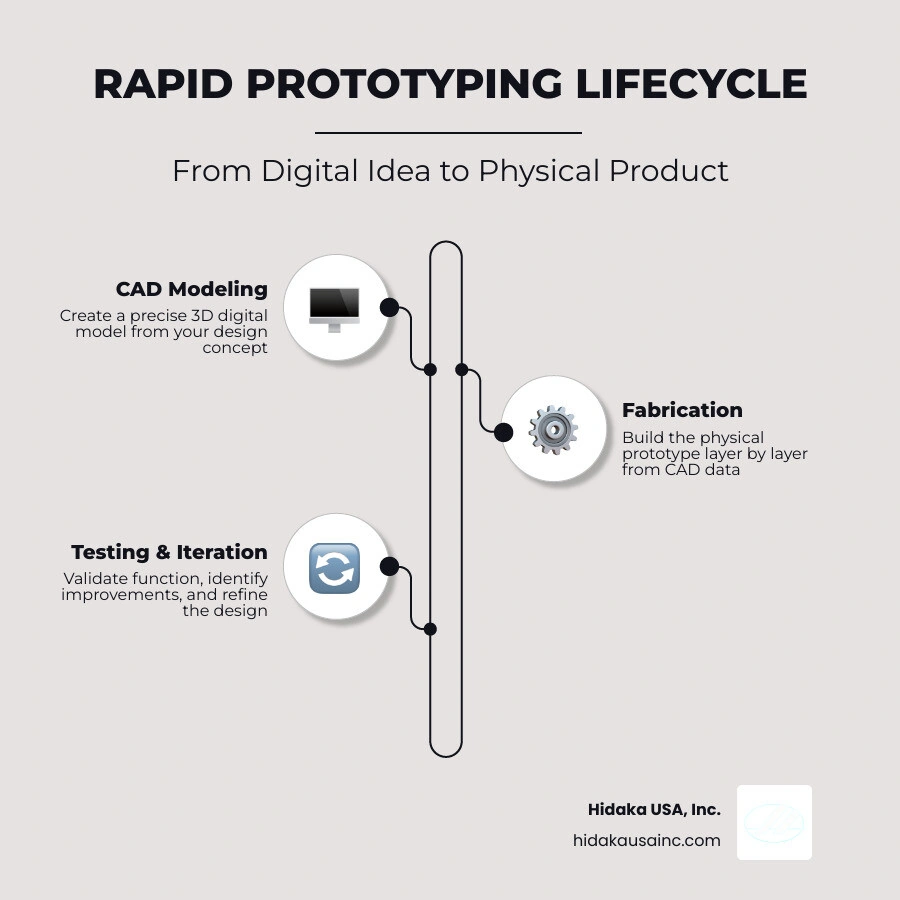
How do we actually go from a "napkin sketch" to a physical part in our Dublin, Ohio facility? It follows a very specific digital-to-physical loop.
- CAD Modeling: You create a 3D design using software like SolidWorks or CATIA.
- Data Preparation: The CAD file is converted into a format the machine can read, usually an STL (Stereolithography) file. This file describes the surface geometry as a series of triangles.
- Slicing: Software "slices" that 3D model into hundreds or thousands of horizontal layers.
- Machine Setup: We select the material (plastic, metal, or resin) and calibrate the machine.
- Build: The machine executes the file, building or cutting the part.
- Post-Processing: This might include removing supports, sanding, painting, or heat-treating.
For a detailed look at this journey, the Product Development Guide: Rapid Prototyping offers great insights into the commercial workflow.
Material Selection for Rapid Prototyping Processes
Choosing the right material is just as important as choosing the process. If you're testing a bracket for an automotive engine, a soft plastic FDM print won't tell you much. You need to know how to prototype metal parts to ensure they can handle the heat and vibration.
- Thermoplastics (ABS, PC, Nylon): Used in FDM and SLS. These are durable and can handle functional testing.
- Photopolymers: Used in SLA and PolyJet. These offer the best surface finish but can be brittle.
- Metal Powders (Steel, Aluminum, Titanium): Used in DMLS. These parts are typically 97% dense and can be used for high-performance functional testing.
- Sheet Metal: For many of our clients, prototype sheet metal fabrication is the final step before mass production. It allows us to test things like bend radius and weld integrity.
Software and Digital Preparation
Software is the "brain" of the operation. Modern rapid prototyping processes rely on more than just drawing a shape.
- Simulation: Before we even hit "print," we use software to simulate how the part will behave. Will it break under load? Will the metal warp during laser cutting?
- Digital Twins: This is a virtual version of your physical part. It allows teams to collaborate globally and identify manufacturability issues before a single ounce of material is used.
- Mesh Repair: Sometimes STL files have "holes" or overlapping triangles. Software like Miro or specialized CAD tools help "heal" these meshes so the machine doesn't get confused. You can find more on the collaborative side of this in What's Rapid Prototyping? A Quick Guide.
Advantages and Disadvantages of Rapid Prototyping
Is rapid prototyping always the answer? Usually, yes—but it's important to understand the trade-offs.
Advantages
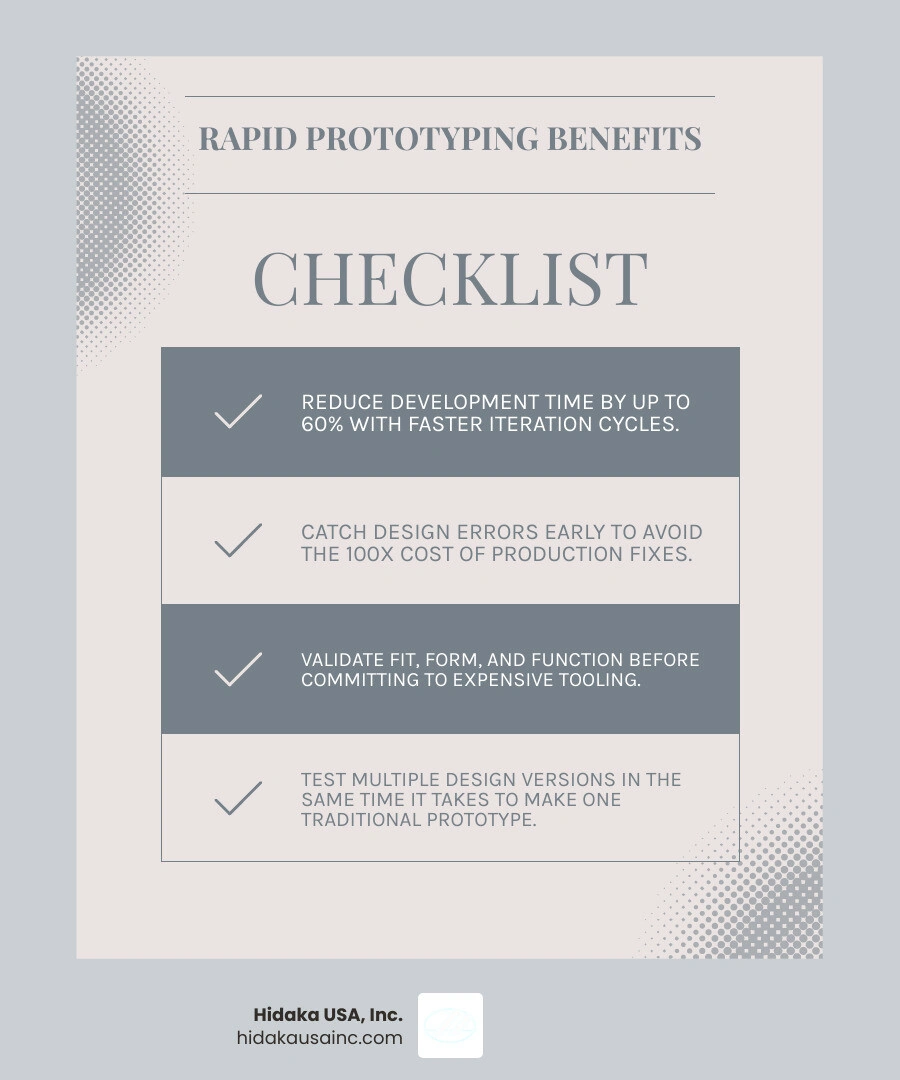
- Speed: You can reduce development time by up to 60%. Imagine going from a concept to a physical part in 8 hours instead of 7 days.
- Cost Savings: By catching a design error early, you avoid the "100x rule"—the idea that a defect costs 100 times more to fix once it hits the production line.
- Risk Reduction: You don't have to guess if a part will fit. You can hold it, bolt it in, and see for yourself.
- Customization: It is just as easy to print 10 different versions of a part as it is to print 10 of the same version.
Disadvantages
- Accuracy Limits: While CNC is very precise, some 3D printing methods have tolerances that are too loose for high-precision aerospace parts.
- Material Limitations: Not every production-grade plastic or metal alloy can be used in every RP machine.
- Surface Finish: Many 3D prints have a "stair-step" texture that requires manual sanding and painting to look professional.
For more on these trade-offs, Harvard Business School has a great post on Exploring Rapid Prototyping Methods & Best Practices.
Industry Applications and Use Cases
We see rapid prototyping processes used every day across various sectors:
- Automotive: Engineers use SLA for "looks-like" dashboard components and 3D laser prototype services for structural metal parts.
- Aerospace: Complex turbine blades with internal cooling channels that are impossible to machine can be printed using DMLS.
- Medical: Surgeons use prototypes of a patient's specific bone structure to practice complex surgeries before entering the OR.
- Startups: For those just beginning, metal prototyping for startups is the only way to prove a concept to investors without spending a fortune on factory tooling.
Choosing the Right Method for Your Project
Choosing a method shouldn't be a guessing game. We recommend using a "fidelity-based" approach.
- Low-Fidelity (Concept Model): Use FDM or paper/cardboard mockups. Goal: "Does the size feel right?"
- Medium-Fidelity (Fit/Assembly): Use SLS or precision sheet metal prototyping. Goal: "Do the parts bolt together correctly?"
- High-Fidelity (Functional/Validation): Use CNC machining, DMLS, or 3D laser prototype services. Goal: "Will this survive 10,000 cycles under load?"
Always keep Design for Manufacturing (DFM) in mind. A part that is easy to 3D print might be impossible to mass-produce via injection molding. It is often better to use a process that mimics your final production method as early as possible.
Frequently Asked Questions about Rapid Prototyping
What is the difference between rapid prototyping and traditional prototyping?
Traditional prototyping uses the same methods as mass production (like steel injection molds or manual metal forging). It is slow and expensive but very accurate. Rapid prototyping uses "tool-less" methods like 3D printing or laser cutting to skip the setup phase, getting you a part much faster but sometimes with different material properties.
How much does rapid prototyping typically cost in 2026?
While we don't list specific prices, the cost has dropped significantly as of May 2026. In-house 3D printing can often pay for itself in a few weeks by eliminating outsourcing fees. For example, a part that used to cost $1,000 to outsource can often be printed for under $50 in materials.
Which rapid prototyping method is the most accurate for metal parts?
CNC Machining is generally the most accurate, capable of holding tolerances within +/- 0.001 inches. However, for complex internal geometries, DMLS (Direct Metal Laser Sintering) is the preferred choice, even though it may require post-process machining to hit specific tolerance goals.
Conclusion
At Hidaka USA, Inc., we've seen the manufacturing world change drastically since we opened our doors in Dublin, Ohio in 1989. What used to take months of manual labor can now be achieved in a weekend thanks to modern rapid prototyping processes.
Whether you are in the automotive, mass-transit railcar, or motorsports industry, our ISO 9001-certified facility is equipped to handle your project from the first laser-cut prototype to full-scale mass production. We pride ourselves on American-made quality and the strict control standards that only 35+ years of experience can provide.
Ready to bring your design to life? From precision sheet metal prototyping to advanced engineering analysis, we are here to help you bridge the gap between a digital dream and a physical reality. Reach out to our team in Dublin, Ohio today to get started with professional prototyping services.