Building from the Floor Up: Structural Railcar Component Fabrication

Why Railcar Side Panel Fabrication Matters
Railcar side panel fabrication turns sheet metal into panels that fit the upright posts of an auto rack car. The panels are cut, formed, coated, and mounted with brackets and fasteners. A sound assembly must hold the panels securely while allowing for the small movements caused by rail travel. Protecting panel corners from rubbing helps preserve the coating, limit rust, and keep the car interior bright enough for safe vehicle loading and unloading.
I am Yoshihiro Hidaka. After 18 years in automotive supply, I founded Hidaka USA, Inc. to make sheet metal prototypes; that experience shapes how I approach accuracy and fit in railcar side panel fabrication. Our Dublin, Ohio facility combines design, engineering, and production under one roof, which lets us control tolerances from the first prototype through full mass production. That continuity matters because a panel that fits perfectly in a static fixture must still perform after years of vibration, thermal cycling, and repeated loading cycles.
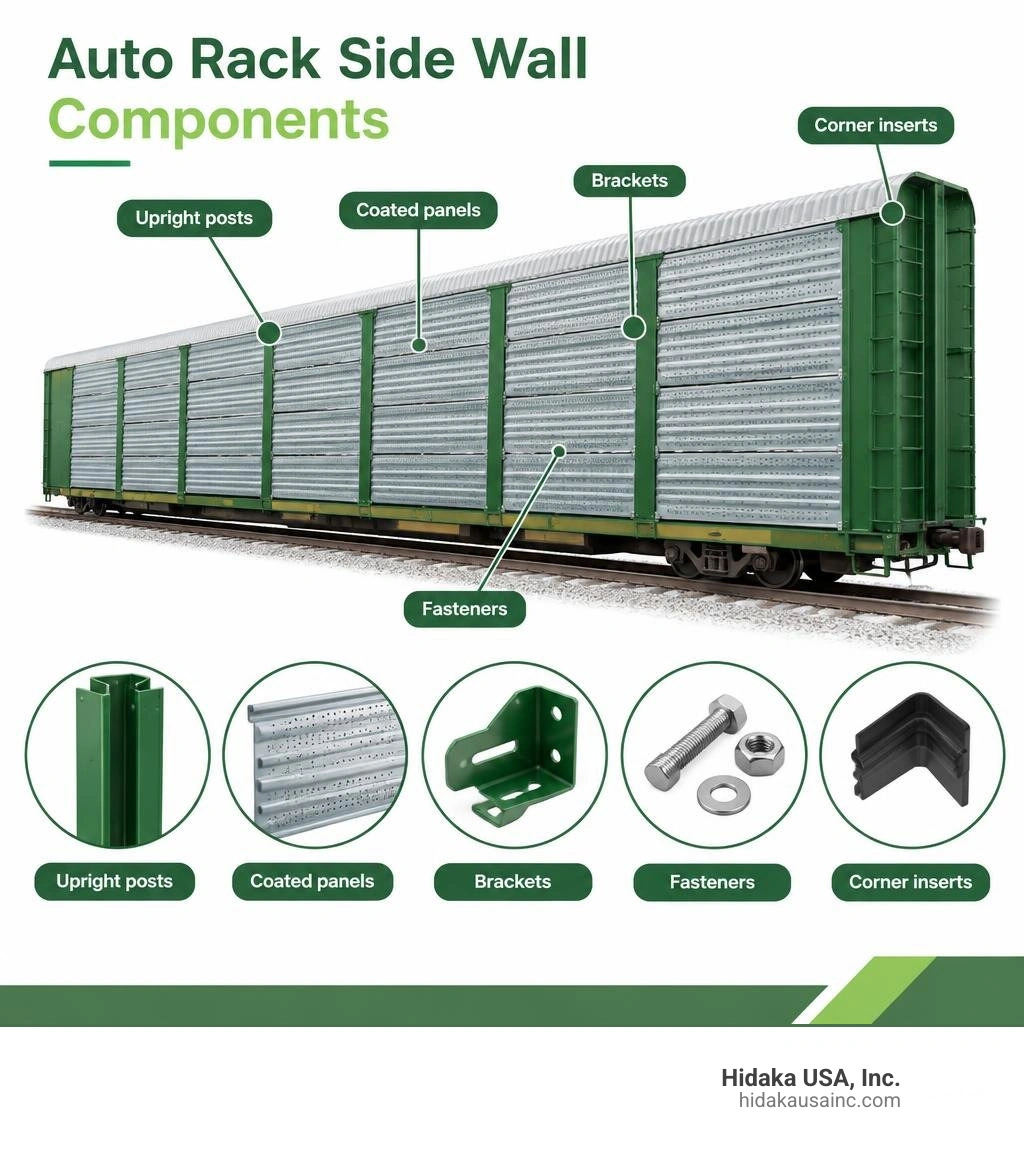
Railcar side panel fabrication definitions:
Structural Engineering Principles in Railcar Side Panel Fabrication

Auto rack railcars endure immense dynamic forces across thousands of miles of track. Side walls must serve a dual purpose: protect cargo from external hazards and contribute to the structural stability of the rack superstructure. Upright support posts form the primary skeleton of these side walls, often shaped using hat-section channels to maximize torsional rigidity while minimizing dead weight.
When a train moves over uneven tracks or rounds sharp curves, the entire railcar undergoes structural flex and harmonic oscillation. The side panels mounted along the side sills must endure these distributed loads without buckling or shearing their mounting hardware. Through robust precision railcar stamping, engineers create panels with uniform dimensional tolerances that distribute these dynamic loads evenly across all upright support posts. This load distribution is essential because a single post carrying more than its designed share can initiate a progressive failure that spreads across the entire side wall.
Precision Tooling and Forming in Railcar Side Panel Fabrication
Fabricating side panels requires specialized metal forming equipment capable of working with large sheet metal stock. Modern facilities combine hydraulic pressing, matched-die stamping, and multi-axis laser cutting to achieve repeatable precision across high-volume production runs. The goal is not simply to cut and form steel, but to produce panels that maintain their designed geometry after forming, coating, and installation.
We rely heavily on sheet metal fabrication techniques that create specific corrugation profiles and functional perforations. Perforated sheet metal designs allow cross-ventilation—reducing aerodynamic drag while preventing exhaust fumes from accumulating during loading operations—without sacrificing sheer strength or rigidity. Corrugation depth, spacing, and profile angle all influence how a panel resists buckling under compressive rail loads, so tooling must be designed and maintained to hold those dimensions consistently across every production run.
Fastening Systems and Upright Post Integration
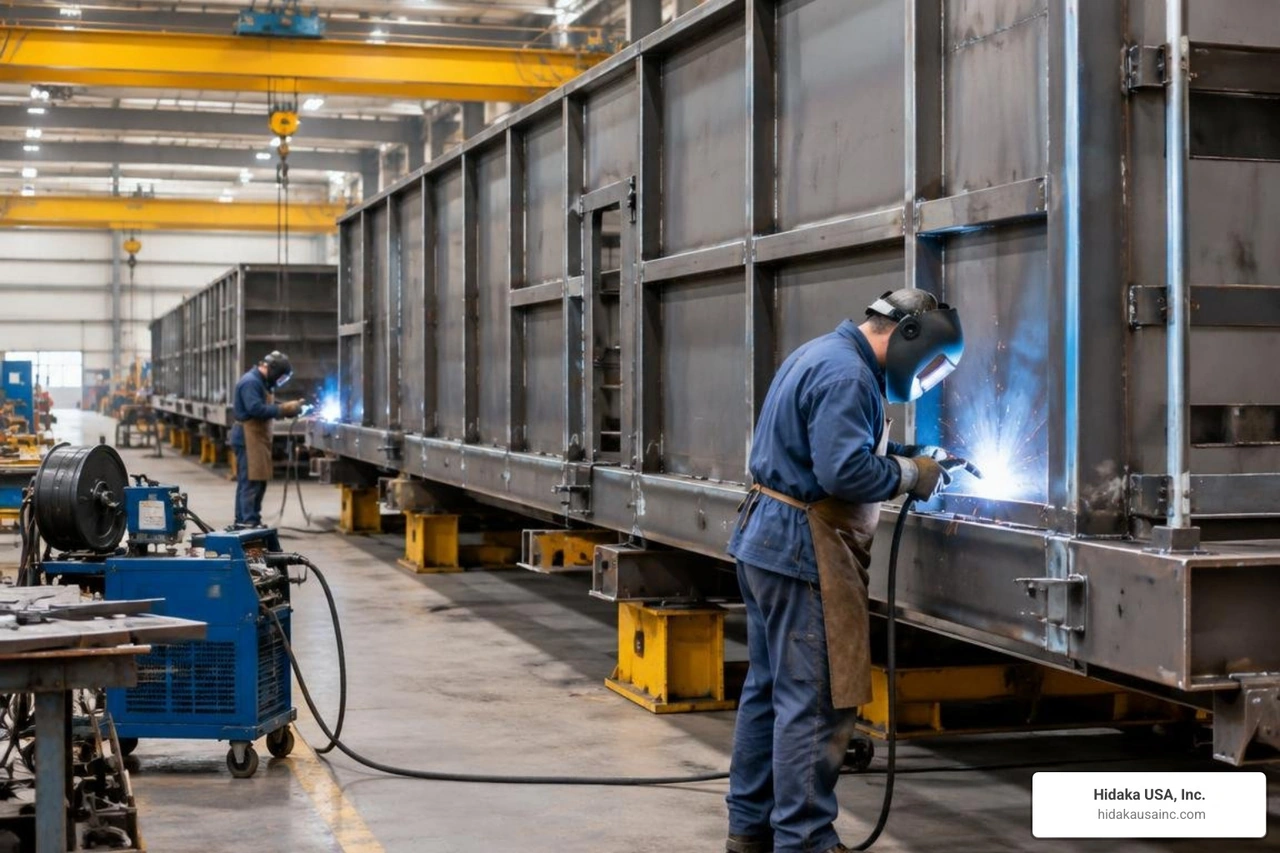
Securing side panels to vertical posts requires careful hardware selection. Fabricators utilize heavy-gauge U-shaped brackets, securing plates, and structural fasteners engineered to withstand cyclic shock loads. Joining these elements reliably demands certified structural welding alongside mechanical fastening. Each connection point must accommodate the small movements that occur during rail travel without loosening or transferring excessive stress to the panel itself.
Our facility delivers high precision metal assemblies through calibrated fixturing, while high volume welding assembly processes ensure that every bracket matches exact geometric tolerances before leaving the production line. By controlling fixture dimensions and weld placement, we reduce the variation that can cause uneven load distribution and premature wear in the field.
Mitigating Vibration, Mechanical Wear, and Structural Friction
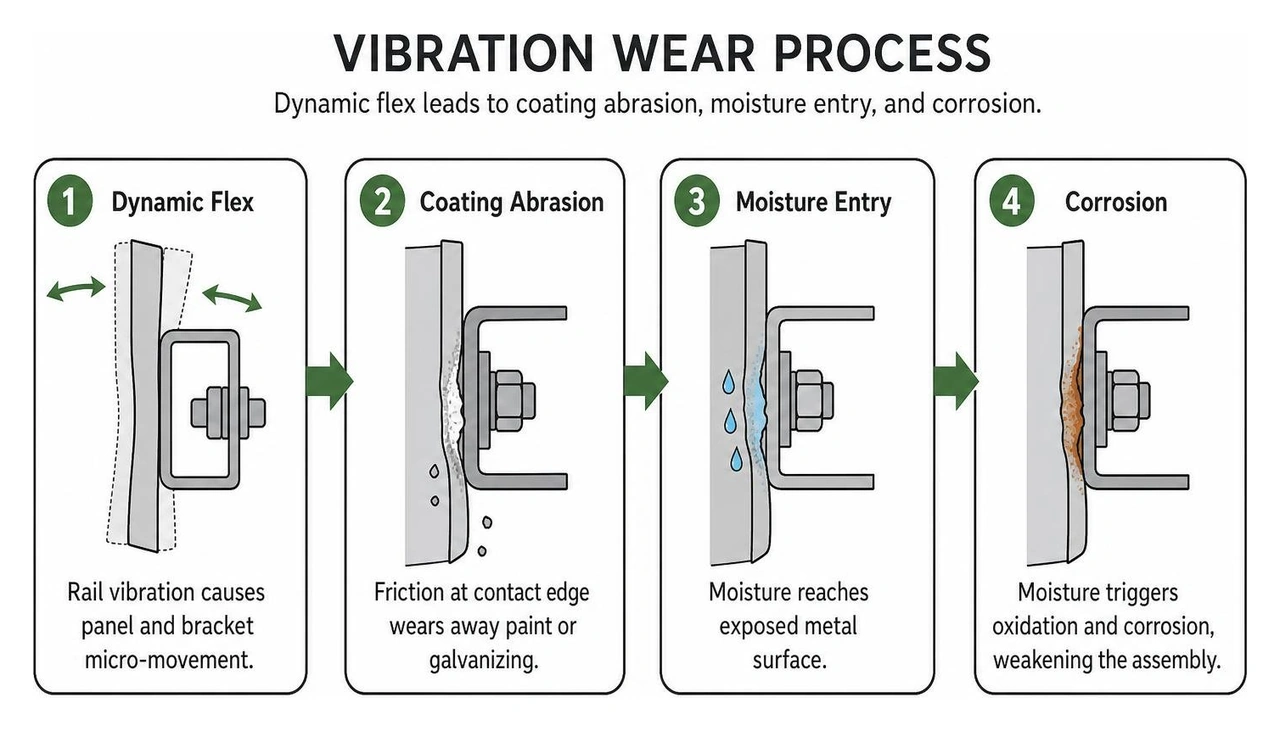
A persistent challenge in auto rack maintenance is friction at the interface where panels meet mounting brackets. As the railcar vibrates and twists along the track, metal-to-metal contact between the side panel edges and the steel retainer brackets wears away protective galvanizing or paint. Once the bare metal is exposed, moisture triggers rapid oxidation, producing dark rust streaks that degrade the structural integrity and appearance of the car. Over time, this corrosion can extend beyond the visible surface and compromise the panel edge thickness, reducing the panel's ability to carry its share of the structural load.
Innovative fastening solutions, such as those documented in Patent documentation on auto rack side panel assemblies, focus on separating these contact surfaces to stop friction-induced corrosion before it starts. The principle is straightforward: if the panel and bracket never touch directly, they cannot abrade each other.
Plastic Corner Inserts and Self-Lubricating Envelopes
To prevent metal-to-metal fretting, modern railcar assemblies incorporate plastic corner inserts. These protective envelopes wrap around the corners of the side panels, acting as a durable physical barrier between the panel and the mounting bracket pocket. The insert absorbs the relative motion that would otherwise scrub the protective coating from the panel edge.
Fabricated from resilient polymers like nylon or elastomeric compounds, these inserts provide a self-lubricating surface that absorbs micro-movements caused by rail vibration. Design features include:
- Integrated snap-over nibs that latch firmly over panel flanges during assembly to prevent displacement.
- Dedicated drainage slots that allow trapped rainwater and condensation to escape freely rather than pooling against the metal.
- Flexible polymer walls based on advanced polymer material engineering to cushion thermal expansion and dynamic rail movement.
Comparative Analysis of Corner Envelope Embodiments
Engineers have developed multiple iterations of corner envelopes to improve assembly speed and wear life. Early designs used simple flat shims that could shift out of position under severe vibration. Modern embodiments utilize full three-dimensional wrap-around geometries that remain seated even when the panel flexes or the bracket pocket experiences dimensional variation.
The primary design features an extended outer lip that snaps directly over the panel flange, seating tightly into the bracket pocket to accommodate minor panel warping. A secondary embodiment incorporates reinforced, multi-slotted bases designed specifically for retrofit programs, allowing maintenance crews to snap new protective envelopes onto existing fleets without disassembling the primary support framing. Both approaches reduce the maintenance burden by extending the interval between panel coating repairs.
Interior Illumination, Corrosion Control, and Rail Fleet Compliance
Inside bi-level and tri-level auto racks, lighting is a serious operational and safety concern. Rail crews must maneuver automobiles into tight multi-tiered decks with mere inches of clearance. Perforated, galvanized, or white-coated side panels serve as natural light reflectors, bouncing ambient daylight throughout the car interior to provide adequate illumination for applying tie-down straps and wheel chocks. Without that reflected light, crews would depend almost entirely on portable lighting, which slows loading operations and increases the chance of missed damage or improper restraint.
When rust forms at panel corners and spreads across the interior faces, it absorbs light and dramatically darkens the loading decks. Low visibility increases the risk of vehicle damage and worker injury during loading and unloading. The problem compounds over time because darker interiors make it harder to spot early corrosion, allowing it to spread before maintenance crews intervene.
Surface Treatment and Coating in Railcar Side Panel Fabrication
Protecting side panels against harsh environmental exposure involves heavy-duty surface treatment systems. Fabricators utilize hot-dip galvanizing, continuous zinc coatings, or specialized high-reflectivity white powder coats to seal the underlying sheet steel. Each system has trade-offs in cost, durability, and reflectivity, but all share the same goal: keep moisture and oxygen away from the base metal.
During railcar fabrication stamping, cutting and punching must be performed cleanly to avoid micro-burrs that could breach protective coatings and cause localized oxidation sites. Even a small burr can create a stress concentration in the coating, allowing moisture to reach the steel beneath and start a corrosion cell that spreads under the coating.
Industry Rack Certification Standards and Maintenance Programs
Major automotive manufacturers impose rigorous quality standards on railroad carriers to protect new vehicles from transit damage. Under industry rack certification programs, auto rack cars must maintain strict interior cleanliness and illumination standards. These programs typically include periodic inspections that evaluate panel condition, coating integrity, and interior light levels.
Railcars showing extensive rust discoloration fail certification and must undergo costly blast-cleaning and repainting. By incorporating robust anti-abrasion inserts and precision-formed components during initial fabrication, fleet owners extend repainting intervals and lower lifetime maintenance overhead. The savings accumulate across an entire fleet, where every avoided repaint cycle represents significant labor and material cost.
Advanced Manufacturing, Prototyping, and Production Logistics
Producing railcar components efficiently requires seamless factory logistics. In modern automotive manufacturing hubs, stamped panels and subassemblies travel in dedicated, reusable transport racks directly to point-of-use unloading docks. Many automotive plants use captive rail boxcars to transfer parts seamlessly from stamping lines to the final assembly plant floor. This approach reduces handling damage and keeps production lines supplied without maintaining large on-site inventories.
Meeting the high-capacity needs of transit networks requires scalable production infrastructure, including custom high volume stamping and dedicated regional hubs like high volume stamping ohio facilities. A well-planned production line balances press capacity, material flow, and quality inspection so that output remains consistent even as order volumes fluctuate.
Prototype Validation and Tooling Development
Before committing to mass production runs, fabricators validate structural concepts through rigorous prototype analysis. We offer specialized railcar prototype manufacturing services utilizing 3D laser cutting, soft tooling, and finite element modeling to verify load paths and vibration resilience. Prototype testing reveals problems that are far less expensive to correct before hard tooling is cut.
Using precision sheet metal prototyping, engineers test corner insert tolerances, bracket engagement, and corrugation rigidity under simulated rail conditions, ensuring flaw-free production tooling. This validation phase also establishes the dimensional reference data used to set quality control limits for full production runs.
Frequently Asked Questions About Structural Railcar Fabrication
How do plastic corner inserts prevent corrosion on auto rack side panels?
Plastic corner inserts provide dielectric and physical isolation between the steel panel edges and the upright mounting brackets. By preventing metal-to-metal rubbing during train travel, the inserts protect the galvanized or painted coating from abrasion, eliminating the bare-metal exposure that causes rust. The polymer material also dampens vibration at the contact point, reducing the energy that would otherwise drive fretting wear.
Why is interior panel reflectivity critical in bi-level and tri-level auto racks?
High-reflectivity panels bounce ambient light throughout multi-level railcars, providing operators with clear visibility to drive vehicles onto decks safely and secure tie-down systems without relying entirely on external artificial lighting. Brighter interiors also help crews spot loose restraints, fluid leaks, or panel damage before the railcar returns to service.
How does continuous rail vibration cause premature side panel failure?
Dynamic track vibrations cause structural twisting across the car's superstructure. If panels are rigidly bolted without wear mitigation, constant micro-fretting strips protective coatings, weakens fasteners, and creates crevice corrosion at bracket connection points. Over thousands of miles, this progressive damage can require panel replacement or extensive repair work that takes the railcar out of revenue service.
Conclusion
Building reliable railcar side panels demands a balance of robust structural design, precise sheet metal forming, and smart friction mitigation. Every design decision—from corrugation profile to corner insert geometry—affects how the panel performs over decades of rail service. Hidaka USA Inc. brings over three decades of engineering expertise, ISO 9001 quality management, and American Welding Society (AWS) certified craftsmanship to every project. From initial prototype engineering to high-volume manufacturing, discover how our team delivers dependable rail components by exploring Hidaka USA Mass Production Capabilities.