How to Master Quality Control ISO Standards Today

What Are Quality Control ISO Standards?
Quality control ISO standards are documents published by the International Organization for Standardization (ISO) that define requirements, guidelines, and best practices to ensure products, services, and processes consistently meet quality and performance criteria.
Here is a quick overview of the most important ISO quality standards:
| Standard | Focus Area | Key Benefit |
|---|---|---|
| ISO 9001:2015 | Quality Management Systems | Consistent product/service quality |
| ISO 14001:2015 | Environmental Management | Reduced environmental impact |
| ISO 19011:2018 | Auditing Management Systems | Effective internal and external audits |
| ISO 45001 | Occupational Health & Safety | Safer workplaces |
| ISO 50001 | Energy Management | Improved energy efficiency |
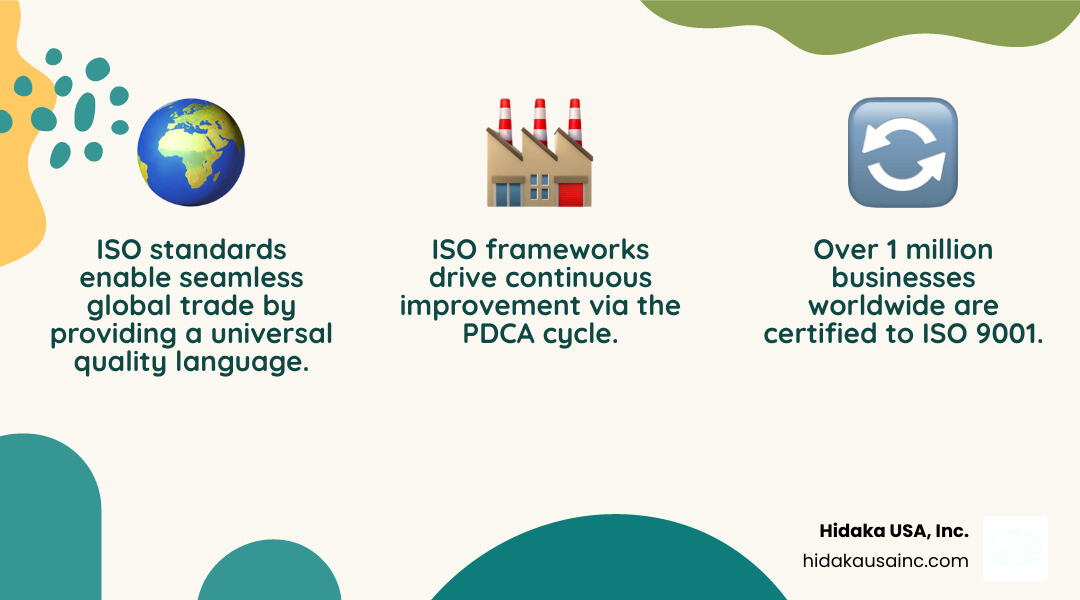
More than one million businesses worldwide are certified to ISO 9001 alone. These standards help organizations:
- Meet customer and regulatory requirements
- Reduce errors, waste, and production costs
- Build trust with stakeholders and global trade partners
- Drive continuous improvement across all operations
For automotive manufacturers especially, ISO standards are not just a formality. They are a foundation for delivering precise, reliable parts on time, every time.
I'm Yoshihiro Hidaka, founder of Hidaka USA, Inc., with over three decades of experience in sheet metal fabrication and automotive supply, where quality control ISO standards have been central to how we operate and serve our customers. In the sections below, we'll break down exactly how these standards work and how your organization can put them to use.
The Global Impact of Quality Control ISO Standards
The International Organization for Standardization, based in Geneva, serves as the world’s largest developer of voluntary international standards. But why does a set of documents from Switzerland matter to a manufacturing shop in Dublin, Ohio? The answer lies in the "universal language" of quality.
In the global economy, quality control ISO standards provide a shared vision and vocabulary. When we say a part is "high quality," that could mean anything without a standard. ISO standards translate that vague idea into specific requirements and specifications. This allows products to cross borders seamlessly; a component manufactured in Ohio can be perfectly compatible with an assembly line in another country because both adhere to the same ISO framework.
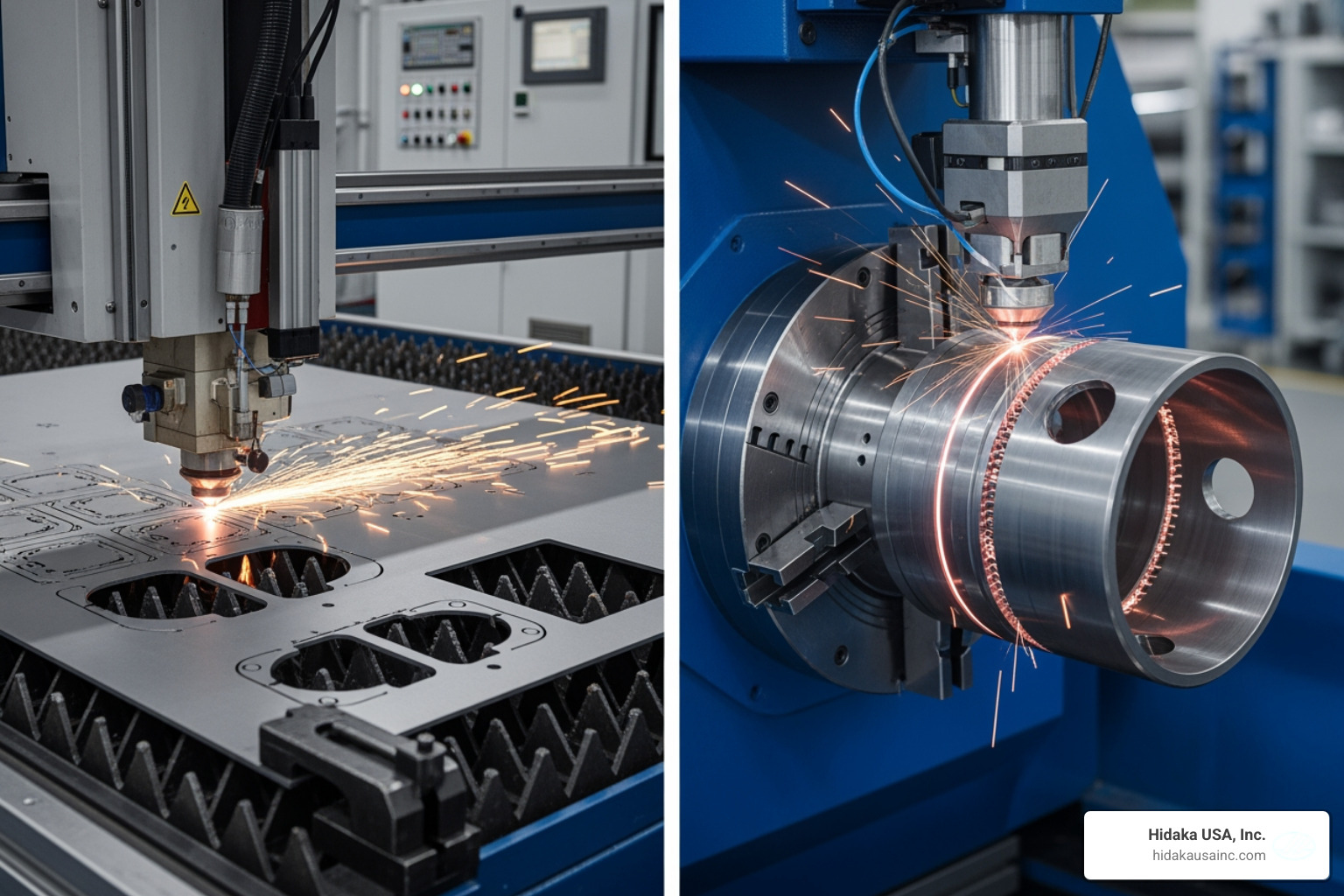
Beyond trade, these standards are vital for consumer protection. They ensure that materials and products are fit for their purpose and, most importantly, safe. For us at Hidaka USA, Inc., following these standards means we aren't just guessing if a weld is strong enough or if a laser-cut edge is precise; we are following Quality management principles that have been vetted by experts worldwide.
Furthermore, ISO standards support regulatory compliance. Many industries—especially automotive and mass-transit—have strict safety requirements. By implementing these standards, organizations can prove to regulators and stakeholders that they have controlled processes in place to mitigate risks and prevent failures before they happen.
The Framework of ISO 9001 and Quality Management Systems
When people talk about "ISO," they are usually referring to the ISO 9000 family. This is a set of five quality management system standards, with ISO 9001 being the most famous because it is the only one in the family that organizations can be certified against.
To master these standards, we first have to understand the difference between Quality Control (QC), Quality Assurance (QA), and a Quality Management System (QMS). While people often use these terms interchangeably, they represent different layers of a "quality sandwich."
| Term | Definition | Focus |
|---|---|---|
| Quality Control (QC) | The technical activities used to fulfill requirements for quality. | Product-oriented: Finding defects in the actual parts. |
| Quality Assurance (QA) | The planned and systematic activities implemented to provide confidence that requirements will be fulfilled. | Process-oriented: Preventing defects by managing how parts are made. |
| Quality Management System (QMS) | The overarching framework of policies, processes, and procedures used to achieve quality objectives. | System-oriented: The "big picture" including leadership and resources. |
The modern framework, specifically ISO 9001:2015, moved away from just "checking boxes" and introduced risk-based thinking. This means we don't just wait for a machine to break or a part to fail. Instead, we look at our entire system to identify factors that could cause our processes to deviate from planned results. We put preventive controls in place to minimize negative effects and maximize the opportunities that come our way.
Implementing Quality Control ISO Standards via PDCA
The "engine" that drives any ISO-compliant system is the Plan-Do-Check-Act (PDCA) cycle. It’s a simple but powerful tool for continuous improvement.
- Plan: We establish the objectives of the system and the processes necessary to deliver results. This involves understanding the "organizational context"—basically, what internal and external issues affect our ability to reach our goals.
- Do: We implement what was planned. This is where the actual manufacturing, welding, and laser cutting happen.
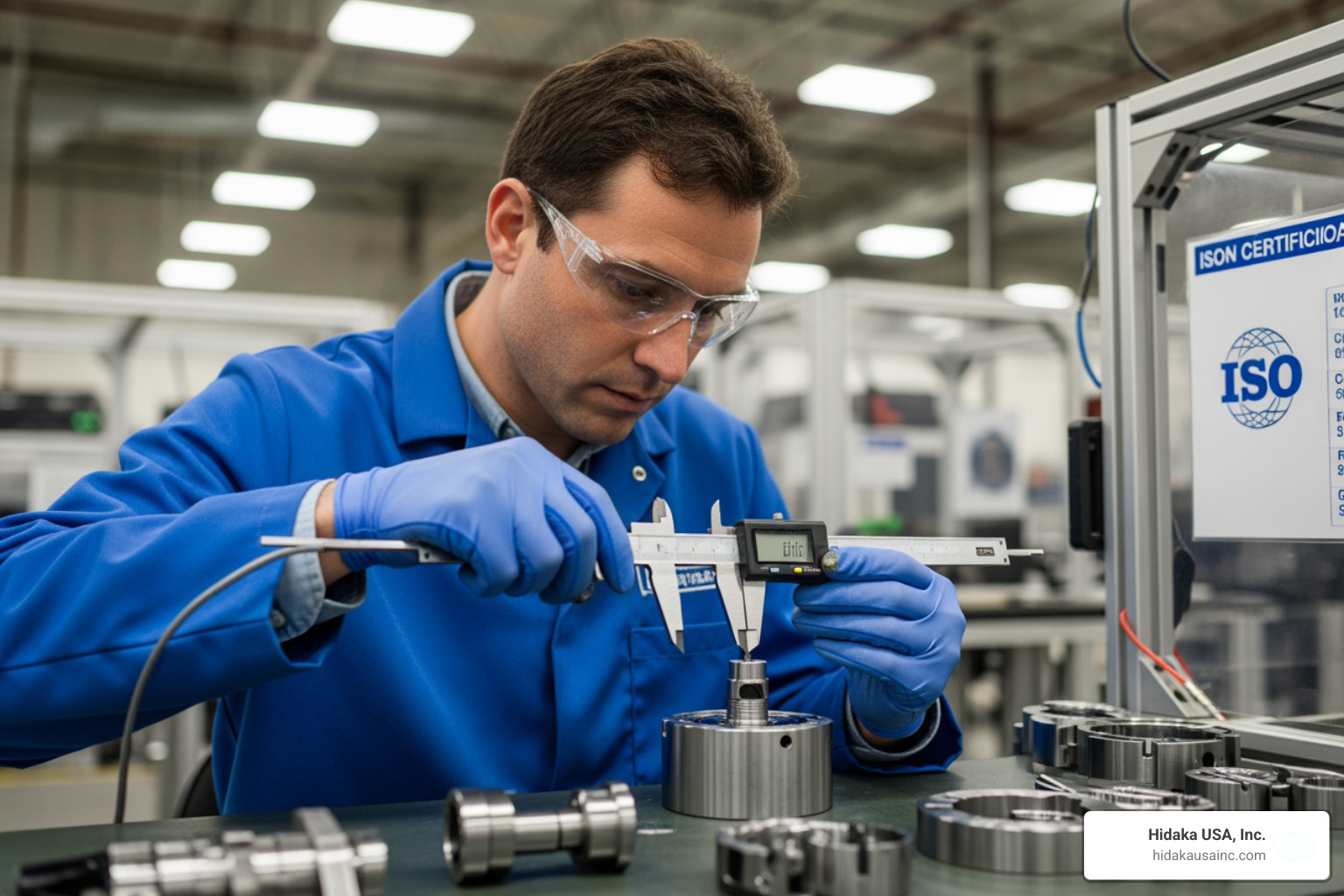
- Check: We monitor and measure processes and the resulting products against policies and requirements. This is where we use our advanced engineering analysis and precision measurement tools.
- Act: We take actions to continually improve performance. If something went wrong, we find the root cause and fix it so it doesn't happen again.
A key part of this implementation is "documented information." In older versions of ISO, you needed a massive "Quality Manual." Today, the standard is more flexible, focusing on ensuring you have the right information available to support your processes, whether that's digital files or Training videos on quality standards.
Benefits of Quality Control ISO Standards for Businesses
Implementing these standards isn't just about getting a certificate to hang on the wall. The real-world benefits are tangible and impact the bottom line:
- Reduced Waste and Lower Costs: By standardizing processes, we minimize errors and recalls. In manufacturing, "scrap" is a dirty word. ISO standards help us get it right the first time.
- Customer Satisfaction: When you consistently meet customer requirements, they trust you. This leads to repeat business and a stronger reputation.
- Operational Efficiency: Standards reduce redundancy. Everyone knows their role and the procedures they need to follow, which speeds up the time to market.
- Competitive Advantage: Many OEMs (Original Equipment Manufacturers) will only do business with suppliers who are ISO 9001 certified. It serves as an independent validation of your competence.
With over one million certified businesses globally, adhering to ISO 9001:2015 Requirements has become the "entry fee" for participating in high-level industrial supply chains.
Key ISO Standards for Modern Organizations
While ISO 9001 is the foundation, it doesn't exist in a vacuum. Modern organizations often integrate multiple standards to create a holistic management system.
- ISO 14001 (Environmental Management): This helps organizations reduce their environmental footprint. In Ohio, where we value our natural resources, this standard is increasingly important for sustainable manufacturing.
- ISO 19011 (Auditing): This provides guidelines for auditing management systems. It’s the "how-to" guide for making sure your internal audits actually provide value.
- ISO 45001 (Health and Safety): This focuses on creating a safer workplace, which is a top priority in any facility involving heavy machinery and welding.
- ISO 50001 (Energy Management): This integrates energy efficiency into the QMS, helping companies reduce energy costs and greenhouse gas emissions.
Organizations like the American Society for Quality (ASQ) play a massive role here. ASQ administers the U.S. Technical Advisory Groups (TAGs) that help develop these international standards. Choosing standards from ASQ ensures you are getting the most current, expert-backed information available in the United States.
Structure of ISO 9001:2015 Clauses
The 2015 version of the standard follows a "High-Level Structure" (HLS) that makes it easier to integrate with other standards. The core requirements are found in Clauses 4 through 10:
- Clause 4: Context of the Organization: Understanding what your company does, who your stakeholders are, and what the scope of your QMS is.
- Clause 5: Leadership: Top management must demonstrate commitment. Quality isn't just the "quality department's" job; it starts at the top.
- Clause 6: Planning: Addressing risks and opportunities and setting measurable quality objectives.
- Clause 7: Support: Managing resources, including people, infrastructure, and "organizational knowledge" (preventing knowledge loss when employees retire).
- Clause 8: Operation: The "meat" of the standard—planning and controlling the actual production of goods or services.
- Clause 9: Performance Evaluation: Monitoring, measurement, analysis, and internal audits.
- Clause 10: Improvement: Taking corrective actions and driving continual improvement.
Achieving and Maintaining ISO Certification
Achieving certification is a journey, not a destination. It typically involves several key steps:
- Gap Analysis: We compare our current processes against the ISO requirements to see what's missing.
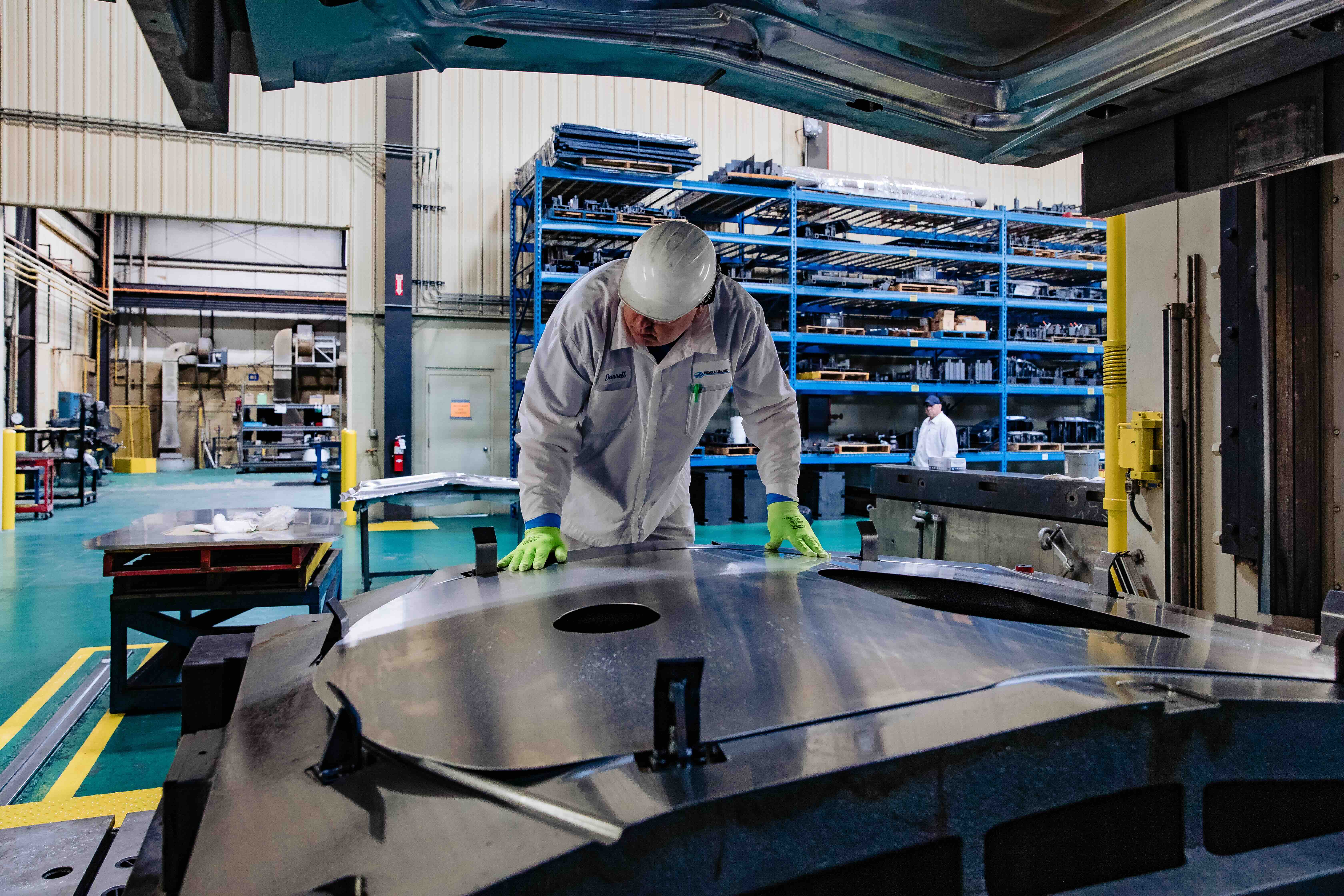
- System Development: We document our processes and train our team. At Hidaka USA, Inc., this involves ensuring our 2D/3D laser cutting and hydraulic pressing operations are fully aligned with our quality manual.
- Internal Audits: We perform our own "practice runs" to find non-conformities.
- External Audit: A third-party registrar (an independent certification body) comes in to verify that we are actually doing what we say we are doing.
- Certification: If we pass, we receive our certification.
It is important to note that ISO certification is voluntary. ISO itself does not certify organizations; this is done by external bodies. However, many customers make it a mandatory condition of doing business. Once certified, you enter a three-year cycle with annual "surveillance audits" to ensure you haven't let your standards slip.
Frequently Asked Questions about ISO Standards
Is ISO 9001 certification mandatory for all businesses?
No, it is not legally mandatory. However, in industries like automotive, aerospace, and medical devices, it is often a "de facto" requirement. Most major manufacturers will not even send a Request for Quote (RFQ) to a supplier that isn't ISO 9001 certified.
What are the latest updates to ISO 9001 and ISO 14001?
The current major versions are ISO 9001:2015 and ISO 14001:2015. These versions introduced the High-Level Structure, an increased emphasis on leadership, and the shift toward risk-based thinking. ISO standards are typically reviewed every five to ten years to ensure they remain relevant to modern business practices.
How does risk-based thinking differ from preventive action?
In previous versions of ISO 9001, "preventive action" was a separate clause. In the 2015 version, risk-based thinking is integrated throughout the entire standard. Instead of having a separate process for prevention, you are expected to consider risk in every process—from planning and leadership to operation and evaluation.
Conclusion
Mastering quality control ISO standards is about more than just compliance; it’s about a commitment to excellence. At Hidaka USA, Inc., we’ve seen how these standards transform a manufacturing facility. By following the ISO 9001 framework, we ensure that our prototyping and mass production services meet the highest possible benchmarks for the automotive and mass-transit industries.
From our 95,000-square-foot facility in Dublin, Ohio, we combine advanced technology like 3D laser cutting with the disciplined structure of ISO standards. This allows us to deliver American-made products that aren't just "good enough," but are precision-engineered to exceed expectations. Whether we are working on a complex assembly or a simple metal part, our strict quality control is what defines us.
If you are looking for a partner who understands the intricacies of quality management and has the certifications to prove it, we are here to help. Learn more about our manufacturing assets and capabilities to see how our commitment to ISO standards translates into better results for your next project.