Rapid Prototyping Services That Bring Ideas to Life

How Prototyping Services Turn CAD Designs Into Testable Parts
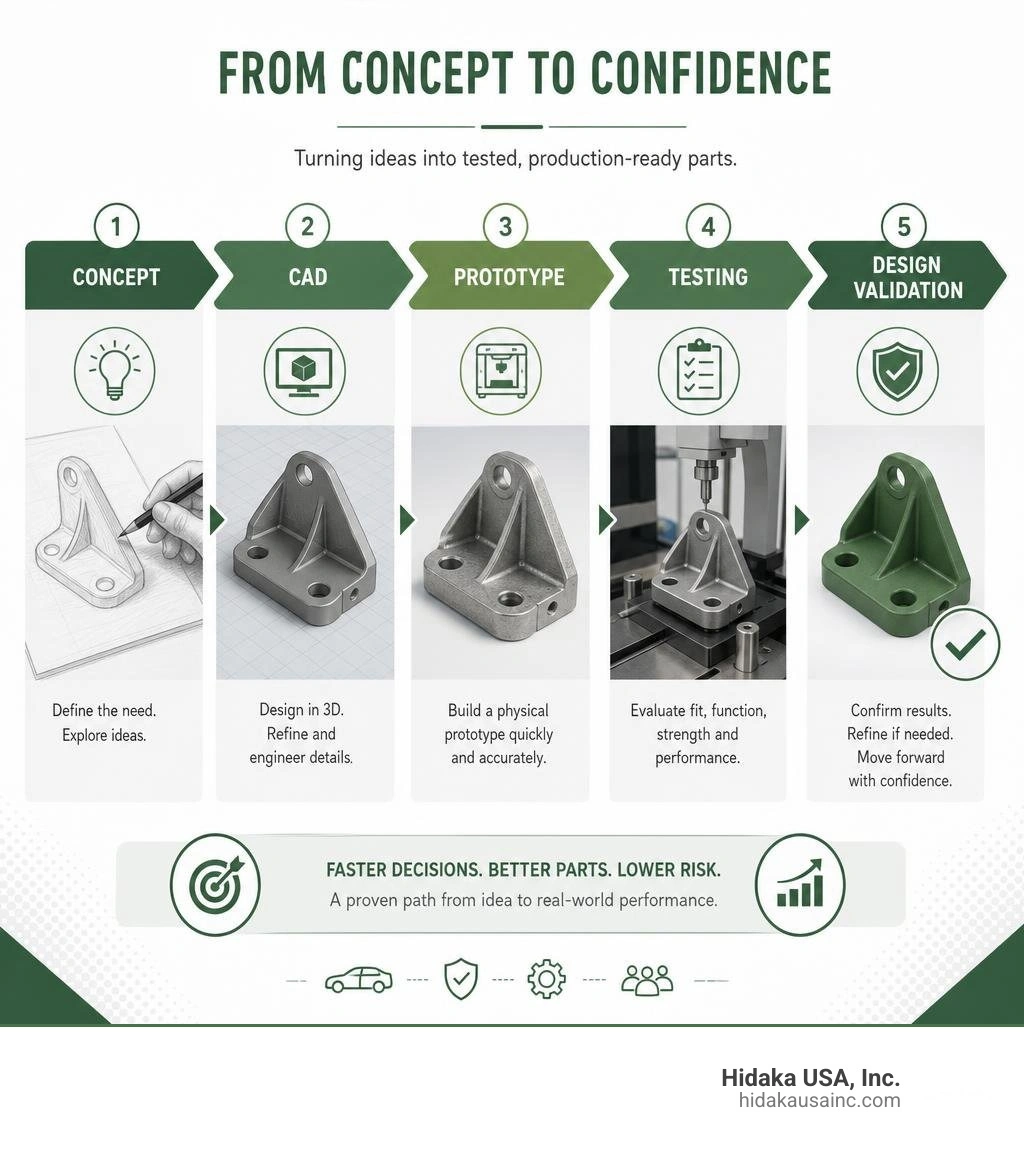
Prototyping services convert a digital design into a physical part so teams can check its form, fit, function, and manufacturability before full production. For an automotive manufacturer, the practical approach is to share a 3D CAD model and drawing, select a process that matches the part's material and accuracy needs, then test the prototype and revise the design before committing to production tooling.
Rapid prototyping uses digital manufacturing methods such as 3D printing, CNC machining, laser cutting, and sheet metal forming to shorten this cycle. Unlike traditional manufacturing, which may require dedicated tooling before parts can be made, prototyping can often produce a small number of parts directly from CAD data. This supports faster design changes, functional testing, assembly checks, and early quality validation.
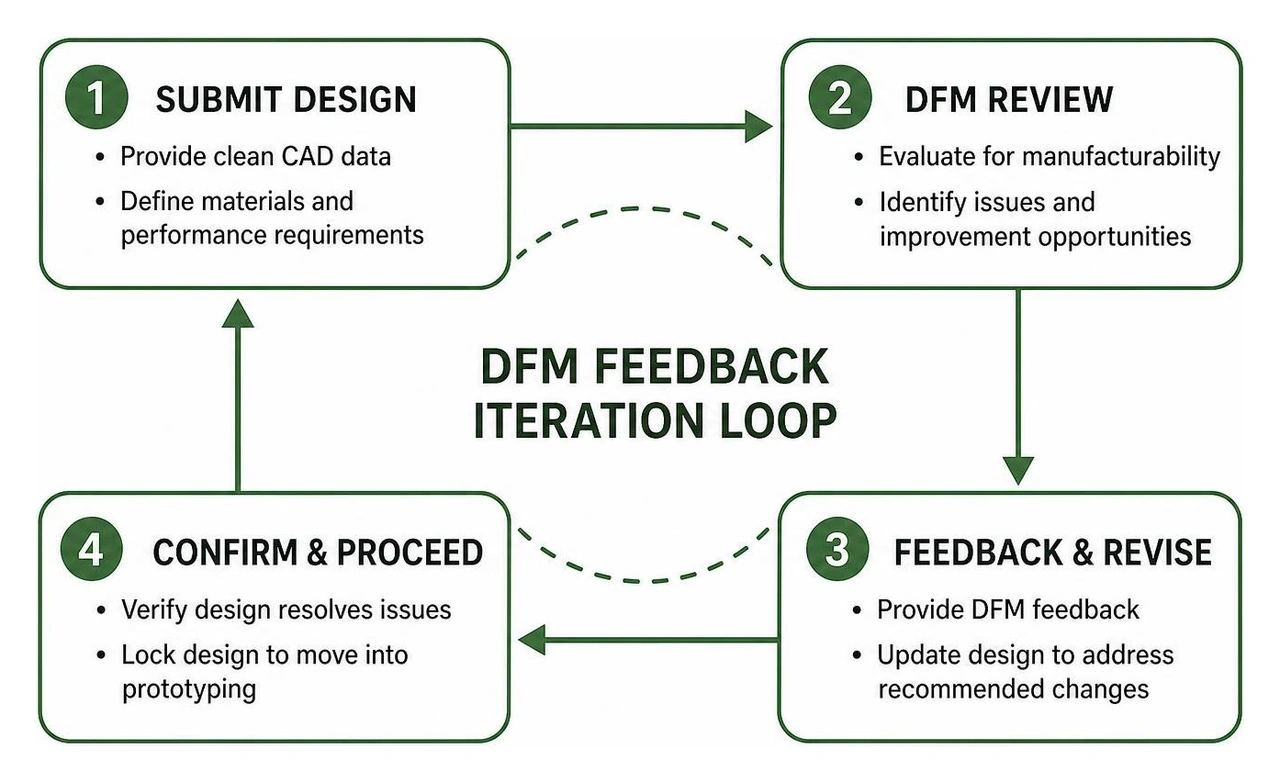
The right process depends on what the part must prove. A printed model may be useful for shape and packaging checks, while CNC machining or formed sheet metal may be better for tight tolerances, strength, and production-like material performance. Early Design for Manufacturability (DFM) review also helps identify concerns such as difficult bends, thin walls, tolerance stack-up, or features that could slow later production.
I am Yoshihiro Hidaka, founder of Hidaka USA, Inc. After beginning my career with a global automotive product supplier, I founded Hidaka USA in 1989 to provide Prototyping services and later expanded into prototype and mass-production parts for automotive and other industries.
Key terms for Prototyping services:
Comparing Prototyping Services and Fabrication Technologies
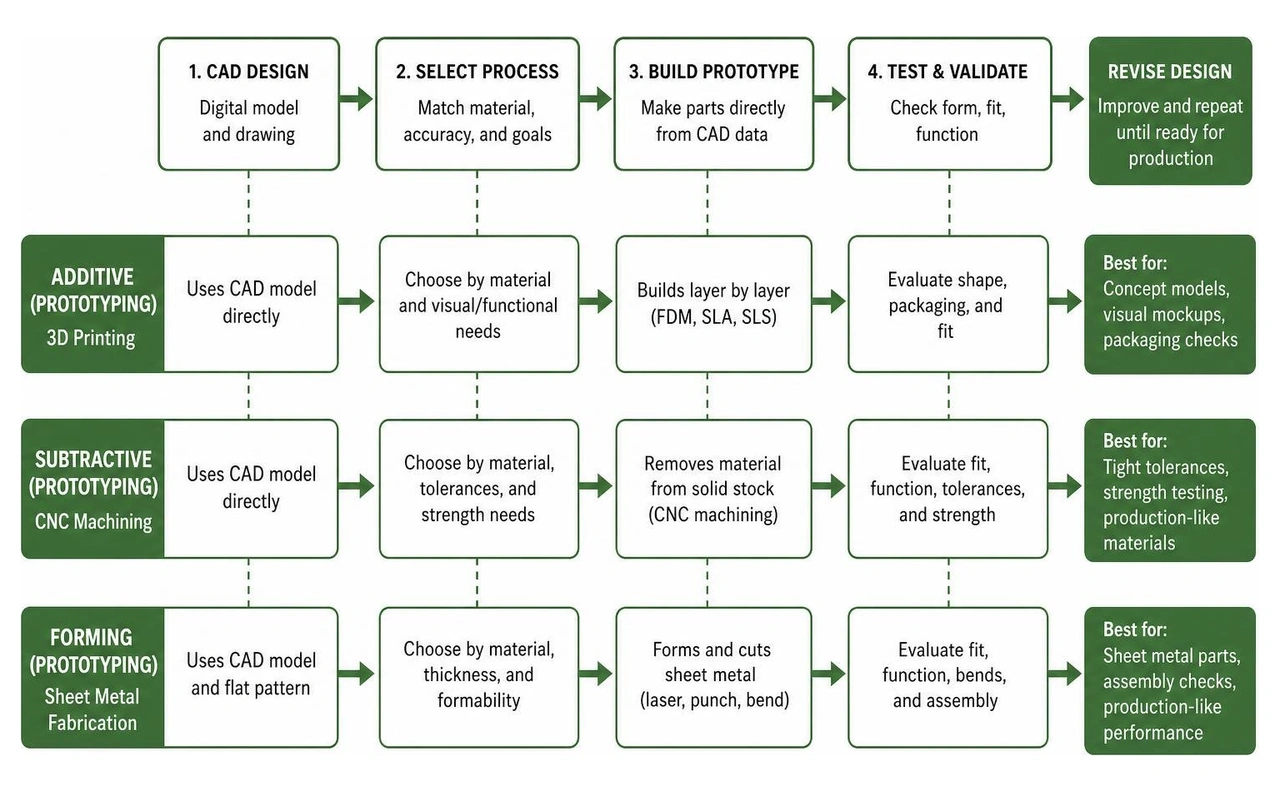
Selecting the best production method is all about balancing speed, mechanical performance, and project objectives. Exploring rapid prototyping advantages and disadvantages helps engineering teams decide when additive, subtractive, or forming methods fit best. Modern manufacturing allows us to bypass lengthy tooling development, but understanding the diverse rapid prototyping processes ensures your parts perform as expected during mechanical testing.
Additive Prototyping Services: 3D Printing Technologies
Additive manufacturing builds components layer by layer directly from digital geometry. Technologies like Fused Deposition Modeling (FDM), Stereolithography (SLA), and Selective Laser Sintering (SLS) offer remarkable design freedom. Utilizing rapid prototyping additive manufacturing makes quick work of highly intricate internal channels or organic lattice shapes without specialized cutting tools.
While additive systems excel at visual mockups and packaging trials, build volume limits and anisotropic mechanical properties require careful consideration when planning dynamic load tests.
Subtractive and Metal Prototyping Services

When functional parts require structural integrity and tight dimensional accuracy, subtractive methods take center stage. High-precision CNC milling and turning carve parts out of solid billet blocks, matching end-use production metallurgy. In specialized prototype machining, parts can achieve tolerances as tight as ±0.01 mm.
Implementing rapid prototyping CNC machining provides true isotropic strength, making it ideal for engine mounts, suspension knuckles, and mission-critical brackets. For components exposed to high stress, rapid metal prototyping through multi-axis milling ensures that real-world stress testing yields actionable data.
Sheet Metal Forming and Stamping Capabilities
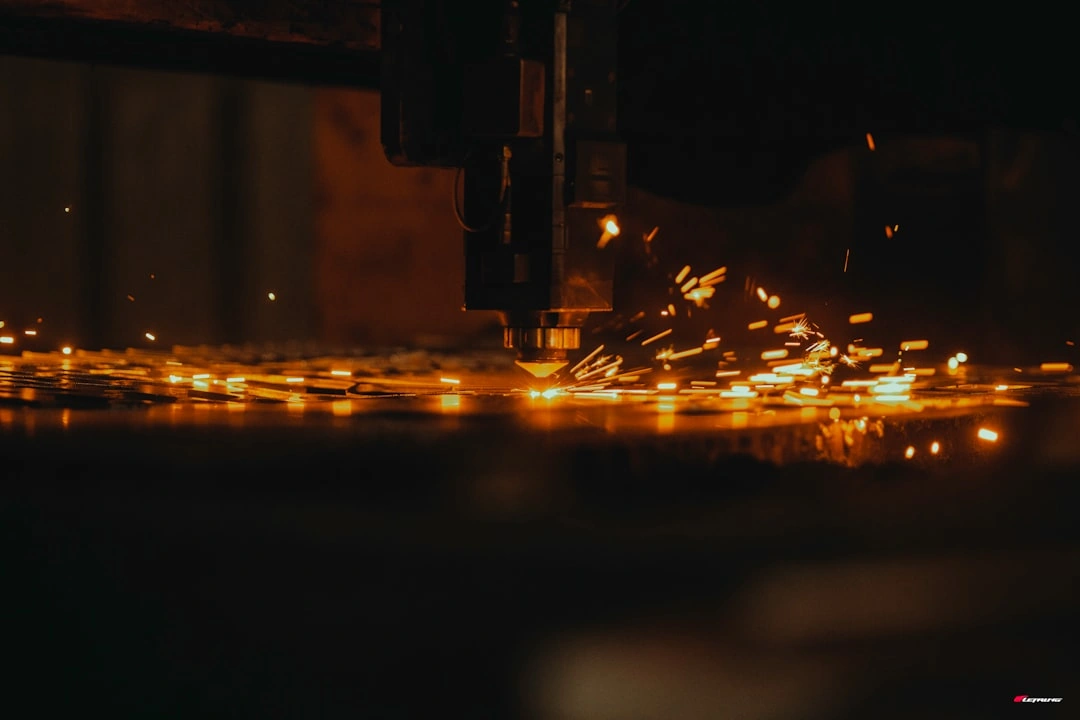
Enclosures, brackets, and structural frames frequently rely on prototype sheet metal fabrication. Using precision prototype laser cutting services, flat patterns are cut cleanly before moving to press brakes or specialized forming presses.
Our comprehensive prototype hydraulic press capabilities allow complex draw forming and progressive stampings to be tested early. Integrating 2D and 3D prototype laser cutting maintains high edge quality and precise hole positioning across tight bend radii.
Selecting Materials for Form, Fit, and Functional Prototypes
The success of any prototype hinges on choosing a material that mirrors the final application's operating environment. For mechanical assemblies, engineers must determine how to prototype metal parts alongside performance requirements like tensile strength, thermal expansion, and corrosion resistance.
Engineering Plastics and Resins
Polymer prototyping provides practical options for lightweight components and aesthetic mockups:
- ABS and Polycarbonate: Tough thermoplastics well-suited for impact-resistant housings and functional snap-fits.
- Nylon Blends (PA 11 / PA 12): Flexible, fatigue-resistant materials ideal for clips, ductwork, and structural enclosures.
- Photopolymer Resins: High-detail resins for SLA printing that replicate smooth injection-molded finishes for design reviews.
- ESD-Safe Formulations: Specialized polymers engineered with static dissipation properties to safeguard sensitive electronic packaging.
Production-Grade Metals and Alloys

For high-stress and high-heat environments, engineering-grade metals deliver proven reliability:
- Aluminum (6061, 5052, 7075): Exceptional strength-to-weight ratio, high machinability, and natural corrosion resistance.
- Stainless Steel (304, 316): Excellent weldability and sanitary performance for harsh, corrosive conditions.
- High-Strength and Advanced Steels: Crucial for impact structures and structural brackets.
Through precision sheet metal prototyping, these alloys undergo realistic stress evaluations, ensuring every bracket or chassis component holds up before full tooling fabrication.
Design for Manufacturability (DFM) and Project Preparation
A successful prototype starts well before metal is cut or resin is cured. Engaging early in custom prototype engineering solutions allows our engineers to perform Design for Manufacturability reviews that resolve manufacturing issues before they lead to shop-floor delays. Knowing how to start prototyping project discussions with clean CAD data streamlines every milestone.
Key DFM checkpoints include:
- Establishing uniform wall thicknesses to prevent warping in molded or printed parts.
- Applying generous internal corner radii to accommodate CNC end mills.
- Ensuring bend relief and minimal flange lengths on formed sheet metal parts.
- Standardizing hole sizes and thread depths to simplify tooling setups.
Optimizing Multi-Component Assemblies
Complex products rarely consist of a single component. Understanding how to prototype assemblies requires tracking tolerance stackup across mating parts. Combining stamped subcomponents into laser cut prototype assemblies using dedicated assembly fixtures guarantees precise fit-up and repeatable welding.
Surface Finishing and Secondary Operations
Post-processing transforms raw parts into production-ready test articles:
- Anodizing (Type II and Type III Hardcoat): Improves corrosion resistance and surface hardness on aluminum parts.
- Plating and Passivation: Protects steel components against environmental oxidation.
- Powder Coating and E-Coating: Delivers durable, uniform cosmetic color finishes.
- Bead Blasting and Tumbling: Eliminates tooling marks and produces smooth, uniform matte textures.
- Heat Treatment: Relieves residual stress and boosts yield strength in stamped metal parts.
Managing Prototyping Costs, Lead Times, and Intellectual Property
Smart project management balances design iteration against production timelines. Implementing proactive prototyping cost reduction strategies helps teams optimize part geometry to lower machining cycles. Finding practical ways on how to reduce prototype costs—such as loosening non-critical tolerances and using standard stock thicknesses—frees up resources for subsequent development phases.
Protecting proprietary designs is just as critical. We safeguard client files through mutual non-disclosure agreements (NDAs), encrypted file management, and strict in-house data governance.
Evaluating Partner Certifications and Quality Standards
A quality prototyping partner must prove dimensional accuracy using calibrated coordinate measuring machines (CMM) and formal quality frameworks. Standard certifications to look for include:
- ISO 9001: Confirms verified quality management across fabrication workflows.
- AS9100: Crucial for aerospace programs requiring complete material traceability.
- AWS (American Welding Society): Ensures structural welding integrity on load-bearing assemblies.
- ITAR Compliance: Mandates strict security protocols for defense-related hardware.
Knowing how to evaluate prototypes against documented inspection reports guarantees that your test data remains reliable.
Scaling from Low-Volume Bridge Tooling to Mass Production
Prototyping should smoothly transition toward volume manufacturing. When demand outpaces individual prototype runs but full-scale hard tooling remains months away, bridge tooling steps in. Producing pilot runs of 100 to 900 parts allows companies to conduct market pilots, assemble field-test units, and finalize assembly line automation without expensive delays.
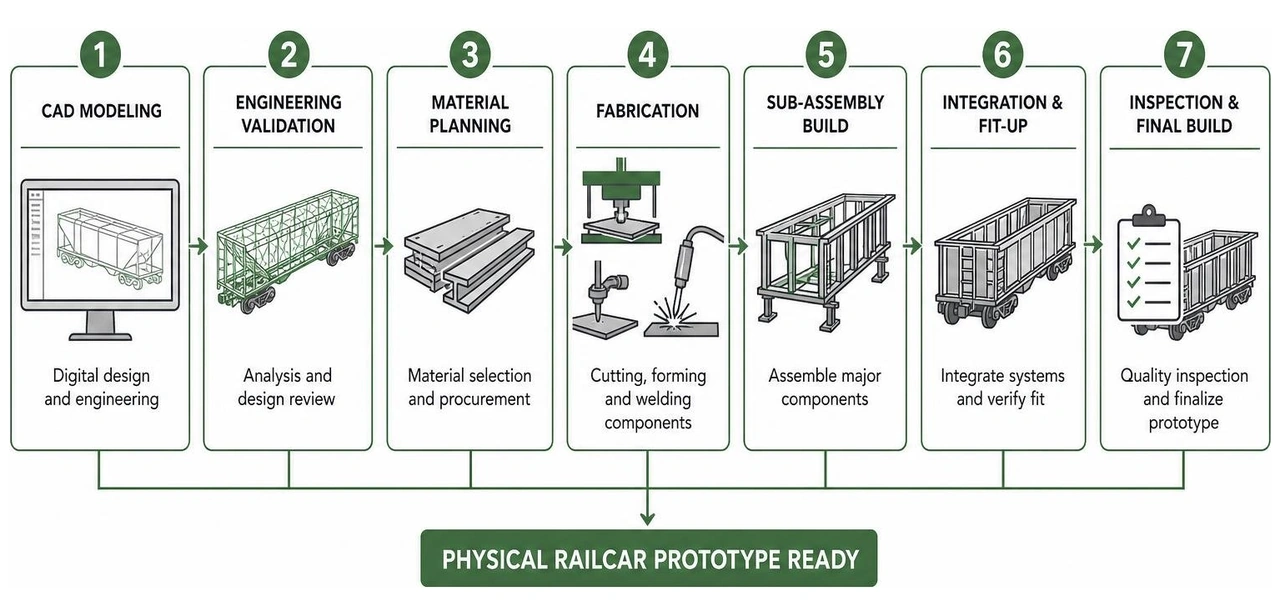
Planning your prototype production scale up early minimizes expensive tooling modifications later on. We apply proven automotive prototyping best practices and precision railcar prototype manufacturing services to help programs transition effortlessly from initial concept to high-volume stamping lines.
Whether serving emerging ventures through metal prototyping for startups or tier-one automotive programs via our prototype manufacturing Dublin Ohio facility, keeping prototyping and high-volume stamping under one roof shortens lead times and protects project momentum.
Frequently Asked Questions About Rapid Prototyping
How fast can custom prototypes be manufactured and delivered?
Lead times vary based on design complexity and process choice. Simple 3D printed components can be produced in as little as 24 hours, while precision CNC machined parts or laser-cut sheet metal brackets typically take 2 to 5 business days. Highly complex welded assemblies or parts requiring secondary plating and custom heat treatment may require additional processing time.
What CAD file formats are standard for starting a project?
The most versatile neutral 3D CAD formats are STEP (.step, .stp) and IGES (.igs) files, which preserve accurate solid geometry across all major software packages. For additive manufacturing, STL files are widely used. Pairing your 3D models with detailed 2D engineering drawings (PDF or DXF) ensures critical tolerances, thread specifications, and surface finish requirements are clearly understood.
Can rapid prototyping processes support low-volume bridge production?
Yes. Rapid tooling, modular soft tooling, and low-volume CNC or sheet metal production runs of 100 to 900 units commonly bridge the gap between initial development and mass manufacturing. This approach allows engineering teams to validate assembly lines, perform regulatory testing, and satisfy early market demand while long-lead production dies are being constructed.
Conclusion
Bringing complex industrial concepts to reality requires more than just machinery; it demands engineering expertise, responsive collaboration, and strict quality control. Since 1989, Hidaka USA, Inc. has served as a dedicated manufacturing partner from our 95,000-square-foot facility in Dublin, Ohio.
By combining 2D and 3D laser cutting, hydraulic stamping presses, multi-axis machining, and certified welding under one roof, we streamline your product development lifecycle. Whether you need an early functional prototype, low-volume bridge assemblies, or a seamless transition to high-volume stamping, our team is ready to assist.
Explore our comprehensive prototyping services and learn how we support your transition into mass production by visiting Hidaka USA, Inc. today.