A Practical Guide to Prototype Production Scale-Up

From Prototype to Reliable Production
A successful prototype production scale up turns a proven design into a repeatable manufacturing process. Start by confirming that the prototype works in real operating conditions, complete a Design for Manufacturability (DFM) review, validate materials and tolerances through pilot runs, and lock down process controls before committing to full-volume production.
The work is commonly part of New Product Introduction (NPI). It is not simply a matter of making more parts. A prototype may prove function, but production must also deliver consistent dimensions, reliable assembly, stable material supply, acceptable cycle times, and documented quality at every run.
For automotive manufacturers, this gap matters because a part that performs in a small prototype build can behave differently when stamping, forming, welding, coating, inspection, packaging, and logistics are repeated at production speed. Early validation helps prevent late tooling changes, line interruptions, and inconsistent parts.
I am Yoshihiro Hidaka, founder of Hidaka USA, Inc., with experience developing prototype and mass-production parts for automotive and other industries since founding the company in 1989. That experience informs this practical guide to prototype production scale up, from early engineering validation through dependable high-volume output.
Essential prototype production scale up terms:
The Engineering Bridge: Crossing the Prototype-to-Production Gap
Every physical product begins its life as an experimental draft. In initial stages, parts are fabricated via flexible methods like 3D printing, manual machining, or soft urethane casting. These early models prove that an idea works mechanically. However, when we transition those parts to serial output, the physics of manufacturing change dramatically.
Moving into volume introduces new variables: thermal heat buildup during extended stamping runs, natural batch-to-batch material shrinkage, tool wear, and cycle consistency shifts. While a prototype can be lovingly adjusted by an experienced machinist with a hand file, a high-speed production line does not pause to hand-finish out-of-spec brackets. Without deliberate engineering, subtle variations cause tolerance drift across thousands of parts, leading to assembly line stoppages and expensive scrap rates.

Bridging this gap requires transitioning from early rapid prototyping processes to standardized, repeatable fabrication workflows. We treat this transitional gap not as a roadblock, but as a valuable opportunity to refine tolerances, streamline assembly interfaces, and ensure full dimensional verification before high-tonnage presses start cycling.
Prototype Architecture vs Final Production Specifications
A common misstep in product development is assuming a working prototype represents a finished design. A proof-of-concept asks, "Can this work?" Production specifications ask, "Can we build 100,000 of these identically, within budget, while maintaining strict dimensional tolerances?"
Prototypes often use alternative materials, looser geometric tolerances, or manual surface finishing methods that are cost-prohibitive in mass manufacturing. When we help teams evaluate prototypes, we analyze long-term component longevity and verify that production-grade alloys will behave consistently under stamping, bending, and laser cutting.
Design for Manufacturability and Assembly Protocols
Design for Manufacturability (DFM) and Design for Assembly (DFA) are the foundations of successful scaling. DFM involves tailoring part geometries specifically to the constraints of high-volume tooling. In plastic injection molding, this means maintaining consistent nominal wall thicknesses (such as 1.0 to 3.5 mm for standard resins) to avoid sink marks and warpage, as well as applying proper draft angles for clean ejection.
In precision metal fabrication, DFM requires standardizing bend radii, adding relief notches, and optimizing hole-to-edge distances to avoid material tearing during press operations. Implementing these adjustments early delivers actionable prototyping cost reduction strategies by reducing cycle times and eliminating post-machining operations. Incorporating continuous design validation feedback loops ensures that engineering revisions happen on digital CAD models rather than on hardened steel tooling.
Strategic Planning for Prototype Production Scale Up
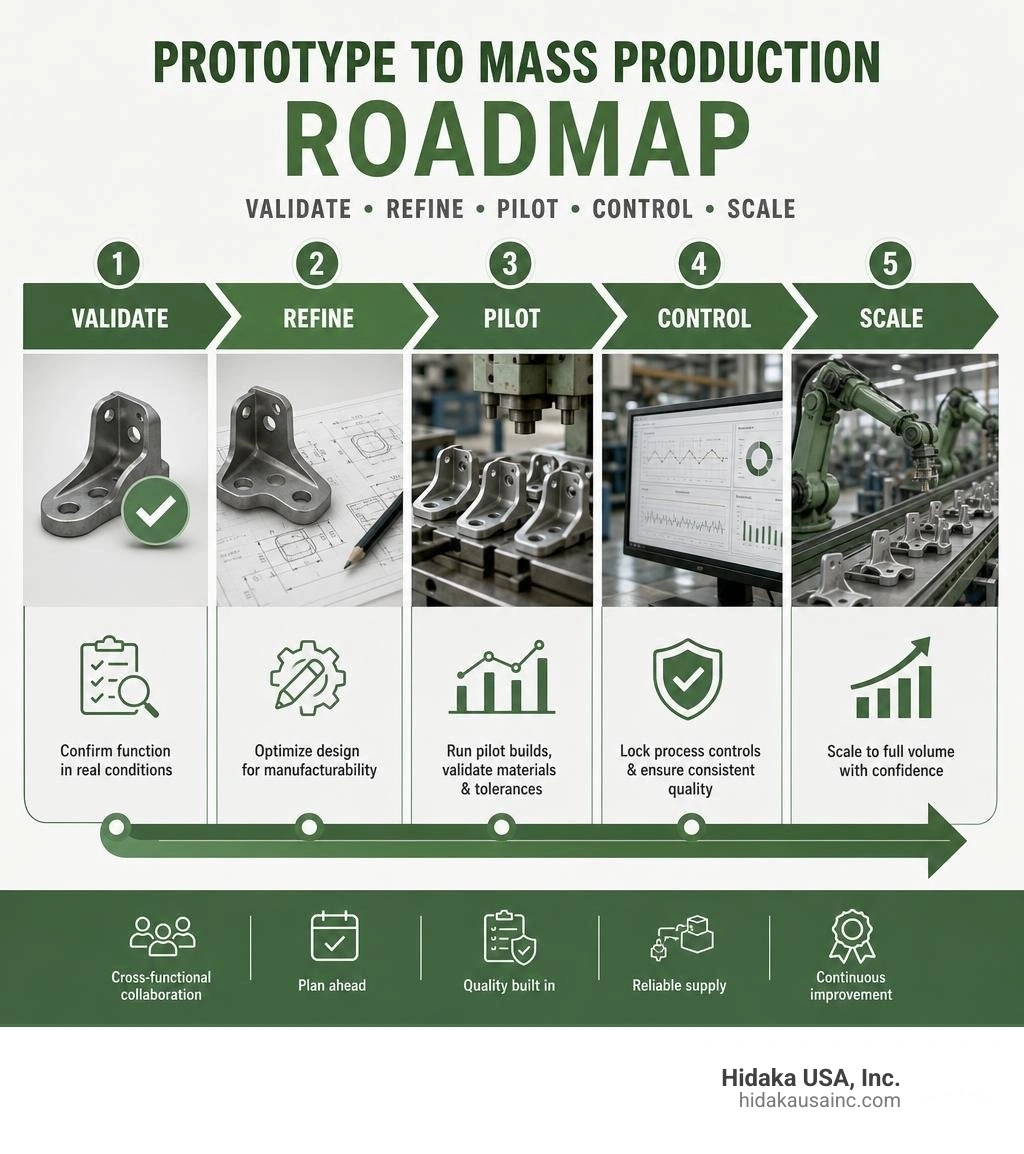
Scaling up requires a clear operational roadmap. Without structured staging, teams risk rushing unproven designs directly into multi-cavity dies or automated stamping lines, which can quickly turn valuable tooling into expensive scrap metal.

At Hidaka USA, Inc., our 95,000-square-foot facility in Dublin, Ohio leverages custom prototype engineering solutions to bridge the divide between initial physical concepts and high-volume output. A structured scale-up plan balances design maturation with systematic pilot validation.
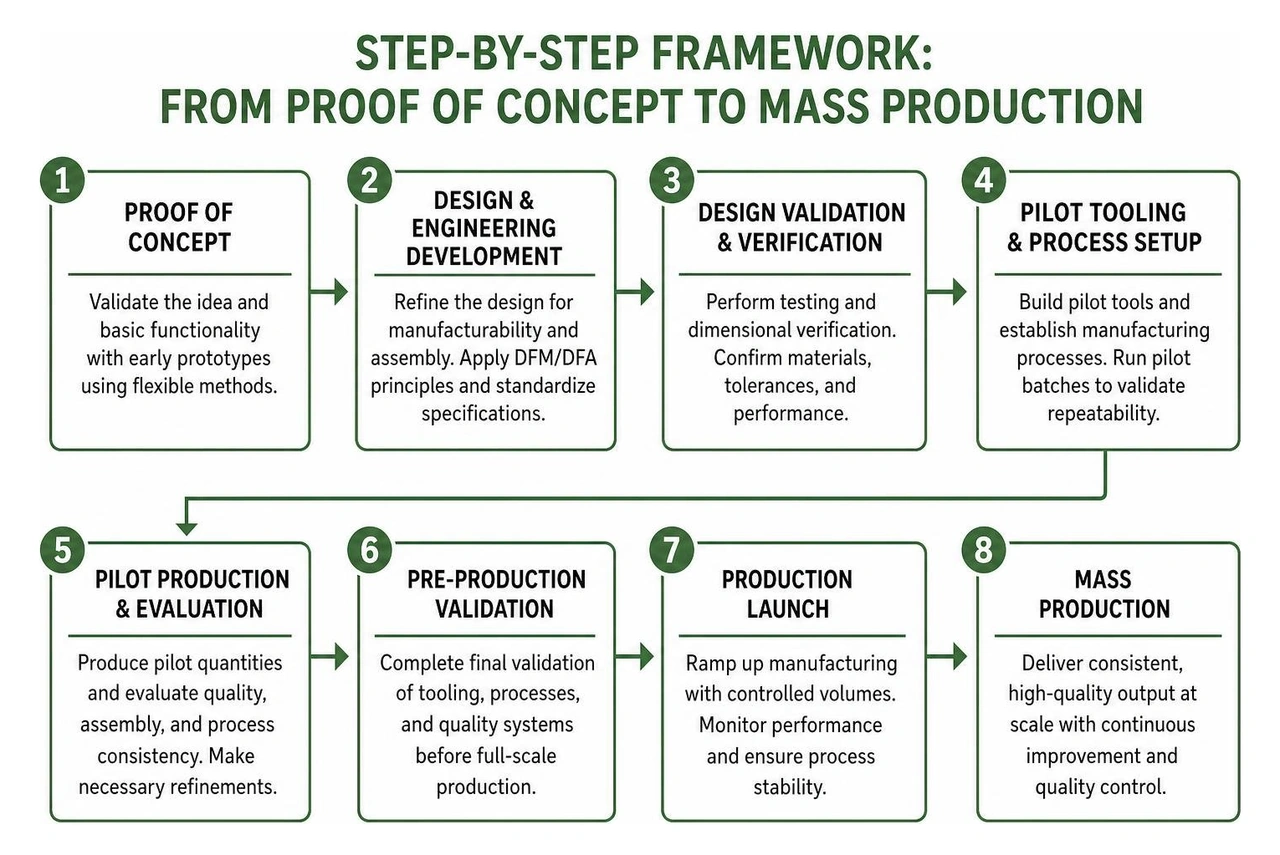
Assessing Prototype Production Scale Up Readiness
Before cutting production-grade tooling, verify that your design has cleared formal validation milestones:
- Engineering Validation Testing (EVT): Core functional and physical benchtop testing to verify that the product fulfills basic engineering specifications.
- Design Validation Testing (DVT): Testing parts produced from production-representative materials under real-world stress limits, thermal cycles, and dynamic vibration.
- Production Validation Testing (PVT): Running the design on actual pilot production equipment at speed to confirm line balance and assembly repeatability.
- Design Freeze: Formal sign-off ensuring no further geometry changes will occur before tooling fabrication.
De-risking via Bridge Tooling and Low-Volume Runs
Jumping directly from a 3D-printed model to a six-figure progressive stamping die is risky. Bridge tooling and low-volume production serve as the ultimate insurance policy. Utilizing soft tooling, temporary silicone molds, or rapid aluminum tooling lets you produce short-series batches—typically between 50 and several thousand parts—using end-use production materials.
Aluminum tooling can last for thousands of cycles, and in certain applications over 200,000 parts, while reaching operating temperatures and cooling faster than steel. This short-series approach allows manufacturers to test the market, validate packaging, and capture the early advantages of mass production while permanent production tooling is being built.
Streamlining Mass Manufacturing and Supply Chain Integration
High-volume manufacturing requires smooth, continuous throughput. Streamlining production begins with lean manufacturing frameworks that eliminate wasted movement, balance assembly workcells, and optimize cycle times.
Whether scaling complex automotive brackets or mass-transit structural weldments, referencing a comprehensive sheet metal stamping complete guide helps clarify how progressive dies, transfer presses, and automated material handling eliminate physical line bottlenecks.
Statistical Process Control and Quality Assurance
Mass manufacturing cannot rely solely on end-of-line visual inspections. To maintain part quality across large volumes, we implement Statistical Process Control (SPC) protocols to track key dimensional characteristics in real time.
Operating under verified ISO 9001 prototyping benefits and stringent quality control ISO standards ensures full traceability across raw materials, weld integrity, and press calibration. Establishing yield benchmarks early during pilot runs allows you to catch tool wear and process variations before they impact final assembly.
Advanced Simulation and Collaborative Supply Networks
Digital engineering tools significantly compress scale-up timelines. By using Computer-Aided Engineering (CAE) and finite element analysis (FEA), we virtually simulate sheet metal forming, thermal stresses, and weld distortion before striking physical metal. This digital validation prevents costly tooling modifications downstream.
Simultaneously, scaling requires qualifying dependable suppliers for raw materials and secondary coatings. Relying on integrated manufacturing partners who manage 2D/3D laser cutting, hydraulic press forming, and certified welding under one roof simplifies communication, prevents engineering drift, and strengthens your overall supply chain.
Financial Modeling and Risk Mitigation in Manufacturing
Scaling up is as much a financial discipline as an engineering one. Managing unit economics, tooling amortization, and cash flow timing is vital when transitioning to high-volume manufacturing.
Investing early in high-speed, custom high volume stamping significantly drops piece-part costs, but it requires upfront capital. Proper financial forecasting balances immediate tooling expenditures against production volume thresholds.
Overcoming Prototype Production Scale Up Pitfalls
Scale-up projects often encounter common, avoidable hurdles. Here is how we mitigate the major risks:
- Single-Source Vulnerabilities: Qualify secondary suppliers for specialized raw materials to prevent line shutdowns caused by upstream supply delays.
- Premature Tooling Investment: Never authorize permanent hard tooling until functional testing is complete and the design is frozen.
- Tolerance Stack-Up Errors: Conduct comprehensive tolerance stack-up analysis across all mating subcomponents before scaling assembly operations.
- Packaging Inefficiencies: Evaluate containerization, packaging cubic utilization, and dunnage early to keep freight and handling costs under control.
Capital Allocation, Tooling ROI, and Capacity Forecasting
A realistic scale-up budget incorporates dedicated contingency buffers for both schedule and capital. Production tooling always requires fine-tuning, and early pilot runs naturally generate higher scrap rates before operating parameters are dialed in.
Calculate tooling Return on Investment (ROI) across projected multi-year sales forecasts to select the right tooling tier—whether that means flexible bridge tooling for market introduction or fully automated progressive dies for long-term production.
Frequently Asked Questions About Scaling Prototypes to Production
What is the formal engineering process called for scaling a proof-of-concept?
The overarching engineering process of bringing a hardware concept from initial design through mass manufacturing is known as New Product Introduction (NPI). Within NPI, the technical scale-up stages follow structured gates, including iterative prototyping, Engineering Validation Testing (EVT), Design Validation Testing (DVT), and Production Validation Testing (PVT), leading to full production ramp.
When is the ideal time to scale up from prototype to mass production?
The ideal time to scale occurs when three milestones are met:
- Design Freeze: The product has passed all real-world functional, environmental, and regulatory compliance tests with no remaining major engineering change orders.
- DFM Verification: The geometry, tolerances, and material specifications are fully aligned with high-volume production machinery.
- Economic & Demand Clarity: Unit economics, scrap allowances, and market demand justify the capital expenditure required for dedicated production tooling.
How do low-volume production and bridge tooling de-risk scaling?
Bridge tooling—such as aluminum molds, soft stamping dies, or precision CNC setups—allows you to produce runs of 50 to several thousand parts in production-grade materials without the lead time and expense of permanent steel tooling. This bridge enables you to fulfill early customer orders, test distribution channels, and refine the manufacturing process before locking in high-volume tooling.
Conclusion
Successfully scaling a prototype into production is the defining milestone in a physical product's lifecycle. Bridging this gap requires combining rigorous Design for Manufacturability, data-driven pilot validation, robust quality management, and reliable supply chain integration.
Since 1989, Hidaka USA, Inc. has supported leading automotive, railcar, and motorsports manufacturers from our Dublin, Ohio facility. Combining advanced 2D/3D laser cutting, hydraulic forming, AWS-certified welding, and ISO 9001 quality systems, our team provides the engineering expertise needed to transition your design into dependable, high-quality mass production.