The Fast and the Fabricated: A Guide to Rapid Prototyping


How Prototype Metal Stamping Services Speed Up Product Development
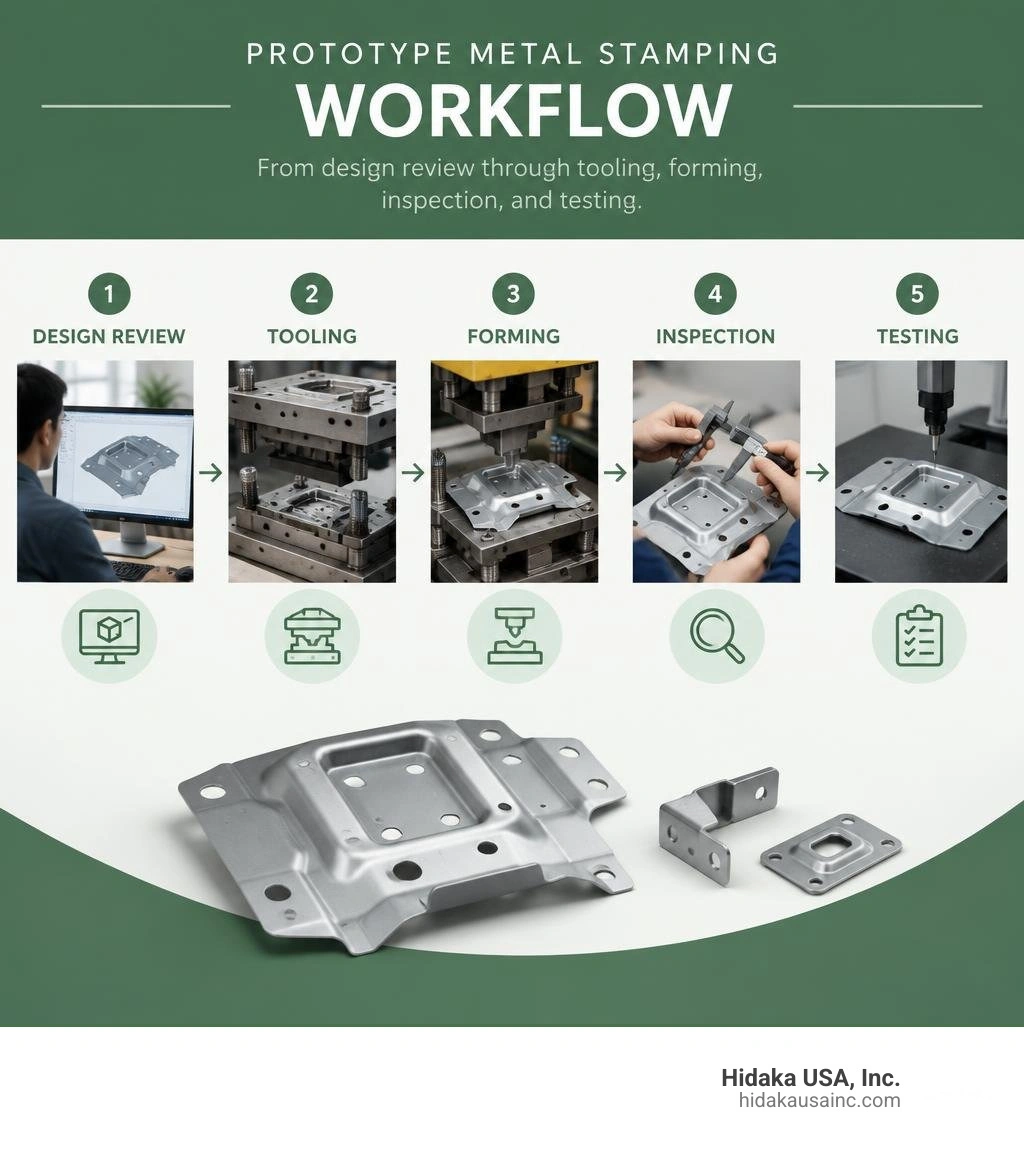
Prototype metal stamping services make small batches of metal parts for fit, function, and design testing before full production. They help manufacturers check how a part forms and performs, find problems early, and refine the design before investing in production tooling.
For automotive teams, a stamped prototype can reveal issues that a drawing alone cannot, such as poor fit or changes in shape after forming. The right approach depends on the part's material, shape, required accuracy, and how many pieces are needed.
I'm Yoshihiro Hidaka. After 18 years with an automotive supplier, I founded Hidaka USA, Inc. in 1989 to supply sheet metal prototypes; that experience guides this look at prototype metal stamping services and the steps from design to testing.
Prototype metal stamping services terms made easy:
Understanding Prototype Metal Stamping vs. Production Stamping
Metal stamping is everywhere. In fact, approximately 70% of all metal parts manufactured globally involve some form of stamping process. The global metal stamping market is projected to reach $318.5 billion by 2027, growing at a CAGR of 4.2% from 2020 to 2027, according to industry research from Grand View Research. The automotive sector alone accounts for over 60% of metal stamping demand worldwide.
The primary difference between prototyping and high-volume manufacturing comes down to tooling strategy, volume, and project goals. Production stamping uses dedicated, high-cost "hard tooling" made of hardened tool steel. These multi-station progressive dies are built to stamp hundreds of thousands or millions of parts with ultra-short cycle times. Building these dies requires significant capital and months of toolmaking.
By contrast, prototype stamping relies on "soft tooling" or modular stage tooling. The objective is not pure speed across millions of hits, but design validation and functional testing. We use cost-effective materials like mild steel, aluminum, or machinable urethane to produce representative parts quickly. This lets engineering teams confirm fitment, study material thinning, and make adjustments before committing to permanent dies. Reviewing our sheet metal stamping complete guide gives deeper insight into how these tooling philosophies diverge.
Key Differences in Tooling and Fabrication Techniques
To keep lead times short and costs manageable, prototype tooling separates operations that are normally combined in a progressive die:
- Blank Generation: Instead of machining custom blanking dies, we cut flat profiles using 2d laser cutting prototypes. This removes blanking die expenses and allows instant CAD adjustments.
- Stage Tooling and Press Brakes: Rather than moving continuous metal strips through synchronized die stations, prototype parts move through individual forming steps using universal press brakes or single-action dies.
- Forming Presses: Using advanced prototype hydraulic press capabilities, we apply controllable tonnage and stroke depths to form complex contours without needing multi-ton production tool sets.
Evaluating Prototype Forming Methods
When testing new component designs, choosing the right fabrication approach is critical. Alternative fabrication methods often fail to replicate the cold-working, grain stretching, or springback characteristics of formed sheet metal.
For parts that must undergo crash testing, thermal cycling, or weld testing, rapid metal prototyping through stamping is the only way to achieve genuine mechanical integrity matching the final manufactured piece.
Core Advantages of Prototype Metal Stamping Services

Investing in prototype metal stamping delivers distinct operational benefits:
- Dramatic Lead Time Compression: Prototype stamping can reduce lead times by up to 50% compared to traditional hard tooling methods.
- Capital Risk Mitigation: Using progressive die concepts for prototypes can cut tooling costs by 30-40% versus traditional dedicated production methods. This prevents costly post-production die modifications.
- Reliable Physical Testing: Parts stamped from true production alloys allow accurate evaluation of structural integrity, NVH (noise, vibration, and harshness), and fatigue limits.
- Actionable Production Insights: Observing how metal stretches and thins in soft tools helps engineers correct split lines and wrinkles before cutting production dies, aligning directly with established automotive prototyping best practices.
Implementing smart prototyping cost reduction strategies during this phase ensures your overall development budget stays on track.
Design Guidelines for Prototype Metal Stamping Services
Designing for sheet metal forming requires an understanding of how metals behave under tension and compression. When planning your components, consider these essential rules:
- Inside Bend Radius: Keep the minimum bend radius at least equal to the material thickness (1t) for soft metals, and 1.5t to 2t for higher-strength steels to avoid outer-wall cracking.
- Hole-to-Edge Spacing: Position pierced holes at a distance of at least 2 times the material thickness away from bend lines to prevent ovalization and distortion during forming.
- Springback Compensation: High-strength materials spring back after the press releases. Our team at advanced prototype engineering services models these behaviors digitally to adjust die angles accordingly.
- Wall Thickness Uniformity: Maintain consistent stock thickness throughout the stamped blank to ensure even pressure distribution during draw steps, following fundamental rules on how to prototype metal parts.
Material Selection and Forming Limits
Selecting the right material requires balancing functional performance against stamping formability:
- Cold-Rolled Steel (CRS): Highly formable, cost-effective, and ideal for deep drawing and automotive brackets.
- Stainless Steel (300/400 Series): High corrosion resistance and yield strength, though it work-hardens quickly and requires higher forming tonnages.
- Aluminum Alloys (5000 and 6000 Series): Lightweight and corrosion-resistant. Annealed tempers form easily, while hardened tempers like 6061-T6 require larger bend radii to avoid cracking.
- Copper and Brass: Excellent thermal and electrical conductivity, widely used in busbars and electronic shielding enclosures.
Our facility applies hydraulic press prototype forming techniques to safely push these materials to their maximum elongation limits without fracturing.
Navigating Project Execution and Production Scaling

Prototyping serves as the direct launchpad to mass manufacturing. When initial testing succeeds, bridge tooling allows companies to initiate low-volume production runs. The average cost savings from using prototype stamping services for low-volume production runs is 25-35%, giving manufacturers breathing room while permanent progressive tooling is constructed.
Planning a seamless transition through prototype production scale up ensures design integrity remains stable as volume shifts from dozens to hundreds of thousands of components. This phase is where many programs succeed or stall, since engineering changes made after tooling is cut become far more expensive. Keeping cross-functional teams, including purchasing, quality, and manufacturing engineering, aligned during this handoff period reduces the risk of costly surprises once production volumes ramp up.
Selecting Prototype Metal Stamping Services and Requesting Quotes
Choosing the right supplier determines how smoothly your project runs. When preparing your Request for Quote (RFQ), provide complete technical packages including 3D CAD models (STEP/IGES), 2D prints with clear Geometric Dimensioning and Tolerancing (GD&T), material specifications, annual volume forecasts, and functional test criteria.
Look for suppliers demonstrating verifiable quality management systems. Benefiting from iso 9001 prototyping benefits means your parts are tracked under rigorous quality controls, material certifications, and calibrated inspection routines. Partnering with domestic manufacturers for american made prototype parts also minimizes supply chain disruptions and speeds up engineering feedback loops. A supplier that can walk you through tooling concepts, material tradeoffs, and realistic lead times before a purchase order is issued will typically save your program both time and money later in the process.
Managing Technical Limitations and Secondary Operations
While prototype stamping offers exceptional flexibility, deep complex draws can occasionally require multiple intermediate annealing steps. Furthermore, stamped components often require post-forming operations to become fully functional assemblies.
Our Dublin, Ohio facility manages secondary requirements under one roof:
- Laser trimming and secondary hole piercing via 3D multi-axis lasers.
- Certified structural joining through aws certified prototype welding.
- Integrated hardware insertion (studs, nuts, standoffs).
- Surface finishing including e-coating, powder coating, zinc plating, and anodizing.
Consolidating these secondary operations in a single facility also shortens the feedback loop between forming and finishing, letting engineers spot fit or coating issues before parts ship for testing.
Frequently Asked Questions About Prototype Stamping
What is the typical turnaround time for metal stamping prototypes?
Standard turnaround times range from 1 to 4 weeks depending on part complexity, compared to 12 to 24 weeks for production progressive tooling. Simple single-stage formed parts cut with lasers can often be turned around on expedited schedules within a few business days.
Can prototype stamping tooling be repurposed for low-volume production runs?
Yes. Prototype soft tooling and modular dies frequently serve as bridge tooling for low-volume manufacturing runs between 50 and 5,000 units. This allows companies to satisfy immediate market demand or fulfill pre-series builds while hard production dies are built.
How does prototype stamping ensure dimensional accuracy before full production?
Dimensional verification involves using coordinate measuring machines (CMM), 3D optical scanning, and check fixtures to compare stamped parts directly against CAD nominal data. Discovering how our engineers apply systematic methods to evaluate stamped components is detailed in our guide on how to evaluate prototypes.
Conclusion
Developing high-performance metal components requires speed, precision, and reliable tooling. Hidaka USA Inc., established in 1989 in Dublin, Ohio, provides end-to-end support for your development timeline. Operating out of our 95,000-square-foot manufacturing facility, we offer comprehensive prototyping services, 2D and 3D laser cutting, hydraulic press forming, AWS-certified welding, and scalable mass-production services.
Whether you need initial functional prototypes or low-volume bridge manufacturing, our team helps accelerate your product development cycle. Connect with us through our prototyping solutions, explore our mass production capabilities, or visit our main page at Hidaka USA to discuss your next project.