What Is Mass Production? Unveiling Its True Meaning

What the Meaning of Mass Production Really Is
The meaning of mass production is straightforward: it is the large-scale manufacturing of standardized products, typically using assembly lines, specialized machinery, and automation to reduce cost per unit and increase output speed.
Quick answer:
| Term | Definition |
|---|---|
| Mass production | Making large quantities of identical products using machines and assembly lines |
| Also called | Flow production, series production, repetitive flow production |
| Key feature | Standardized, interchangeable parts produced at high volume and low unit cost |
| First known use | 1873; popularized by a 1926 Encyclopædia Britannica article based on Ford Motor Company correspondence |
| Famous example | Henry Ford's Model T assembly line (1913) |
Mass production sits at the heart of virtually every modern industry — from the cars on our roads to the smartphones in our pockets. It transformed how goods are made, how much they cost, and how people live and work. What began with simple standardized molds in the Bronze Age has grown into a global system of automated factories producing billions of units every year.
I'm Yoshihiro Hidaka, founder of Hidaka USA, Inc., with over three decades of hands-on experience in both prototype and mass production parts for the automotive industry — experience that gives me a practical, ground-level perspective on the meaning of mass production that goes beyond textbook definitions. In the sections below, I'll walk you through everything you need to know, from core principles to real-world applications.
Defining the Meaning of Mass Production
When we talk about the meaning of mass production, we are describing a system designed for a constant, high-volume flow. Unlike a craftsman who builds one item from start to finish, mass production breaks the process down into tiny, repeatable steps.
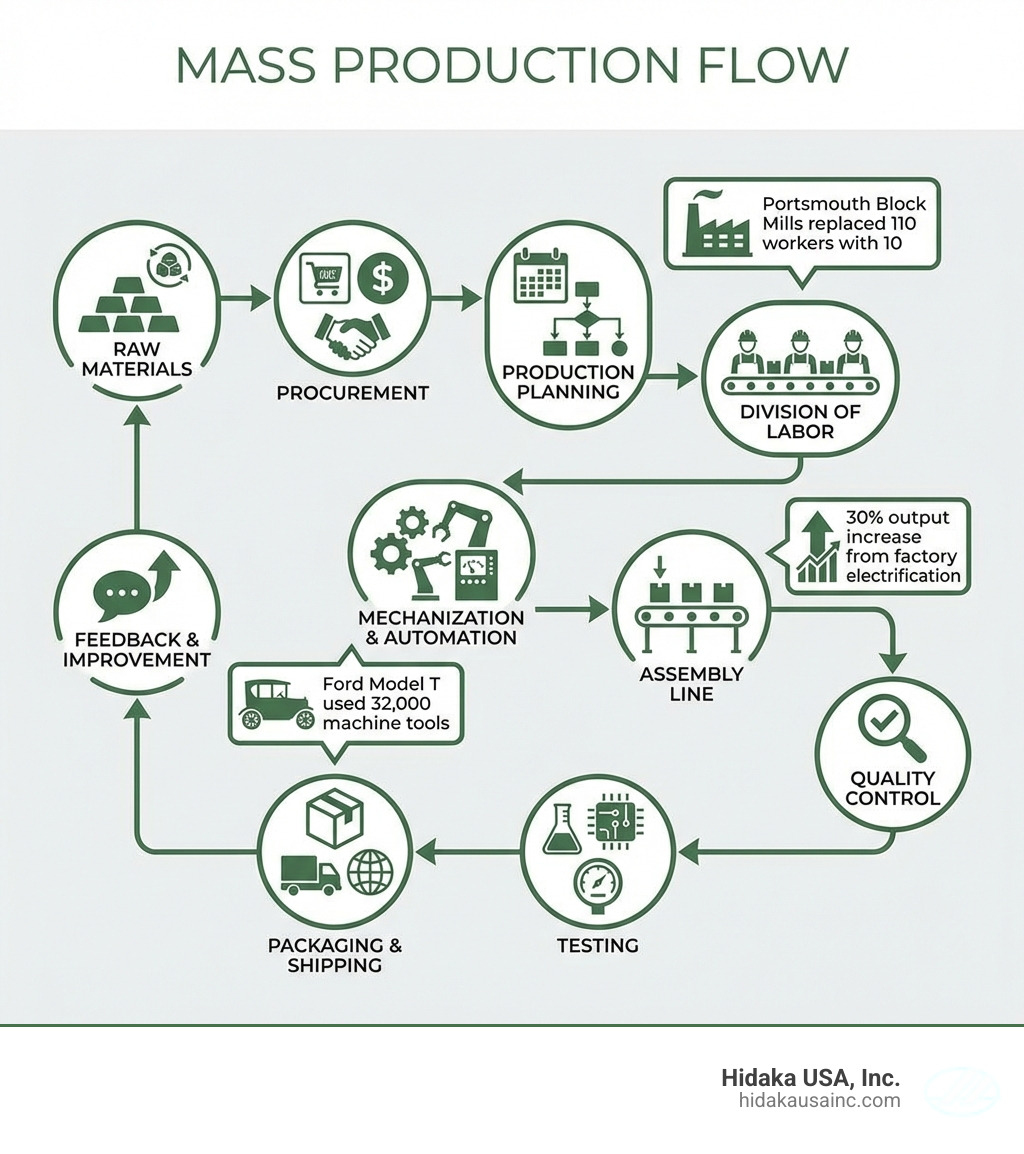
At its core, mass production relies on several pillars:
- Continuous Flow: The product moves through the factory in a steady stream. There is very little "sitting around" time for parts.
- Interchangeable Parts: This is the secret sauce. Every part is made to such precise specifications that it can fit into any assembly of the same model. You don't need a file or a hammer to "make it fit"—it just does.
- Standardized Products: In a traditional mass production setup, every item coming off the line is identical. While modern technology allows for some variation, the foundation remains standardized products and interchangeable parts.
- Economies of Scale: This is the economic "why" behind the system. As you produce more units, the fixed costs (like the price of the building and the machines) are spread across a larger number of items. This makes the cost per unit drop significantly.
- Capital and Energy Intensive: Setting up a mass production line isn't cheap. It requires a massive upfront investment in specialized machinery and a lot of energy to keep those machines running. However, once the line is moving, the efficiency is unmatched.
In our facility in Dublin, Ohio, we see this in action every day. Whether we are working on a complex welding assembly or a high-volume hydraulic press run, the goal is always to maximize machinery-driven output while keeping unit costs low for our partners.
The Evolution of High-Volume Manufacturing
While many people think the meaning of mass production started with Henry Ford, the roots go back much further than the 20th century. Humans have been looking for ways to make things faster and more uniformly for thousands of years.
In the Bronze Age, ancient civilizations used stone molds to cast identical sickles and axes. One of the most impressive early examples comes from the Warring States period in China, where ancient Chinese crossbow triggers were manufactured with interchangeable bronze parts. This allowed soldiers to swap out broken pieces on the battlefield—a concept at the time.
Later, the Venetian Arsenal in the 15th century functioned like a modern factory. At its height, it employed 16,000 people and could produce nearly one warship every single day using a pre-industrial version of an assembly line.
The true shift toward the modern meaning of mass production happened during the Industrial Revolution. Key developments included:
- Portsmouth Block Mills (1803): This British naval facility used 45 specialized machines to produce pulley blocks. By 1808, they were making 130,000 blocks a year. Remarkably, just ten men were able to accomplish what previously required 110 skilled workers.
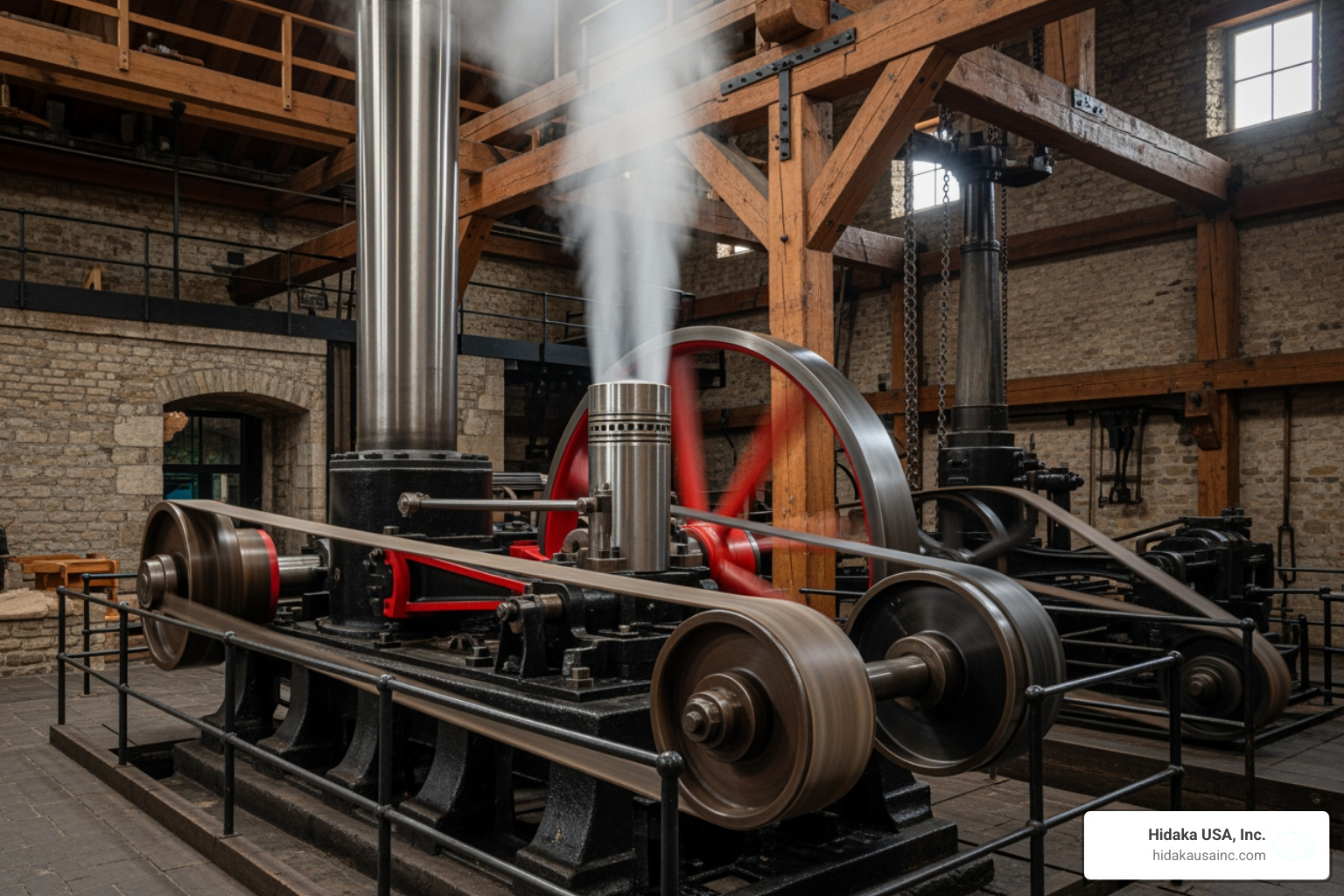
- Factory Electrification: Between 1900 and 1930, the shift from steam to electricity changed everything. Electrification allowed machines to be arranged in the order of the production flow rather than being tethered to a central steam shaft. This change alone led to a 30% increase in output for many factories.
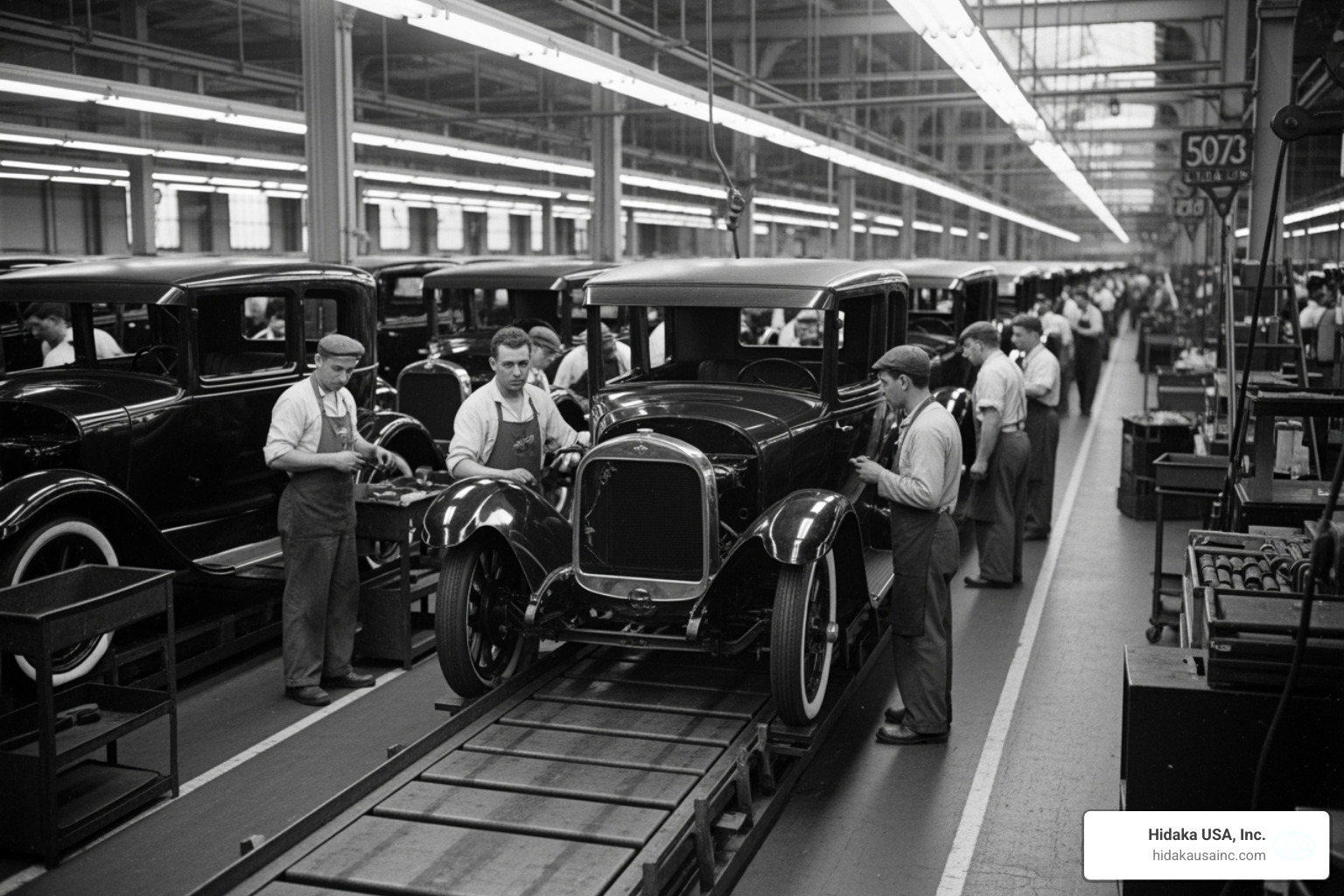
- The Ford Model T: Henry Ford didn't invent the assembly line, but he perfected it. By using 32,000 machine tools and a moving conveyor belt, he reduced the assembly time of a car from over 12 hours to just 93 minutes.
Historical Milestones in the Meaning of Mass Production
Several pioneers helped refine the meaning of mass production into the scientific discipline it is today:
- Eli Whitney: Often credited with popularizing interchangeable parts in the U.S. through his work on muskets for the Department of War.
- Marc Brunel: The engineer behind the Portsmouth Block Mills, who proved that "the skill is built into the tool." This meant that even less-skilled workers could produce high-precision parts if the machines were designed correctly.
- Scientific Management: Figures like Frederick W. Taylor and Frank and Lillian Gilbreth used time-and-motion studies to eliminate "non-productive effort." They looked at every movement a worker made to ensure the most efficient path was taken.
- The American System of Manufacturing: Developed in the mid-19th century, this system combined precision machine tools with jigs and fixtures to ensure every part was a perfect match for the next.
Core Principles and Modern Methods
To truly grasp the meaning of mass production, you have to look at how it differs from other ways of making things. It’s all about finding the right balance between volume and variety.
In the manufacturing world, we generally categorize production into three main methods. Here is a quick breakdown to help you see where mass production fits:
| Feature | Job Shop Manufacturing | Batch Production | Mass Production |
|---|---|---|---|
| Volume | Very Low (1 to a few) | Moderate | Very High |
| Variety | Very High (Custom) | Moderate (Seasonal/Color) | Very Low (Standardized) |
| Labor | Highly Skilled Artisans | Skilled Operators | Specialized/Automated |
| Setup Cost | Low | Moderate | Very High |
| Unit Cost | Very High | Moderate | Very Low |
| Examples | Custom jewelry, prototypes | Seasonal clothing, fan blades | Smartphones, car parts, soda cans |
At Hidaka USA, Inc., we actually operate in both the "Job Shop" world (for our high-end metal prototyping) and the "Mass Production" world. This gives us a unique perspective on how a part evolves from a one-off design into something produced by the thousands.
Technological Tools Shaping the Meaning of Mass Production Today
Modern mass production is a far cry from the greasy, loud factories of the 1920s. Today, the meaning of mass production is tied to "Industry 4.0"—the integration of digital technology into the physical manufacturing process.
- Robotics and Automation: Robotic arms now handle the heavy lifting, high-precision welding, and repetitive assembly tasks that used to cause worker fatigue.
- CNC Machining: Computer Numerical Control allows us to cut and shape metal with incredible precision, ensuring that the "interchangeable parts" principle is upheld to the thousandth of an inch.
- ERP and MES Software: Enterprise Resource Planning (ERP) and Manufacturing Execution Systems (MES) act as the "brain" of the factory. They track raw materials, monitor machine health, and ensure that the production flow never stops.
- Vertical Integration: Many large companies now control their entire supply chain, from the raw materials to the final assembly. This was a strategy famously used by Ford at the River Rouge Complex and is still used today to ensure quality and reduce delays.
Advantages and Disadvantages of Mass Production
Like any system, mass production has its trade-offs. While it has made life easier and more affordable for billions of people, it also presents significant challenges.
The Advantages:
- Unbeatable Efficiency: No other method can produce goods as quickly or as cheaply.
- High Precision: Because the "skill is built into the tool," human error is greatly reduced. Once a machine is calibrated, it will produce the 10,000th part exactly like the first.
- Economic Growth: By making products affordable, mass production fuels consumerism and creates millions of jobs in logistics, retail, and engineering.
- Fast Distribution: Mass production allows companies to stock shelves globally almost overnight.
The Disadvantages:
- Inflexibility: This is the biggest hurdle. If you want to change the design of a mass-produced product, you often have to retool the entire factory. This is expensive and time-consuming.
- Initial Capital Investment: You need a lot of money to start. If the product doesn't sell as expected, the financial loss can be devastating.
- Worker Discontent: Repeating the same task for eight hours a day can lead to boredom and high turnover. Modern factories try to combat this with job rotation and better ergonomics.
- Environmental Impact: Mass production is energy-intensive and can lead to overproduction. The rise of "fast fashion," for example, has raised serious concerns about waste. You can read more about these challenges in these sustainable fast fashion insights.
Frequently Asked Questions about Mass Production
Is mass production expensive to set up?
Yes, it is very expensive. The meaning of mass production implies a heavy reliance on specialized machinery, jigs, fixtures, and automated systems. For example, a single high-volume hydraulic press or a 3D laser cutting system is a major investment. However, companies justify this cost through the Return on Investment (ROI). If you are making 500,000 car door panels, the cost of the machine becomes a tiny fraction of each unit's price.
Does mass production result in lower quality?
Not necessarily. In fact, mass production often results in higher consistency than hand-made goods. Because machines don't get tired or distracted, the precision is often superior. However, if there is an error in the initial setup or a machine goes out of calibration, that error can be replicated across thousands of units before it is caught, leading to large-scale recalls. This is why strict quality control and statistical process monitoring are vital.
How does mass production differ from mass customization?
This is a great question that defines the future of the industry. Traditional mass production (think Henry Ford) offered "any color as long as it's black." Mass customization uses flexible manufacturing technology to give consumers choices without losing the price advantage of high volume.
A classic historical example is how General Motors eventually overtook Ford in market share. While Ford stuck to the rigid Model T, GM introduced annual model changes, different colors, and various accessories. Today, we see this in the automotive industry where you can choose your car's interior, tech package, and color, even though the underlying frame is mass-produced on a standardized platform.
Conclusion
Understanding the meaning of mass production is essential for anyone in business or engineering. It is a system that has defined the modern era, bringing high-quality goods to the masses while constantly evolving to meet new technological and environmental standards.
At Hidaka USA, Inc., we are proud to be part of this tradition right here in Dublin, Ohio. Our 95,000-square-foot facility is dedicated to the principles we've discussed: precision, efficiency, and quality control. Whether we are helping a client develop a new prototype or managing a high-volume assembly run for the automotive or mass-transit industries, we bring decades of expertise to every project.
We hold ISO 9001 and AWS certifications because we believe that American-made quality should be the gold standard. If you are looking for a partner who understands the deep complexities of manufacturing, we invite you to learn more about our mass production services and see how we can help bring your next project to life.