The Meaning of Mass-Produced: More Than Just a Definition

What "Mass-Produced" Really Means — and Why It Matters
The mass-produced meaning is straightforward: goods made in large quantities using machines, assembly lines, and standardized processes — resulting in identical, affordable products for a wide market.
Quick answer:
| Term | Definition |
|---|---|
| Mass-produced | Made in large quantities using machinery and assembly lines |
| Mass production | The manufacturing system that produces standardized goods at high volume and low unit cost |
| Key features | Identical parts, automated processes, division of labor, economies of scale |
| Common examples | Cars, smartphones, packaged food, clothing |
The term mass production first appeared as early as 1873, and the verb mass-produce followed in 1923 as a back-formation — growing directly out of the automobile industry's rapid expansion. Today, it describes one of the most powerful forces shaping modern industry, consumer pricing, and daily life.
Mass production is not simply about making more of something. It is about making things consistently, efficiently, and at a lower cost per unit — a principle that has driven manufacturing forward for over two centuries.
I'm Yoshihiro Hidaka, founder of Hidaka USA, Inc., with over three decades of hands-on experience in sheet metal fabrication and mass-produced meaning applied to real automotive and industrial parts. That background shapes every insight in this guide.
Defining the mass-produced meaning in Modern Manufacturing
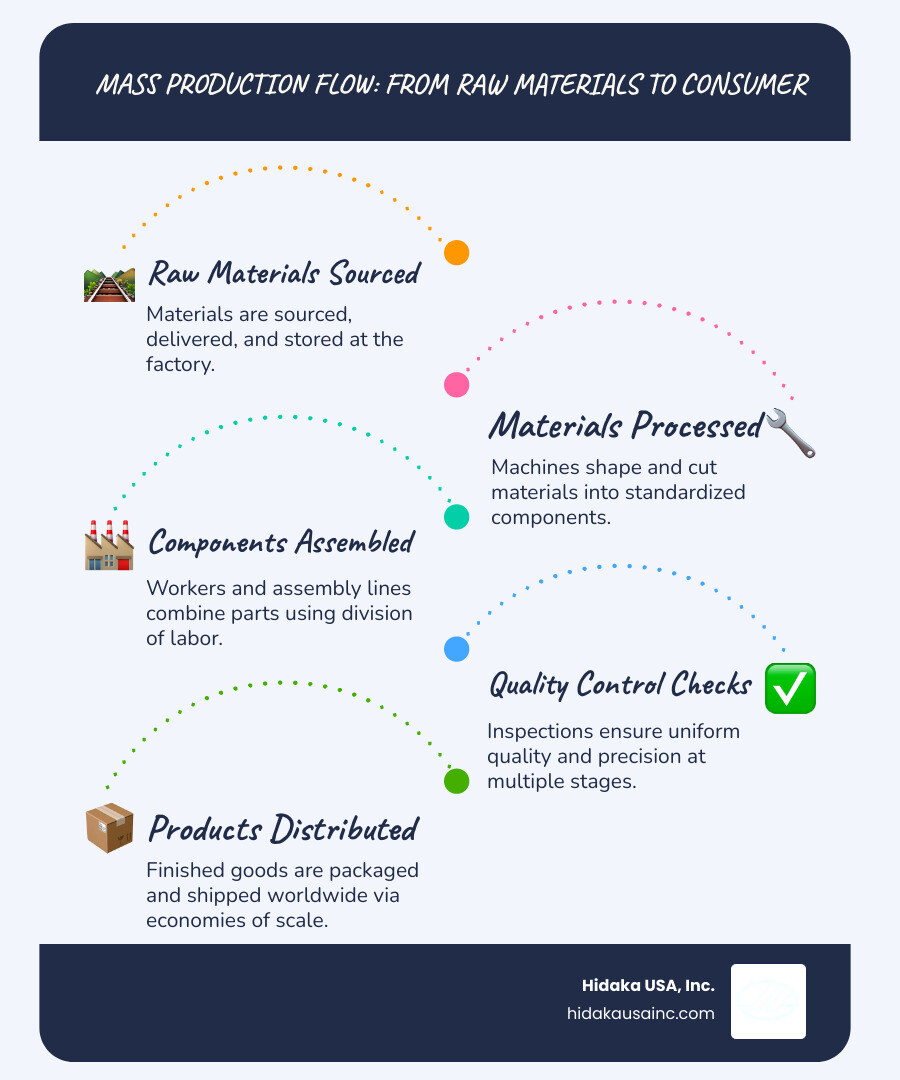
When we talk about the mass-produced meaning, we are describing a specific philosophy of making things. It is often called "flow production" or "series production." At its heart, it is the manufacturing of substantial amounts of standardized products in a constant flow.
In our facility in Dublin, Ohio, we see the difference between a one-off prototype and a mass-produced run every day. To truly understand this, we have to look at how it differs from other ways of making things.
Comparing Production Methods
| Feature | Job Production | Batch Production | Mass Production |
|---|---|---|---|
| Quantity | One or very few | Groups or "batches" | Continuous, high volume |
| Standardization | Low (customized) | Medium | High (identical) |
| Cost per unit | High | Medium | Low |
| Labor Skill | Highly skilled artisans | Skilled/Semi-skilled | Specialized/Automated |
| Example | Custom jewelry | Seasonal baked goods | Ford Model T |
While job production focuses on the unique needs of a single customer, the mass-produced meaning focuses on the shared needs of millions. By using heavy machinery and specialized assembly lines, we can produce goods at a speed that would be impossible for human hands alone.
Understanding the mass-produced meaning through Standardization
Standardization is the "secret sauce" of mass production. Before this concept took hold, if you bought two clocks from the same maker, the gears might not be interchangeable. If one broke, a craftsman had to hand-file a new part to fit your specific clock.
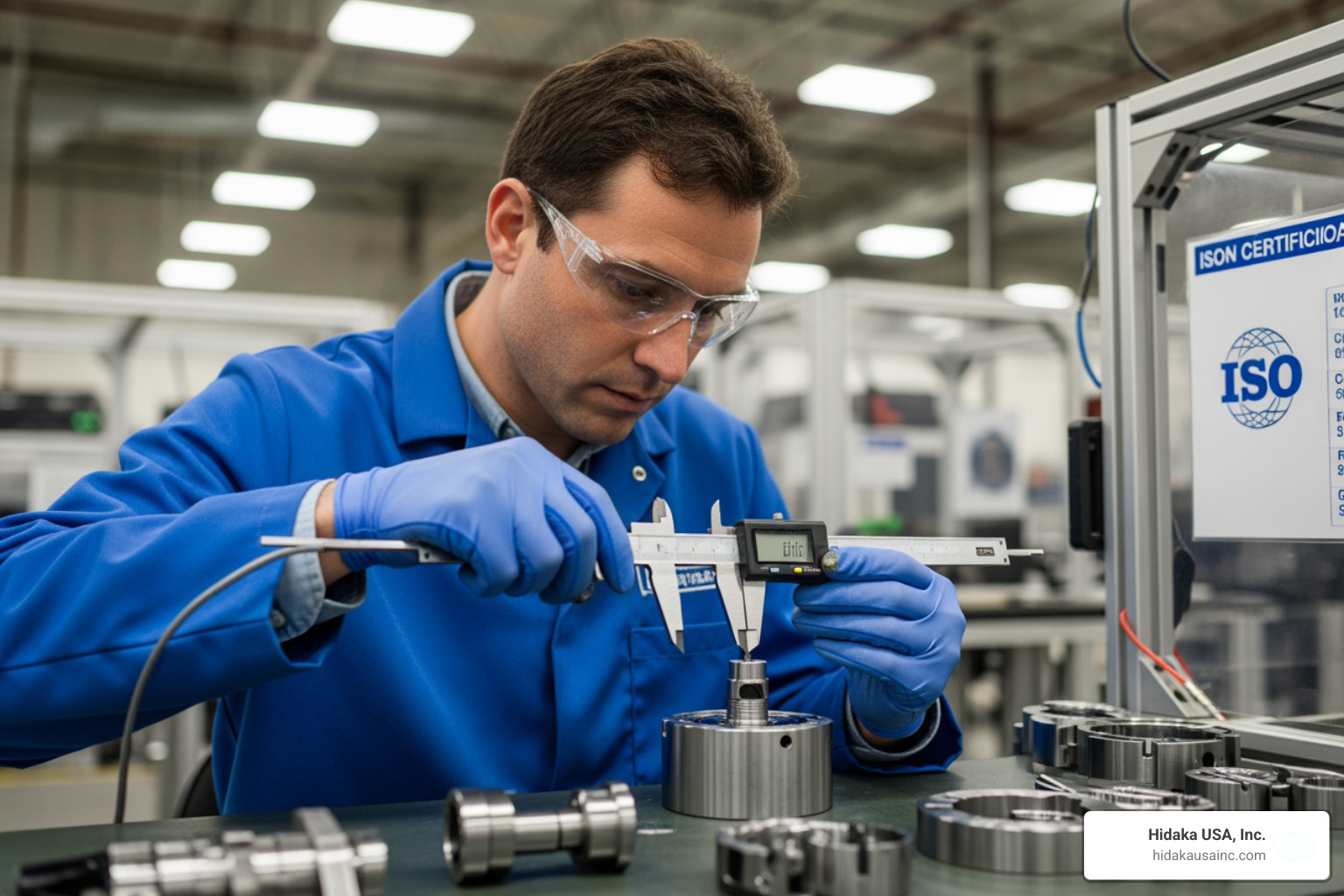
Today, the Definition of mass production relies on the application of specialization, division of labor, and standardization of parts. This ensures uniform quality and precision. When we manufacture metal parts for the automotive or railcar industries, every single bracket must be identical to the last. This precision is "built into the tool," meaning the machinery is set up to replicate the exact same dimensions every single time, reducing the margin for human error.
How the mass-produced meaning impacts Consumer Costs
Why does this matter to you as a consumer? One word: affordability.
Mass production creates "economies of scale." This means that as we produce more units, the cost to make each individual unit goes down. The high "setup cost" of building a factory and buying expensive hydraulic presses is spread out over thousands or millions of products.
This leads to rapid market penetration. Because products are cheaper, more people can afford them, which increases demand, which in turn justifies more mass production. It’s a cycle that has raised the standard of living globally, turning luxury items like cars and washing machines into household staples.
The Evolution and History of Mass Production
The mass-produced meaning didn't just appear out of thin air with Henry Ford. Its roots go back much further than most people realize.
Pre-Industrial Roots
Even in the ancient world, we saw flashes of mass production. The Qin Emperor’s Terracotta Army in China used standardized molds on what was essentially an early assembly line. In the Middle Ages, the Venetian Arsenal was a marvel of the world; they could produce nearly one ship every day by using prefabricated parts and a specialized workforce of 16,000 people. It was, for all intents and purposes, the world's first factory.
Pioneers of the Assembly Line
The Industrial Revolution in the 18th and 19th centuries changed everything. Pioneers like Eli Whitney proposed using interchangeable parts for muskets in 1797, moving away from hand-fitted craftsmanship.
One of the most impressive early examples was the Portsmouth blockmaking machinery. By 1808, annual production from 45 machines reached 130,000 pulley blocks for the Royal Navy. Incredibly, 10 men using this machinery accomplished what previously required 110 skilled workers.
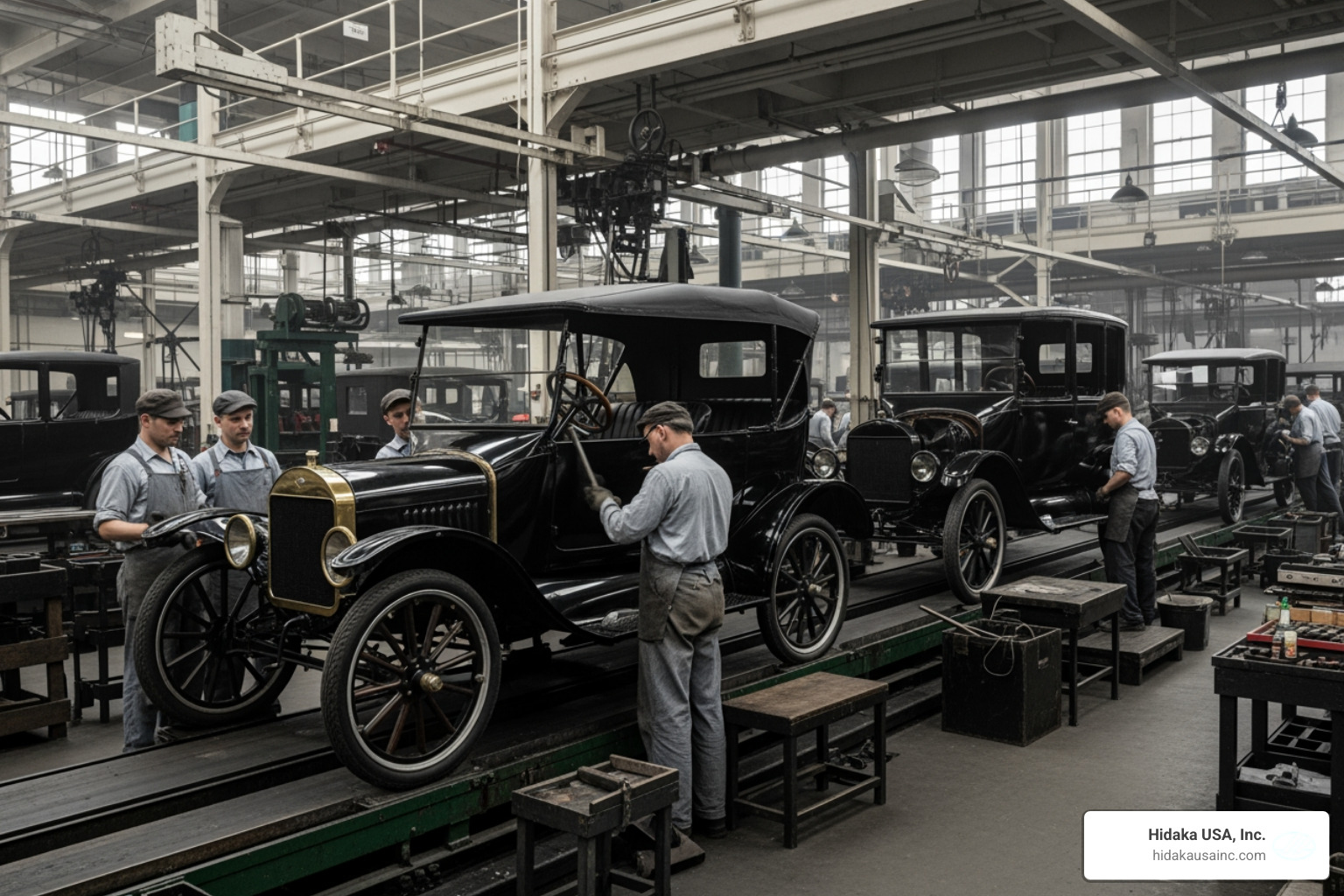
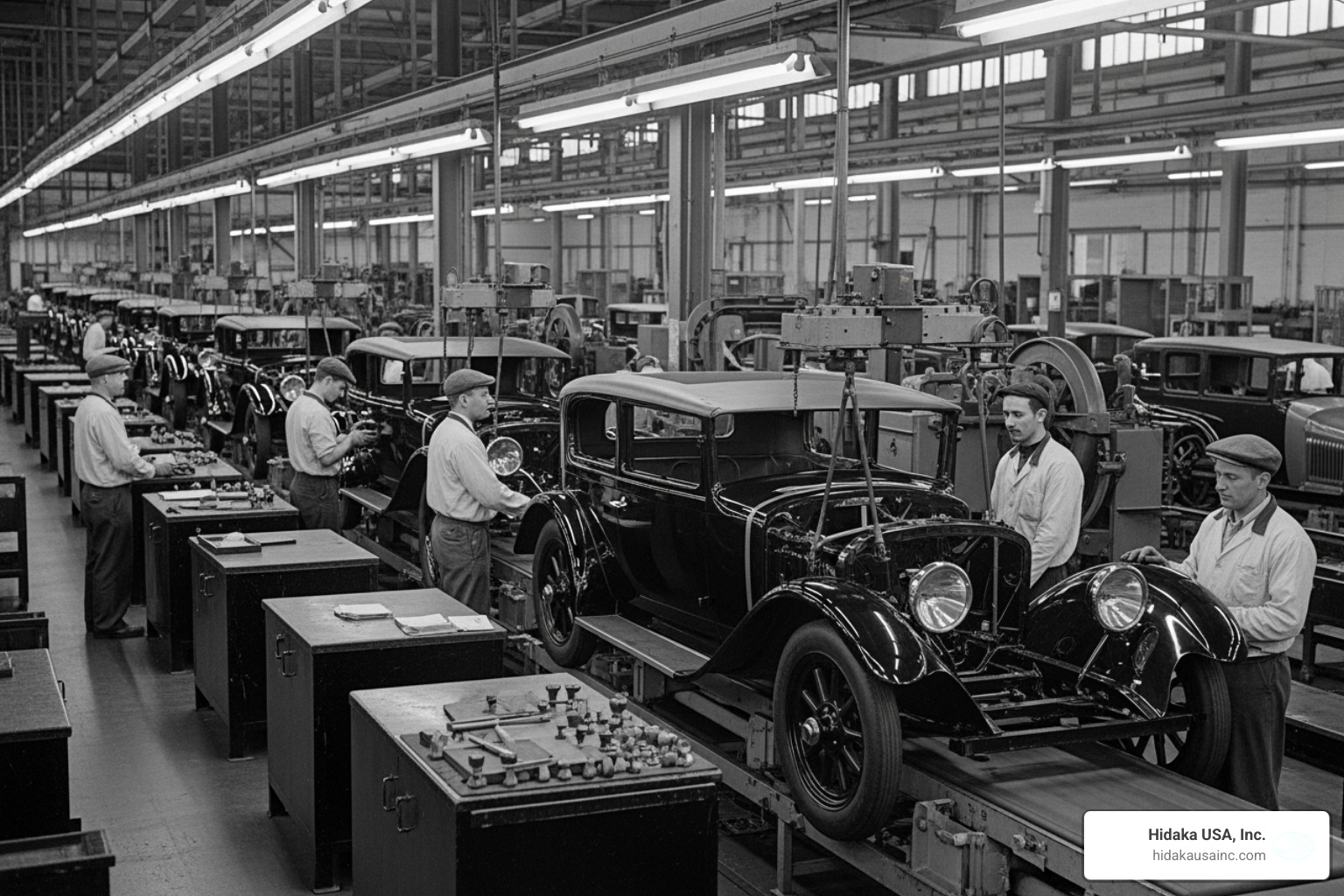
Of course, we can't talk about the history of mass production without mentioning Henry Ford. While he didn't invent the assembly line, he perfected it for the Ford Model T. His factory used a staggering 32,000 machine tools to churn out cars at a rate the world had never seen. By 1913, his moving assembly line reduced the time it took to build a chassis from 12.5 hours to just 93 minutes.
From Steam to Electrification
The energy source behind the factory also dictated the evolution of the mass-produced meaning. Early factories relied on water wheels or James Watt’s steam engine. These required complex "line shafts" and belts to transfer power to machines.
However, between 1900 and 1930, factory electrification changed the game. Switching to electric motors allowed machines to be arranged more flexibly based on the flow of work rather than the location of a central power shaft. Many factories saw a 30% increase in output simply from this shift.
Key Characteristics and Processes of Mass Production
Modern mass production is a highly organized dance of technology, logistics, and labor. To maintain a constant flow of goods, manufacturers often use specific techniques.
Vertical Integration
In the early days, companies like Ford practiced "vertical integration," meaning they owned everything from the iron ore mines to the rubber plantations. While modern companies often outsource parts, the goal remains the same: total control over the production timeline to ensure the assembly line never stops.
The Role of Interchangeable Parts
We owe a lot to the clockmakers for this. In 1807, Eli Terry produced 4,000 wooden movement clocks in a single contract. This was at a time when most clockmakers only finished a few dozen a year. This was only possible because every part was machined to be identical.
This precision machining is why, today, you can buy a replacement part for your car in Ohio and know it will fit perfectly, even if the car was assembled thousands of miles away.
Automation and Robotics in the Factory
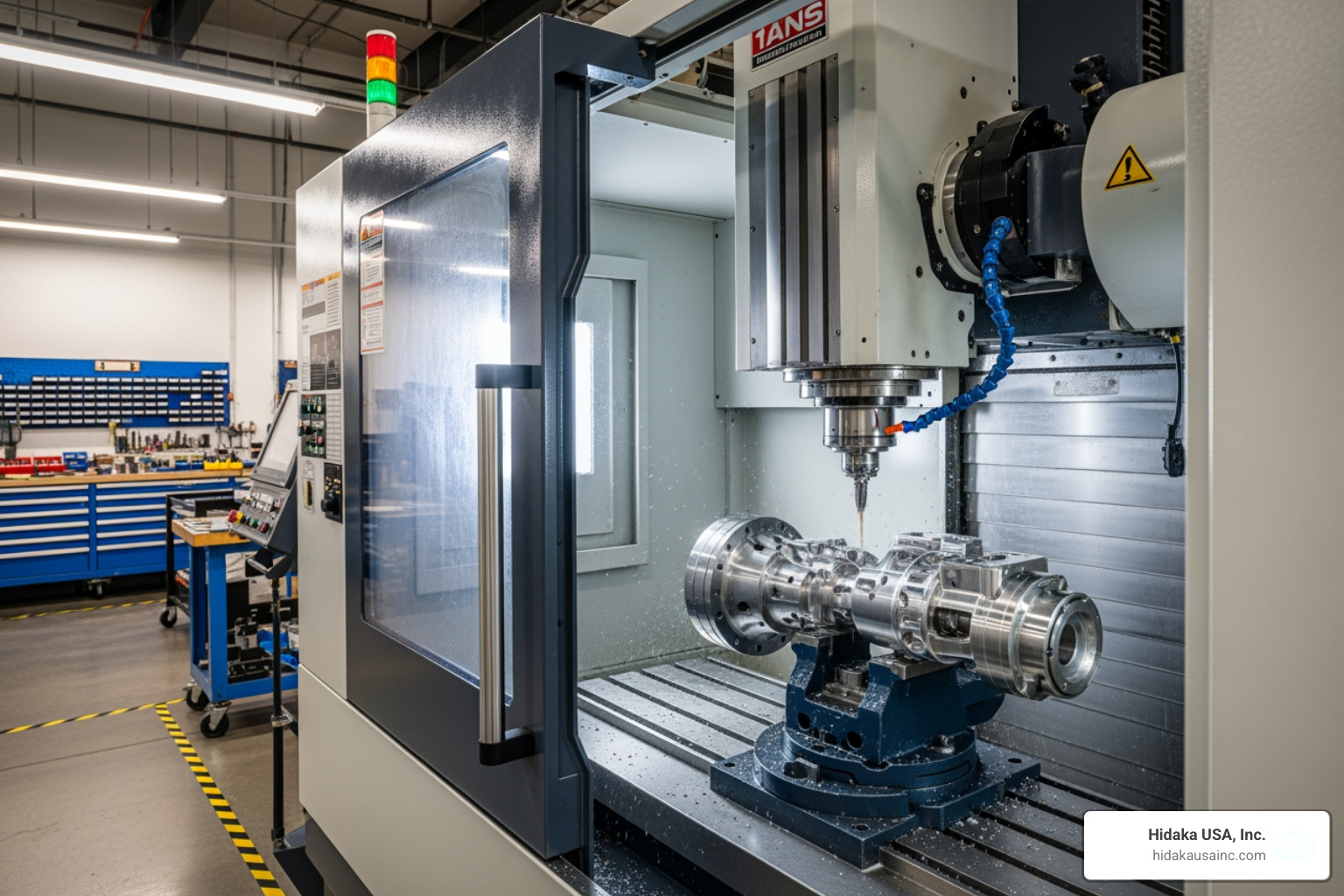
Today, the "skill" of the worker has largely been transferred to the machine. We use Production Methods and assembly lines that incorporate advanced robotics and CNC (Computer Numerical Control) machines.
Robotic arms can perform complex welds with a level of consistency that a human welder—no matter how talented—simply cannot match over an eight-hour shift. These systems use sensors and feedback loops to monitor quality in real-time, ensuring that if a single part is out of spec, the system can correct itself or alert an operator immediately.
Advantages and Disadvantages of Large-Scale Manufacturing
Like any major technological shift, mass production is a double-edged sword. It has created immense wealth and convenience, but it also presents unique challenges.
The Benefits for Manufacturers and Consumers
The primary advantage is efficiency. Mass production allows for:
- Cost Efficiency: Lowering the price of goods for everyone.
- Consistent Quality: Every product meets the same high standard.
- Rapid Distribution: Getting products to market faster.
- Innovation: By perfecting the "basics," companies can spend more on researching the next big thing.
Consider the Ford Model T: Ford built over 15 million of them between 1908 and 1927. This volume didn't just make Ford rich; it changed the very layout of our cities and the way we live.
Limitations and Environmental Impacts
However, we must also consider the Socioeconomic impacts of mass production. One of the biggest downsides is inflexibility. Because a mass production line is so expensive to set up, it is very difficult and costly to change the design of a product once the machines are running. Henry Ford said customers could have the Model T in any color "so long as it is black"—because changing the paint line would have slowed down production.
There are also environmental concerns. The "fast fashion" industry is a prime example of mass production leading to overconsumption and waste. We are constantly looking for a Sustainable fast-fashion formula to balance our love for new things with the health of our planet. Overproduction remains a risk; if a manufacturer miscalculates demand, they end up with thousands of identical items that no one wants, leading to significant wastage.
Contemporary Applications: Electronics, Renewable Energy, and AI
The mass-produced meaning is currently being redefined by the digital age and the green revolution. We aren't just mass-producing "clunky" mechanical items anymore; we are mass-producing microscopic circuits and massive energy structures.
Mass Production in Green Technology
Renewable energy is the next great frontier for mass production. For example, Mass production in renewable energy is currently helping to slash the cost of offshore wind turbine foundations. By standardizing the components of these massive structures, companies can produce them much more cheaply than if each one were a custom engineering project.
The same applies to solar cells. High-efficiency solar panels are now being mass-produced at a scale that has made solar energy competitive with fossil fuels in many parts of the world.
The Future: AI and Mass Customization
We are entering the era of "Industry 4.0," where the Internet of Things (IoT) and AI are making factories "smart."
One of the most exciting developments is mass customization. This sounds like an oxymoron, but with generative AI and 3D printing, we are finding ways to use mass production efficiency to create products tailored to individual needs. Imagine a mass-produced sneaker where the sole is 3D-printed to match the exact shape of your foot. This hybrid model combines the low cost of mass production with the personal touch of job production.
Frequently Asked Questions about Mass Production
How does mass production differ from batch production?
Batch production involves making a specific number of items at once (like a bakery making 50 loaves of sourdough) and then stopping to change the setup for a different product. Mass production is continuous; the machines keep running the same product for as long as there is demand.
Is mass production always automated?
Not always, but it usually is in the modern world. While the mass-produced meaning focuses on the process (standardization and flow), automation is the tool that makes that process fast enough to be profitable. In some industries, humans still work on assembly lines, but their tasks are highly specialized and repetitive.
What are the primary environmental impacts of mass production?
The biggest impacts are resource depletion, high energy consumption, and waste from overproduction. However, many modern factories (including ours!) are moving toward more sustainable practices, such as recycling scrap metal and using energy-efficient machinery to reduce our carbon footprint.
Conclusion
At Hidaka USA, Inc., we live and breathe the mass-produced meaning. Since we established our facility in Dublin, Ohio, in 1989, we have focused on bridging the gap between high-quality prototyping and efficient mass production.
With over 95,000 square feet of space, we serve the automotive, mass-transit railcar, and motorsports industries with pride. Whether we are using our 2D/3D laser cutting technology or our massive hydraulic presses, our goal is always the same: American-made quality that meets strict ISO 9001 and AWS standards.
Mass production isn't just about "cheap" goods; it's about the incredible engineering required to make complex parts perfectly, every single time. If you're looking for a partner to help bring your metal parts and assemblies to life at scale, we invite you to learn More info about mass production services at Hidaka USA. We are here to help you turn your designs into the standardized, high-quality products that move the world.