A – Z Guide to ISO 9001 Prototyping Benefits

Why ISO 9001 Prototyping Benefits Matter for Manufacturers
The ISO 9001 prototyping benefits are well-established across automotive, aerospace, and medical device manufacturing: certified suppliers deliver more consistent parts, catch design flaws earlier, and give customers measurable confidence in every prototype they receive.
Here is a quick summary of the core benefits:
| Benefit | What It Means for You |
|---|---|
| Consistent part quality | Uniform processes reduce variation between prototype runs |
| Earlier defect detection | Design controls catch errors before they become costly |
| Faster design cycles | Structured reviews and feedback loops cut iteration time |
| Reduced rework and scrap | Documented controls lower waste across development stages |
| Stronger customer trust | Third-party certification validates supplier reliability |
| Clearer communication | Defined feedback channels reduce misunderstandings |
| Lower total project risk | Verified design inputs and validation steps prevent downstream failures |
ISO 9001 is an internationally recognized Quality Management System (QMS) standard. When applied to prototyping, it brings structured design controls, documented processes, and continuous improvement into every stage of product development — from first design input to final prototype validation.
For automotive manufacturers facing tight deadlines and zero tolerance for inaccuracy, choosing an ISO 9001-certified prototype supplier is not just a preference. It is a risk management decision.
I'm Yoshihiro Hidaka, founder of Hidaka USA, Inc., where I have spent over three decades supplying sheet metal prototypes and production parts to the automotive industry — giving me experience with how ISO 9001 prototyping benefits translate from the standard's clauses into real shop-floor outcomes. That experience shapes everything covered in this guide.
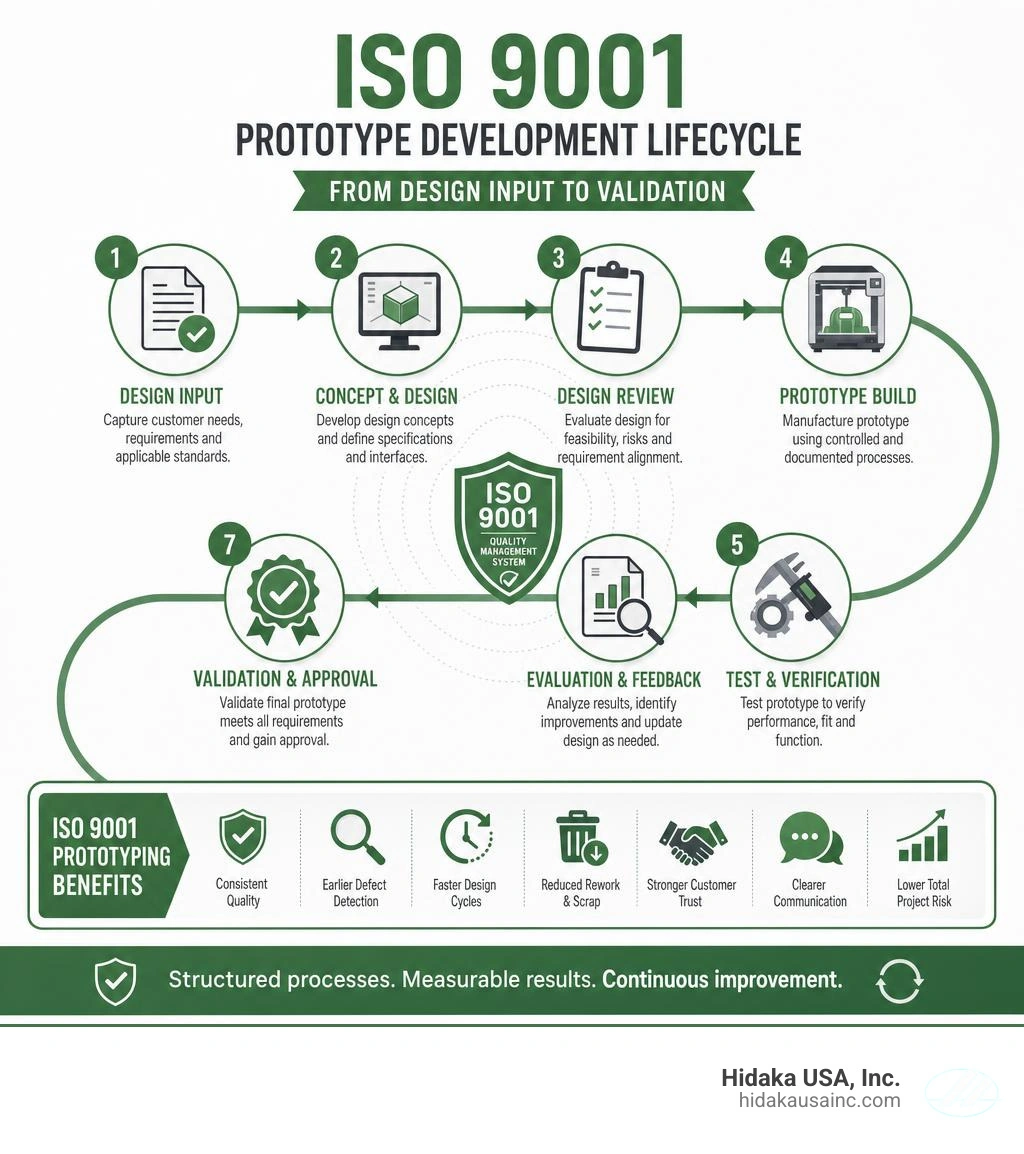
ISO 9001 prototyping benefits glossary:
What is ISO 9001 and How Does It Apply to Prototyping?
At its core, ISO 9001 is a globally recognized standard that outlines the requirements for a Quality Management System (QMS). Many people mistakenly believe that ISO 9001 is only meant for high-volume, repetitive mass production where every part must look identical to the last. However, the standard is built on a foundation of process control, risk management, and continuous improvement—principles that are incredibly valuable during the highly iterative research and development (R&D) and prototyping phases.
When applied to prototyping, ISO 9001 ensures that the creative and experimental process of building a new product does not descend into chaos. Instead of relying on guesswork, a certified prototype developer follows structured processes to document design changes, verify dimensions, and maintain full traceability. Understanding how these Quality Control ISO Standards apply to custom builds is the first step toward achieving predictable innovation.
By integrating a QMS into the prototype development lifecycle, organizations can successfully balance flexibility with control. This structured approach is why leading automotive and aerospace manufacturers look for specific Industries Certifications when selecting their development partners.
Can R&D and Pure Prototyping Firms Achieve ISO 9001?
A common question we hear in the engineering community is: Can a company that only produces prototypes, reports, or R&D deliverables actually achieve ISO 9001 certification?
The short answer is a resounding yes.
Because ISO 9001 is designed to evaluate the process rather than a specific physical output, it applies to any organization, regardless of whether its final deliverable is a million mass-produced brackets or a single 3D-printed concept model accompanied by an engineering report. For pure R&D firms, the "product" is often intellectual property, design files, or feasibility studies.
To achieve certification, these firms must map out their ISO 9001 design and development process to show how customer requirements are captured, analyzed, and translated into the final R&D deliverables. If a small prototyping team relies on a parent company or an outside partner for secondary services like shipping or purchasing, ISO 9001 allows them to treat these functions as outsourced processes. This means even lean R&D operations can successfully build a compliant, high-performing QMS without unnecessary administrative overhead.
Key ISO 9001 Prototyping Benefits for Manufacturers and Clients
Implementing a certified QMS yields substantial advantages for both the prototype manufacturer and the customer. For startups and established OEMs alike, working with a certified partner reduces project risk, manages costs, and prevents the classic "prototype-to-production" disconnect.
When you partner with an ISO 9001-certified supplier, you are not just buying a physical component; you are investing in a verified process. Startups, in particular, gain a massive advantage by utilizing certified Metal Prototyping for Startups because it ensures that early-stage physical models are precise enough to secure investor trust and pass strict regulatory hurdles.
Furthermore, as outlined in the 10 reasons your business will benefit from ISO certification, implementing these standardized processes makes organizations more efficient, reduces scrap, and ensures that customer requirements remain at the center of every engineering decision.
How ISO 9001 Prototyping Benefits Streamline Communication and Feedback Loops
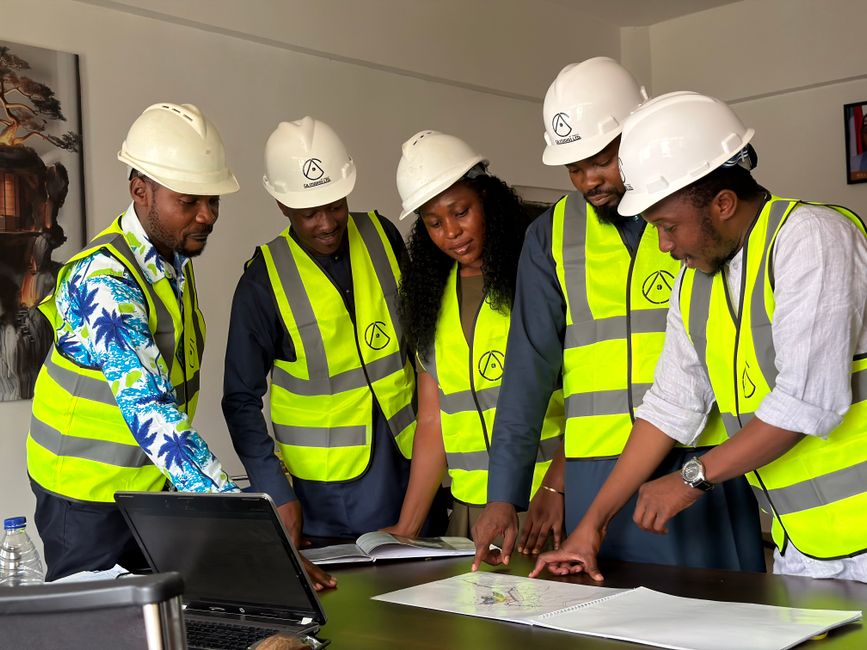
One of the greatest challenges in rapid prototyping is communication. When design requirements change rapidly, a lack of version control can lead to a manufacturer building a prototype based on an outdated CAD file.
ISO 9001 addresses this directly by requiring formal communication channels and rigorous document control. The standard mirrors the iterative feedback loops that are vital to successful prototype development. By establishing clear gateways for design reviews, both the client and the manufacturer stay aligned on every modification.
This collaborative approach is supercharged by modern digital tools. As explored in the guide on how to Revolutionize Prototype Manufacturing in 2025 with Digital Research & Collaboration Tools | ISO Compliance, integrating cloud-based digital annotation tools with an ISO-compliant QMS allows engineers to mark up CAD models and drawings in real time. This digital thread ensures that every piece of feedback is traceable, eliminating chaotic email chains and preventing costly errors caused by outdated drawings.
Maximizing Efficiency: Financial and Operational ISO 9001 Prototyping Benefits
Operational efficiency is where the ISO 9001 prototyping benefits truly impact your bottom line. Research shows that ISO 9001-certified organizations experience an average 20% to 30% reduction in product development cycle times and rework costs due to structured design controls and validation processes.
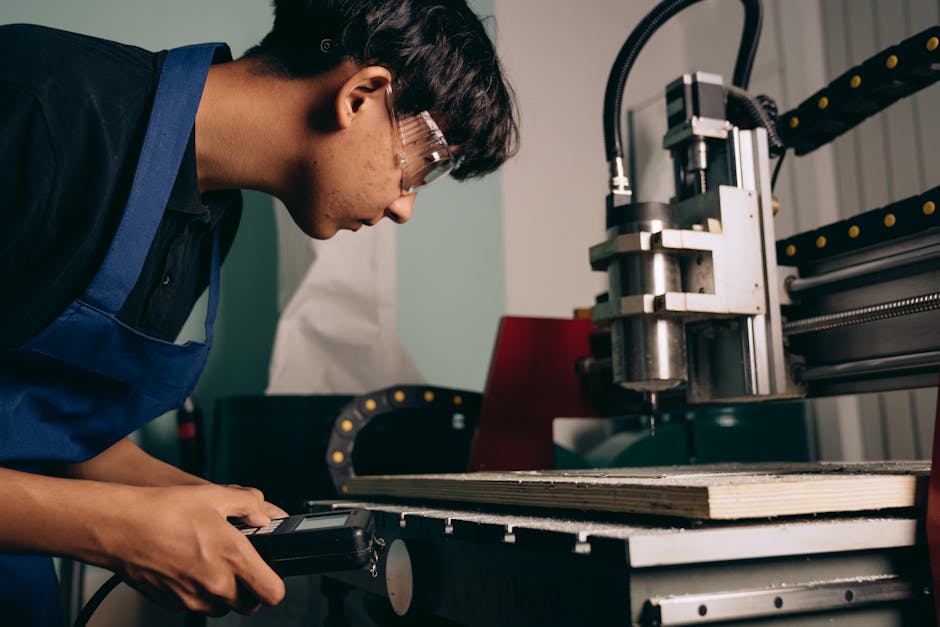
By catching design conflicts during the initial review stages, manufacturers can avoid cutting expensive metal on the shop floor only to realize a hole pattern is misaligned. When machining high-precision components, utilizing a certified partner for Rapid Prototyping CNC Machining ensures that every setup, toolpath, and material grade is verified before the spindle starts spinning.
This disciplined approach translates directly into a higher First Article Inspection (FAI) pass rate, minimizing scrap and ensuring that your prototype is delivered on time and within budget.
Demystifying Clause 8.3: Design and Development Controls in Prototyping
For prototype manufacturers, Clause 8.3 (Design and Development of Products and Services) is the heart of the ISO 9001 standard. This clause outlines how an organization must manage the transition from a conceptual idea to a fully realized product. It breaks down the process into structured stages: planning, inputs, controls, outputs, and changes.
Under 8.3 Design & Development of Products & Services, design controls act as a system of checks and balances. They ensure that:
- Design Inputs (customer specifications, regulatory standards, and physical constraints) are complete, clear, and conflict-free.
- Design Verifications (such as CAD simulations, engineering calculations, and peer reviews) prove that the design output meets the input requirements.
- Design Validations (including physical prototype testing and field trials) confirm that the finished product is capable of meeting its intended real-world use.
To understand how these controls differ between prototype development and full series production, consider the following comparison:
| Stage of Clause 8.3 | Prototyping Focus | Production Focus |
|---|---|---|
| 8.3.2 Planning | Short-range, highly iterative phases; rapid feedback loops. | Long-range, fixed milestones; focus on tool life and capacity. |
| 8.3.3 Inputs | Functional requirements, target weight, envelope constraints. | Detailed material specs, assembly tolerances, packaging needs. |
| 8.3.4 Controls | Design reviews focused on fit-up, assembly, and initial testing. | Formal PPAP, statistical process control (SPC), and capability studies. |
| 8.3.5 Outputs | Proof-of-concept models, initial CAD files, 3D prints. | Final production drawings, bill of materials (BOM), work instructions. |
| 8.3.6 Changes | Rapid revision tracking; documenting reasons for design iterations. | Engineering Change Notices (ECN); formal customer approvals. |
Managing Clause 8.3.4.3: The Prototype Programme Requirements
In highly regulated sectors like the automotive industry, quality standards like IATF 16949 build upon ISO 9001 by introducing specific sub-clauses such as Clause 8.3.4.3 (Prototype Programme). This clause requires that when a customer requests a prototype program, the manufacturer must establish a dedicated control plan, track testing activities, and ensure that the prototypes are built using processes that are as close as possible to final production.
As discussed in the quality forum thread 8.3.4.3 Prototype - what exactly prototype is?, a prototype is defined as a physical product made before final design confirmation. It is not the same as a PPAP (Production Part Approval Process) sample. Under this standard, manufacturers must monitor all testing activities for timely completion and compliance, ensuring that any outsourced services—such as heat treating or specialized plating—are fully controlled under the QMS.
Implementing ISO 9001 in Prototyping: Challenges and Best Practices
While the benefits are clear, implementing ISO 9001 in an R&D or prototyping environment is not without its hurdles. The most common challenge is preventing the quality system from becoming too rigid. Prototyping thrives on speed and flexibility; if your QMS requires a mountain of paperwork for every minor design tweak, innovation will grind to a halt.
To avoid this, we recommend several best practices:
- Focus on Skills and Project Management: In an R&D setting, prioritize tracking employee competency and robust project management over overly detailed step-by-step procedures.
- Keep Documentation Simple: Use simple, digital change-tracking logs rather than complex paper routing systems.
- Secure Your Digital Thread: Implement CAD document control with secure, competence-based approval stages to ensure that only authorized personnel can release designs to the shop floor.
- Partner with Certified Suppliers: Ensure your raw materials and specialized services are sourced through a verified ISO 9001 Supply Chain to maintain traceability from start to finish.
For more practical tips, reviewing the ISO 9001 Design & Development Process Tips & Best Practices - Management Systems International (MSI) can provide deep insights into structuring your QMS to support, rather than restrict, your engineering team.
Frequently Asked Questions about ISO 9001 Prototyping
What is the difference between a prototype and a production part under ISO 9001?
A prototype is a preliminary model built to validate a design, test functionality, and identify potential manufacturing issues. It is often produced using temporary tooling or different manufacturing methods (like rapid CNC machining or 3D printing) to save time and cost.
A production part, on the other hand, is manufactured using finalized, high-volume tooling and processes that have been validated through a formal PPAP. As detailed by ISO 9001:2015: Prototype Development Auto & Aerospace - AGS, maintaining clear separation between these two phases under your QMS is essential for ensuring both prototype speed and production consistency.
How does ISO 9001 help reduce prototype lead times?
It might seem like adding quality controls would slow things down, but the opposite is true. By utilizing automated Design for Manufacturability (DFM) feedback and structured design inputs, ISO 9001-certified companies achieve up to 40% faster design review cycles and 30% shorter time-to-market. Catching an interference issue in a CAD model is infinitely faster than re-machining a physical block of tool steel.
Do prototype suppliers need ISO 9001 if they don't do mass production?
Yes. Major aerospace, automotive, and medical device companies often require all of their suppliers—including prototype shops—to be ISO 9001 certified. Certification builds immediate customer trust, proving that the supplier operates with professional management systems and can reliably deliver components that match the engineering specifications.
Conclusion
At Hidaka USA, Inc., we have spent decades refining the delicate balance between rapid prototyping and rigorous quality control. Operating out of our 95,000-square-foot facility in Dublin, Ohio, we leverage our dual ISO 9001 and AWS certifications to deliver high-precision sheet metal prototypes and assemblies that our clients can trust implicitly.
Whether you are an automotive OEM developing the next generation of electric vehicles or a startup refining your first physical product, our team has the advanced engineering capabilities, laser cutting, and hydraulic pressing technology to bring your vision to life. If you are looking for a certified partner who understands how to turn quality standards into competitive advantages, explore our Prototype Manufacturing Dublin Ohio services.
Partner with Hidaka USA for Certified Prototyping Services
Ready to experience the ISO 9001 prototyping benefits firsthand? Let us help you accelerate your development cycle while maintaining absolute precision. Contact our engineering team in Dublin, Ohio today to discuss your next project!
Local Ohio Quality Resources and Certified Partners:
- To explore local quality system support, consider contacting ISO 9001 Consulting in Cincinnati OH - Management Solutions Group or utilizing ISO 9001 Certification Columbus OH - Core Business Solutions to establish your own internal QMS.
- You can also view industry-standard quality execution from other Ohio manufacturers, such as the OSP ISO 9001 2015 certificate - Ohio Screw Products or the rigorous standards maintained by Quality - Ohio Valley Manufacturing Inc..