A Complete List of Essential Industries and Certifications
Why Industries & Certifications Are Essential for Business Success
Industries & Certifications cover a wide range of standards and credentials that help businesses prove their quality, safety, and reliability. Here is a quick overview of the most important certifications by industry:
| Industry | Key Certifications |
|---|---|
| Automotive | ISO 9001, IATF 16949, PPAP |
| Aerospace & Defense | AS9100D, ITAR |
| Healthcare | ISO 13485, PALS, EPCS |
| Oil & Gas | ISO 9001, ISO 14001, CRC Petrobras, DUNS |
| Manufacturing | ISO 9001, AWS, ISO 45001 |
| Education & STEM | RECF, FIRST, PLTW |
| IT & Digital | ISO 27001, Google, Adobe |
| Energy & Utilities | ISO 14001, ISO 45001 |
Certifications are formal credentials that show a company or professional meets a recognized standard. They are used across more than 23 distinct industry sectors — from agriculture and automotive to aerospace and pharmaceuticals.
Getting certified is not just about paperwork. It builds customer trust, improves internal processes, and opens doors to new business opportunities. For manufacturers especially, certifications like ISO 9001 can make the difference between winning or losing a contract.
I'm Yoshihiro Hidaka, founder of Hidaka USA, Inc., with over three decades of experience navigating Industries & Certifications across automotive prototyping and mass production. That background shapes everything in this guide, so let's walk through what matters most.
What are Industry Certifications and Why Do They Matter?

When we talk about industry certifications, we are talking about a seal of approval from an independent body. These credentials validate that a business—or an individual—has reached a specific level of expertise or operational maturity. In manufacturing, where precision is everything, these standards are the heartbeat of our daily operations.
Why do they matter so much? For starters, they provide ISO 9001 credibility that is recognized globally. When we bid on a project, having these certifications tells the client, "We don't just say we're good; we've been audited and proven it." This is crucial in bidding processes where high-stakes contracts are on the line.
Beyond just winning work, certifications help with:
- Operational Efficiency: Standards force us to look at our workflows and trim the fat.
- Risk Mitigation: By following strict guidelines, we reduce the chance of errors, accidents, or product recalls.
- Customer Trust: It gives our partners peace of mind knowing their reputation is protected by our high standards.
- Sustainability and Compliance: Standards like ISO 14001 environmental standards ensure we are looking after the planet while staying on the right side of the law.
In high-risk environments, such as offshore drilling or aerospace, certifications provide sustainability assurance that operations are safe and self-sufficient.
Essential Industries & Cetrifications for Global Manufacturing
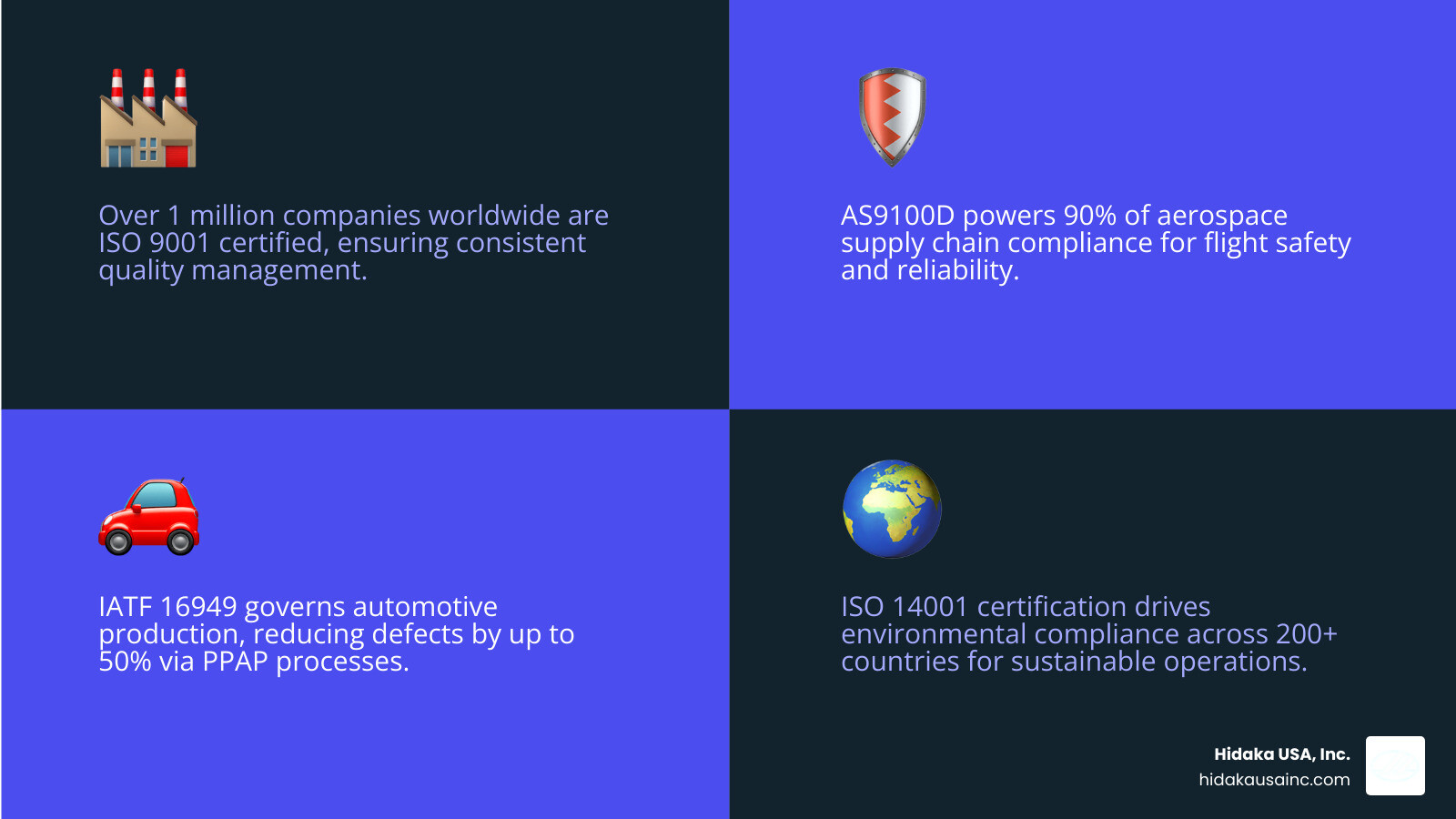
Manufacturing is a massive umbrella, but certain sectors have much stricter requirements than others. With over a billion estimated vehicles on the road worldwide, the automotive industry is a prime example of a sector that cannot afford a "close enough" attitude.
To keep the supply chain moving, we rely on Quality Management Systems (QMS) that emphasize continuous improvement. One of the most critical tools in this toolkit is the Production Part Approval Process (PPAP). This isn't just a one-time check; it’s a standardized system that ensures a supplier can consistently produce parts that meet the customer's requirements during an actual production run.
| Feature | ISO 9001 | AS9100 |
|---|---|---|
| Focus | General Quality Management | Aerospace & Defense Quality |
| Applicability | Any Industry | Aerospace Supply Chain |
| Risk Management | General | High-Level/Mission Critical |
| Audit Cycle | 3 Years (Annual Surveillance) | 3 Years (Annual Surveillance) |
Quality Management in the Automotive Sector
In the automotive world, IATF 16949 is the gold standard, often working alongside ISO 9001. For us at Hidaka USA, Inc., serving the automotive and motorsports industries means living and breathing these requirements. Whether we are working on initial prototype development or transitioning into mass production, PPAP requirements ensure that every weld and every cut is documented and verified. It’s about creating a repeatable, reliable process that stands up to the rigors of the road.
High-Risk Industries & Cetrifications: Aerospace and Defense
Aerospace is even more demanding. AS9100D certification is a prerequisite for any supplier looking to work with major aerospace firms. This standard is required for both new product development and any changes to existing products. In this sector, "compliance" means flight safety. There is zero room for error when a part is destined for a commercial jet or a military defense system.
Sector-Specific Standards: From Healthcare to Energy
While ISO standards are great for general quality, many sectors require specialized "passports" to enter the market.
In the Oil and Gas sector safety is the top priority. Because offshore rigs are often isolated, they must be self-sufficient in terms of maintenance, resource use, and offshore compliance. To work in these environments, companies often need specific registrations like:
- CRC Petrobras: Essential for supplying goods and services to Petrobras operations.
- ONIP Register: Used for oil and gas exploration in specific regions.
- DUNS Register: A global standard used for international bidding and hiring by the UN or EU.
In healthcare, the focus shifts to data security and patient safety. Healthcare digital certificates are vital for things like EPCS prescribing (Electronic Prescription of Controlled Substances), which must meet strict DEA mandates. Manufacturers in this space must also adhere to ISO 13485, which is specifically designed for medical device quality management.
The Role of Certifications in STEM Education and Career Growth
Certifications aren't just for established corporations; they are the bridge that carries students from the classroom to the factory floor. Programs like FIRST Robotics and VEX are doing incredible work here.
For instance, VEX V5 STEM Labs offer over 65 hours of free instruction covering everything from math and science to engineering and programming. These lessons are aligned with national standards, providing students with the foundational skills they need before they even step foot in a professional shop.
Other notable programs include:
- Project Lead The Way (PLTW): The Project Lead The Way (PLTW) engineering curriculum includes year-long classes that incorporate RECF certification standards.
- ITEEA Engineering byDesign: The ITEEA Engineering byDesign program integrates STEM concepts with hands-on, project-based learning.
These programs offer "stackable credentials." A student might start with a basic robotics certification and eventually add credentials in CNC milling, 3D printing, or CAD design through partners like Mastercam or Solidworks. This makes them "career-ready" the moment they graduate.
Navigating Industries & Cetrifications for Career Advancement
For professionals already in the workforce, certifications are the fastest way to climb the ladder. In the health industry, a PALS (Pediatric Advanced Life Support) certification is a game-changer for those moving into pediatric care. In the business world, digital marketing certifications from Google or Adobe are often considered more valuable than a traditional degree because they prove you have current, tactical skills.
How to Obtain and Maintain Professional Certifications
Getting certified is a journey, not a destination. Organizations like the Operations Management Institute (OMI) offer specialized training for operations managers across 20+ industries. They provide both "Professional" and "Manager" level credentials (like CMOP™ and CMOM™) to help leaders master the unique terminology and tactical skills of their specific field.
The process usually looks like this:
- Training: Completing the required hours of instruction (online or in-person).
- Audit/Exam: A third-party registrar or instructor validates your knowledge or your company's processes.
- Annual Surveillance: Most major certifications require an annual check-up to make sure you haven't let your standards slip.
- Three-Year Renewal: Every three years, a full re-certification audit is typically required.
It’s a rigorous cycle, but it ensures that "quality" is a daily habit rather than a wall decoration.
Frequently Asked Questions about Industries & Cetrifications
What is the difference between general and sector-specific certifications?
Think of ISO 9001 as the "General Education" of the business world—it proves you have a solid Quality Management System that can apply to almost any business. Sector-specific certifications, like AS9100 for aerospace or IATF 16949 for automotive, add layers of industry-unique requirements. They focus on specific tactical skills, unique terminology, and higher levels of risk management that are only relevant to that particular field.
Why should companies choose suppliers with ISO 9001 or AS9100 certifications?
Choosing a certified supplier is about protecting your own reputation. When we at Hidaka USA, Inc. maintain our ISO 9001 certification, we are giving our clients objective evidence that we follow verifiable standards. It provides independent validation that our processes—from the moment a file is uploaded to the moment a part is shipped—are controlled and consistent.
What are the costs and renewal processes for major certifications?
While costs vary depending on the size of the company and the complexity of the audit, the process is fairly standardized. Most ISO standards are upgraded every 7-10 years to stay current with technology. Companies undergo a three-year audit cycle, which includes a heavy initial audit followed by annual surveillance visits from third-party registrars to ensure ongoing compliance.
Conclusion
At Hidaka USA, Inc., we’ve seen how Industries & Certifications drive excellence. Since 1989, we’ve called Dublin, Ohio home, and our commitment to quality has only grown. By maintaining our ISO 9001 and American Welding Society (AWS) certifications, we ensure that every part we produce for the automotive, mass-transit railcar, and motorsports industries meets the highest possible standards.
Whether you are looking for high-quality American-made prototypes or mass-produced assemblies, choosing a certified partner is the first step toward success. If you want to see how our certified processes can help your next project, check out more info about asset capabilities on our website. We're here to help you navigate the complex world of manufacturing with precision, safety, and a little bit of Buckeye pride.