
How Custom Metal Forming for Motorsports Keeps You on the Track


Choosing Custom Motorsports Component Fabrication for Race Parts
For custom motorsports component fabrication, start with the part's load, weight, fit, and testing needs. Choose a fabrication process that can produce a test part quickly and make it consistently if the design moves into production. Laser cutting, hydraulic pressing, and welding can be used to make and assemble metal components; inspection helps confirm that each part fits as intended on the chassis.
Racing parts must hold up under severe vibration, thermal cycling, and repeated dynamic loads, often within tight development schedules. A clear design and a short test-and-revise cycle help teams find mechanical problems long before initial track deployment or full production runs begin.
I am Yoshihiro Hidaka, founder of Hidaka USA, Inc. My background in automotive prototypes and production informs my approach to custom motorsports component fabrication, from early design work to repeatable metal parts for elite teams.
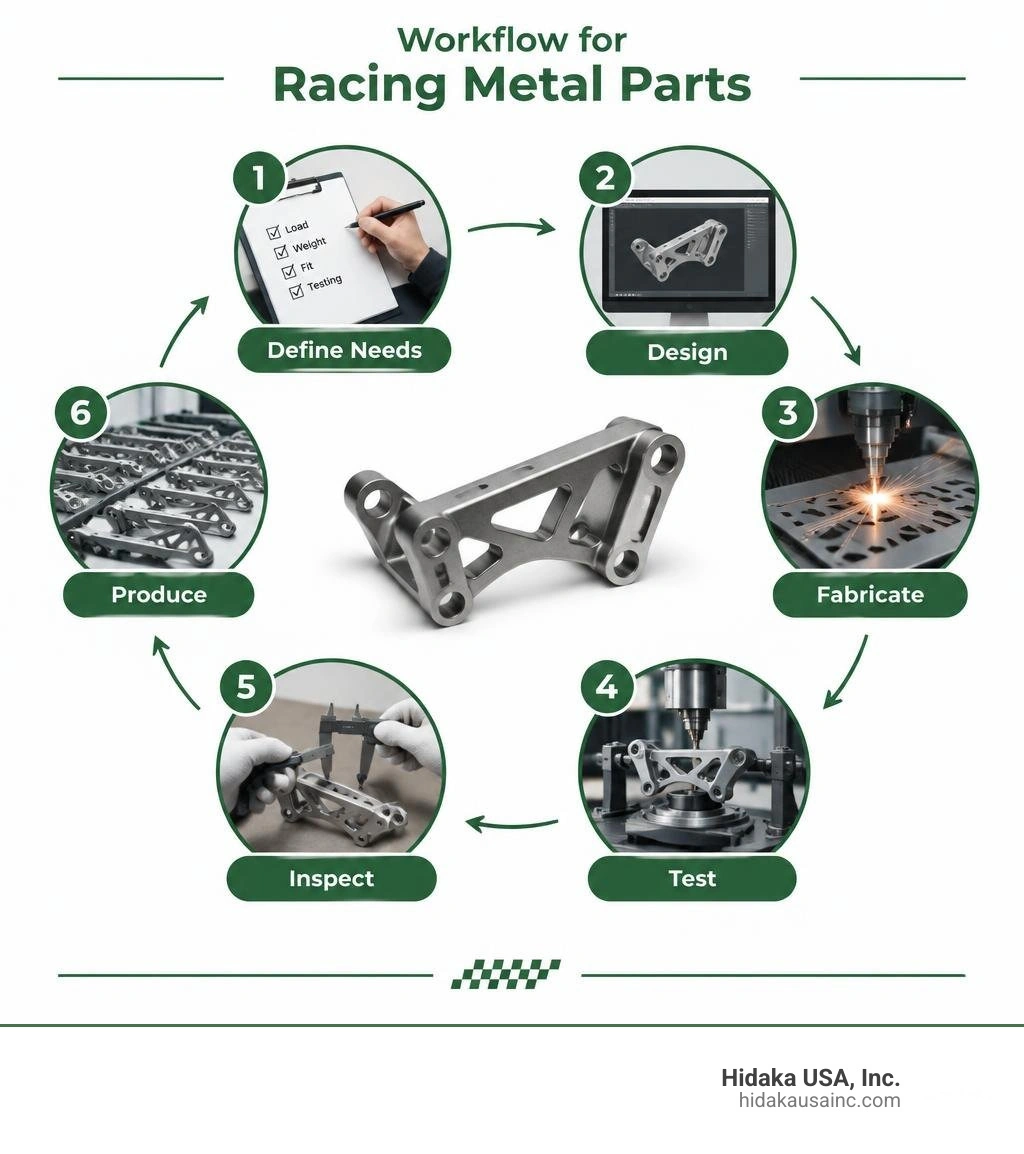
Quick custom motorsports component fabrication definitions:
The Critical Role of Custom Motorsports Component Fabrication on the Track
Racing pushes mechanical limits far beyond anything experienced in standard automotive applications. Components encounter extreme rotational speeds, cyclic thermal spikes, continuous chassis flex, and brutal aerodynamic loads across every lap. Under these punishing conditions, standard off-the-shelf catalog parts often fall short. Generic brackets and structural members can introduce unnecessary bulk or create weak stress concentration points that lead to premature fatigue failures under high g-force cornering.
Achieving maximum track speed demands aggressive weight reduction paired with uncompromised structural integrity. Every single gram saved above the roll center significantly improves vehicle handling responsiveness, while dedicated thermal stress management ensures critical assemblies remain stable under relentless track temperatures. Meeting these demanding engineering objectives requires specialized motorsport engineering services capable of turning high-tolerance engineering concepts into fully functional hardware ready for competition.
Rapid Iteration and Custom Motorsports Component Fabrication for Dyno Validation
In high-stakes racing programs, dynamometer validation serves as the ultimate proving ground before hitting the circuit. Consider high-output racing engines, such as the lightweight 800cc V4 MotoGP platforms developed to meet strict displacement caps while generating nearly 210 horsepower at an astounding 18,000 rpm. Operating at these extreme rotational speeds generates severe crankcase windage, oil aeration, and volatile intake resonance harmonics.
To validate performance under such brutal conditions, powertrain engineers develop specialized physical test hardware including dyno-specific intake manifolds, custom air inlets, high-efficiency oil scrapers, and internal sump baffles. Fabricating these dynamic fluid-management components quickly allows engineering teams to control lubrication flow and air routing on the test bench, dialing in engine maps before committing to final configurations.
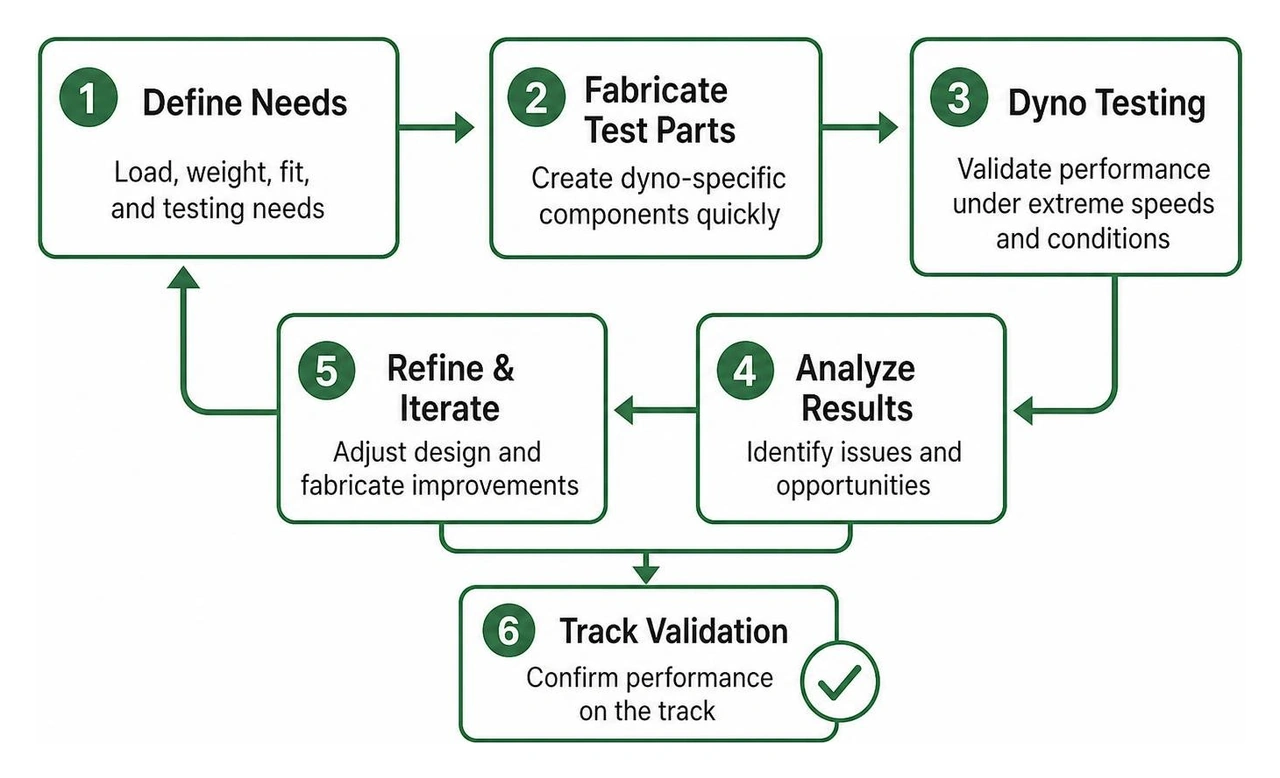
Engineering Agility in Custom Motorsports Component Fabrication
Agility often determines who reaches the top step of the podium. When sanctioning bodies alter technical regulations mid-season or real-time track telemetry demands immediate geometry revisions, waiting weeks for replacement components is out of the question. As the racing adage goes, if size was the only thing that mattered, dinosaurs would still be walking the earth. Agility wins races.
A prime example is the manufacturing of precision scavenge pump housings, custom fuel rails, and lightweight cylinder head brackets. Specialized manufacturing partners have repeatedly delivered critical engine components with tight tolerance envelopes in as little as one week. Delivering race-ready components within days rather than months enables competitive race programs to adapt to seasonal rule changes seamlessly. By partnering with experts providing custom prototype engineering solutions, teams compress their development cycles and validate complex assemblies without missing scheduled race weekends.
Essential Metal Forming Processes for Race Teams

Fabricating lightweight, resilient racing parts requires sophisticated manufacturing equipment that balances dimensional precision with optimal material strength. Sheet metal forming using hydraulic press technology creates rigid, lightweight structural parts that outmatch solid billet parts in continuous stress applications.
Hydraulic pressing aligns the natural grain structure of the metal with the component's geometry, significantly boosting resistance to fatigue from continuous track vibrations. By applying prototype sheet metal fabrication, fabricators produce complex structural components—such as suspension gussets, floor pans, heat shields, and crash structure brackets—with consistent wall thicknesses and exceptional strength-to-weight ratios across demanding racing environments.
Combining Laser Cutting and Press Forming for Intricate Geometries
Modern metal shaping relies on the seamless integration of laser trimming and multi-axis forming technologies. High-power 2D cutting tables quickly profile the initial flat blanks, while 5-axis 3D laser systems trim formed parts post-press, ensuring smooth edge quality and mitigating the heat-affected zone across sensitive alloys.
Using advanced prototype laser cutting allows technicians to cut complex hole patterns, weight-saving cutouts, and interlocking alignment tabs with minimal thermal distortion. When assembling complex chassis elements, integrating laser cut prototype assemblies guarantees that mating joints align perfectly before final joining procedures commence.
Precision Post-Forming Finishing
Forming thin-gauge or high-strength sheet metal under heavy hydraulic tonnages can introduce residual stresses or unpredictable material springback. Precision post-forming processes ensure that critical mounting points, sealing faces, and bearing interfaces achieve perfectly flat, accurate dimensions.
Through localized secondary trimming, secondary restrike pressing, and precision deburring, fabricators achieve tight dimensional tolerances across complex curved surfaces. This hybrid manufacturing approach delivers functional metal components that bolt directly to chassis and engine assemblies without requiring manual modification in the paddock during intense pit stops.
Advanced Joining, Materials, and Quality Control for Racing Components
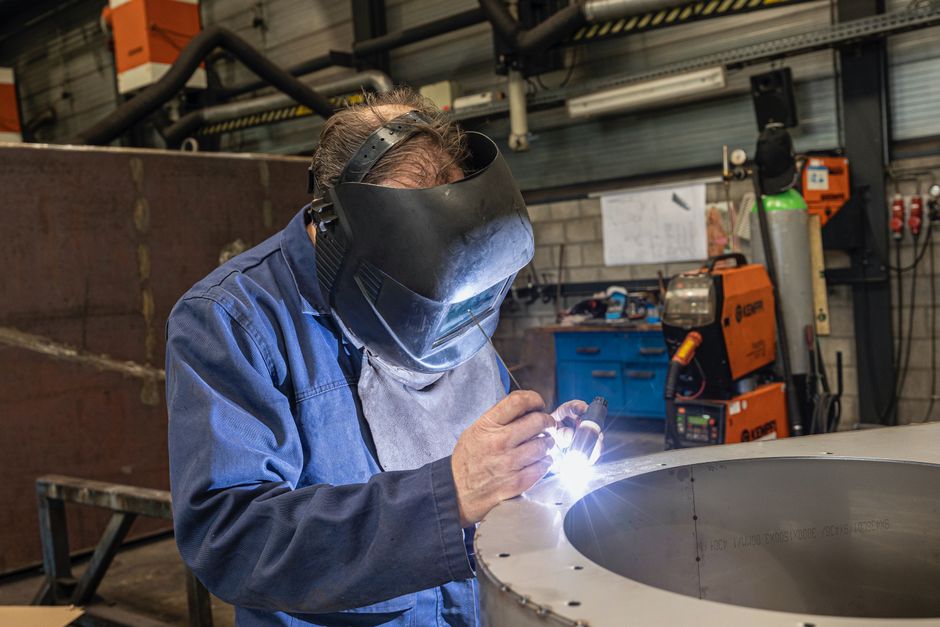
Motorsports hardware requires carefully chosen alloys that balance lightweight properties with thermal and tensile durability. Fabricators regularly work with aerospace-grade aluminum alloys (such as 6061-T6 and 7075), advanced high-strength steels, stainless alloys for exhaust systems, and high-strength titanium alloys.
Joining these high-performance metals requires meticulous heat input control to avoid thermal warpage and maintain base-metal strength across heat-affected zones. Whether you are assembling structural nodes for dedicated open-wheel racecars or creating high-downforce aero mounts for a street-legal track car, maintaining proper welding protocols is essential. We rely on certified AWS certified prototype welding practices to ensure total weld integrity across safety-critical components like roll cages, suspension arms, subframe crossmembers, and pressurized fluid tanks.
High-Precision Assembly and Rigorous Inspection
Fabricating a single metal piece is only half the battle; assembling multi-part systems demands rigorous dimensional verification at every stage. Using coordinate measuring machines (CMM), 3D optical scanning arms, and non-destructive testing (NDT), quality engineers verify that every fabricated bracket matches the CAD model down to the specified micron range.
Our 95,000-square-foot Dublin, Ohio facility operates under strict ISO 9001 certified quality standards. By integrating high precision metal assemblies with advanced prototype engineering services, race teams can trust that sub-assemblies will fit the chassis cleanly during tight pit-lane rebuilds.
Scaling from Track Prototypes to Full Batch Production
Once extensive track testing validates a new design, the manufacturing process shifts seamlessly from one-off prototypes to small-batch or full-scale production. Consistency across batches is vital for spec racing series and commercial track-day vehicle manufacturers who need identical replacement parts throughout the racing season.
Transitioning from quick-turn rapid metal prototyping to dedicated modular tooling allows for reliable, high-volume sheet metal fabrication. Deploying innovative engineering solutions across tool design, stamping, and automated assembly guarantees that the hundredth part formed in our press delivers the exact same fit and strength as the initial track-proven prototype.
Frequently Asked Questions About Motorsports Component Fabrication
How fast can custom motorsports metal prototypes be delivered for testing?
Emergency turnaround schedules frequently deliver functional, single-piece metal prototypes and modified test brackets in 5 to 7 business days. When crucial dyno sessions or race weekends are rapidly approaching, expedited workflows—leveraging 2D/3D laser cutting and soft modular forming tools—bypass long-lead hard tooling to deliver test-ready components quickly and reliably.
What is the advantage of press-formed sheet metal over billet machining for race parts?
While 5-axis CNC machining excels at thick, solid structural parts, press-formed sheet metal assemblies offer superior strength-to-weight ratios for enclosures, fluid tanks, brackets, and body framing. Forming retains continuous metal grain flow along contour curves, increasing fatigue resistance under dynamic vibration. Sheet metal fabrication also significantly reduces raw material waste and lowers per-part cycle times during production runs.
How do fabricators maintain tight tolerances on thin-gauge racing parts?
Fabricators control tolerances on thin materials by combining precision 3D laser trimming, rigid hydraulic press clamping, dedicated welding fixtures, and automated CMM inspection. Advanced press-brake and hydraulic tool design accounts for material-specific springback, ensuring formed bends stay within exact drawing tolerances even under harsh, continuous track conditions.
Conclusion
Success in motorsports is decided by fractions of a second, making reliable manufacturing partners essential for building a winning car. At Hidaka USA Inc., we combine decades of automotive and racing experience with over 95,000 square feet of advanced manufacturing space in Dublin, Ohio. From initial design consultation and rapid metal prototyping to high-precision welding and full-rate production, we deliver the precision components you need to stay ahead of the competition.
Explore our custom prototyping capabilities and mass production services at Hidaka USA Inc. to start engineering your next track-ready solution.


