Making Millions of Parts Without Breaking a Sweat

What Is Custom High Volume Stamping and Why It Matters for Modern Manufacturers
Custom high volume stamping is a precision metal forming process that uses specialized dies and presses to produce large quantities of identical metal parts — often millions — with tight tolerances and consistent quality.
Quick answer: What is custom high volume stamping?
| Element | Details |
|---|---|
| Process | Flat metal strips or coils are fed into stamping presses fitted with custom dies that cut, bend, punch, or draw the metal into a specific shape |
| Volume | Typically starts at 30,000 pieces per run, scaling into the millions |
| Speed | High-speed presses can run up to 1,200–1,500 strokes per minute |
| Precision | Typical tolerances of ±0.02mm, suitable for safety-critical parts |
| Common methods | Progressive die, transfer stamping, four-slide/multi-slide |
| Key industries | Automotive, aerospace, electronics, medical, appliances |
| Main benefit | Lowest per-unit cost at scale, with repeatable, die-controlled accuracy |
For automotive manufacturers and other OEMs, keeping assembly lines running means having a steady supply of parts that are accurate every single time. A single inconsistent component can stop a production line — and every minute of downtime is costly. That is why custom high volume stamping has become one of the most relied-upon manufacturing methods across industries that demand both speed and precision.
Unlike low-volume or prototype stamping, high-volume stamping is designed from the ground up for repeatability. Once a custom die is engineered and approved, the same shape can be reproduced millions of times without variation. This makes it especially well-suited for automotive body panels, electronic connectors, aerospace brackets, and other components where deviation is not acceptable.
I'm Yoshihiro Hidaka, founder of Hidaka USA, Inc., and I've spent over three decades applying custom high volume stamping to real-world automotive and mass production challenges — first as a sheet metal fabrication supplier starting in 1989, and growing into a full mass-production partner for OEMs across multiple industries. In the sections that follow, I'll walk you through exactly how this process works, what equipment and materials are involved, and how to ensure quality at scale.

Custom high volume stamping terms simplified:
Defining Custom high volume stamping and Its Core Advantages
When we talk about Custom high volume stamping, we are essentially describing a manufacturing superpower. It is the ability to take a raw coil of metal and, through a series of highly orchestrated mechanical "punches," turn it into a finished, complex component in a matter of seconds. In April 2026 manufacturing, this isn't just about making things fast; it’s about making things smart.
The primary advantage is simple: unit cost reduction. In the early stages of a project, the investment in custom tooling can seem significant. However, as the production volume climbs into the hundreds of thousands or millions, that initial cost is amortized until the price per part becomes incredibly low. This is how modern electronics and vehicles remain affordable despite their complexity.
Beyond cost, the repeatability is unmatched. When you use a die-controlled process, the millionth part looks exactly like the first. This level of consistency is a cornerstone of Custom High Volume Stamping Solutions at Hidaka USA, where we focus on ensuring that every component meets the original design specifications without fail.

The Difference Between Prototyping and Mass Production
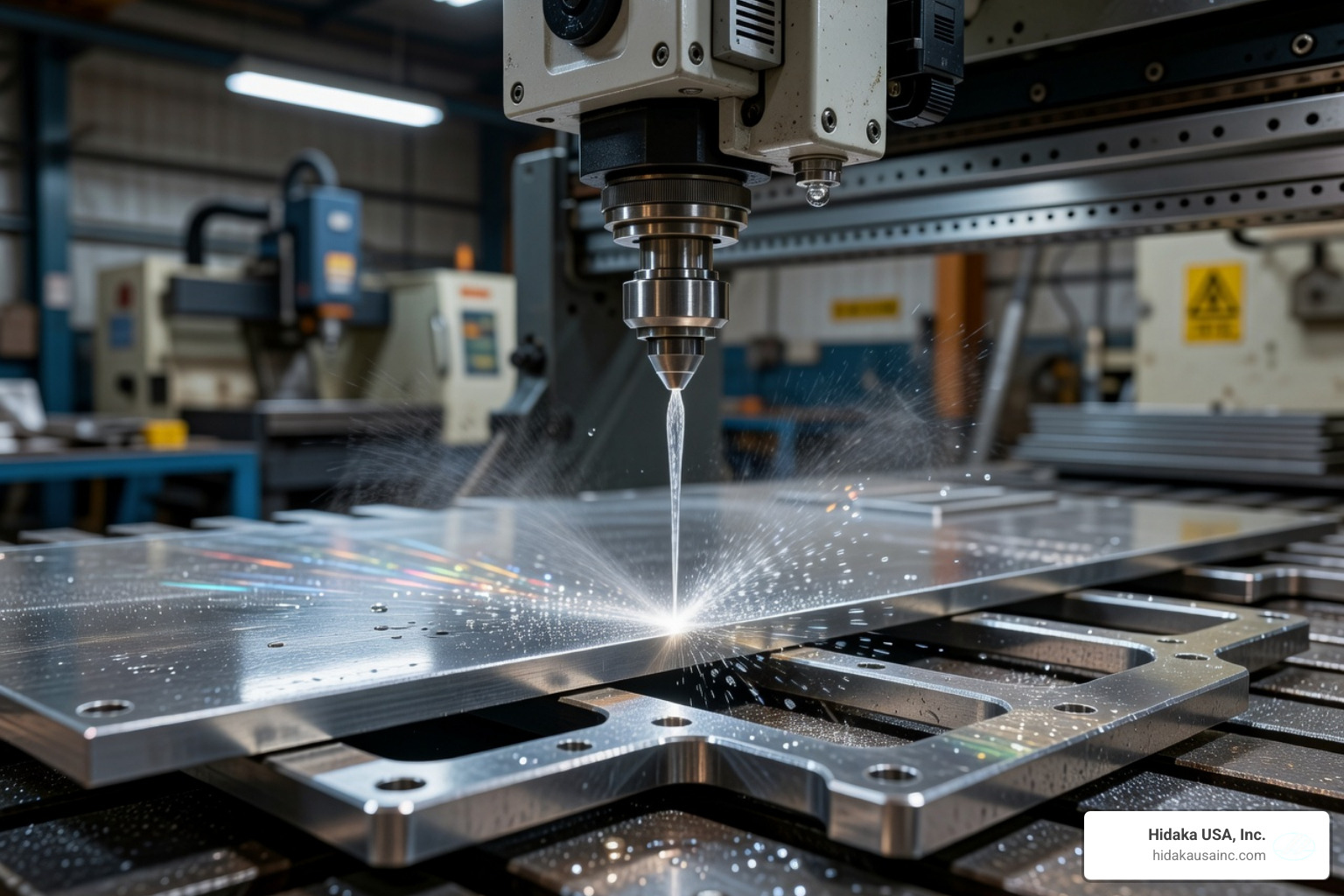
It is helpful to think of prototyping and mass production as two different mindsets. Prototyping is about "proof of concept." It’s a short-run process where we might produce 1 to 500 parts to test a design, often using 2D/3D laser cutting or soft tooling.
Mass production, or Custom high volume stamping, typically kicks in when your requirements exceed 30,000 pieces. While prototyping focuses on flexibility and speed of design changes, mass production focuses on efficiency and stability. If you are still in the testing phase, you might want to look at our prototyping services to refine your design before committing to the high-speed dies used in long-run production.
Key Benefits for Modern OEMs
For an Original Equipment Manufacturer (OEM), the benefits of high-volume stamping extend into every corner of the business:
- Material Efficiency: Advanced die design minimizes "scrap" metal. By nesting parts closely on the metal strip, we can get more parts out of every pound of material.
- Labor Cost Reduction: Because the process is highly automated—often assisted by robotics—the amount of manual labor per part is negligible.
- Geometric Complexity: Modern progressive dies can perform multiple operations—punching, coining, bending, and even tapping threads—within a single press stroke.
By utilizing these Precision Metal Stamping Capabilities, companies can tackle intricate designs that would be too slow or expensive to machine or cast.
High-Speed Processes and Equipment Capacities
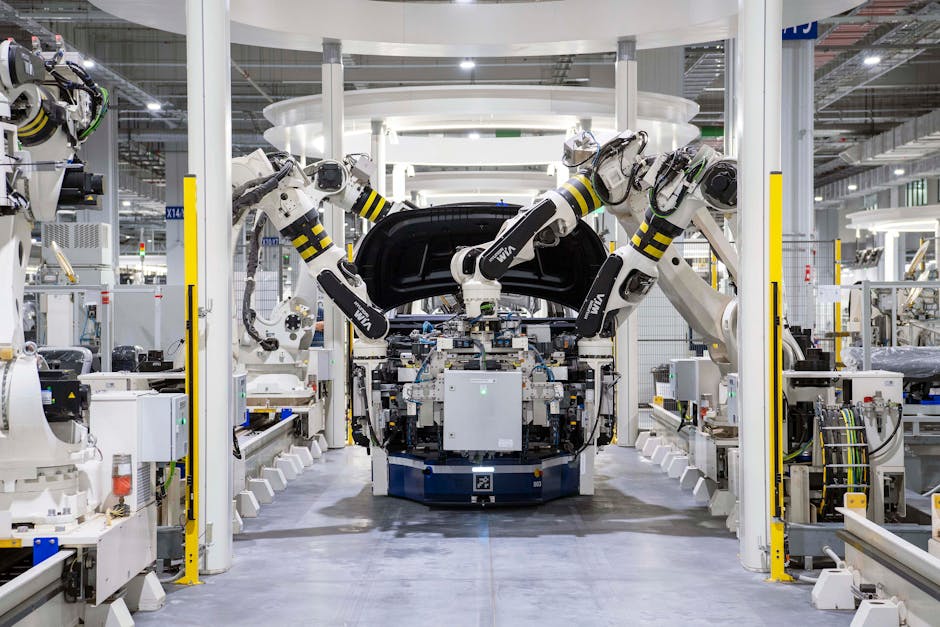
To "make millions of parts without breaking a sweat," you need the right heavy machinery. High-volume stamping doesn't happen on a workbench; it happens in massive press rooms where the floor literally vibrates with the rhythm of production.
Equipment capacity is usually measured in "tonnage"—the amount of force the press can exert—and "strokes per minute" (SPM). In our industry, we see a wide range of needs. Some small, intricate electronic parts are produced on high-speed presses running at a staggering 1,500 SPM. Meanwhile, larger structural automotive parts might require heavy-duty presses with capacities up to 1,300 tons to move thicker gauges of steel.
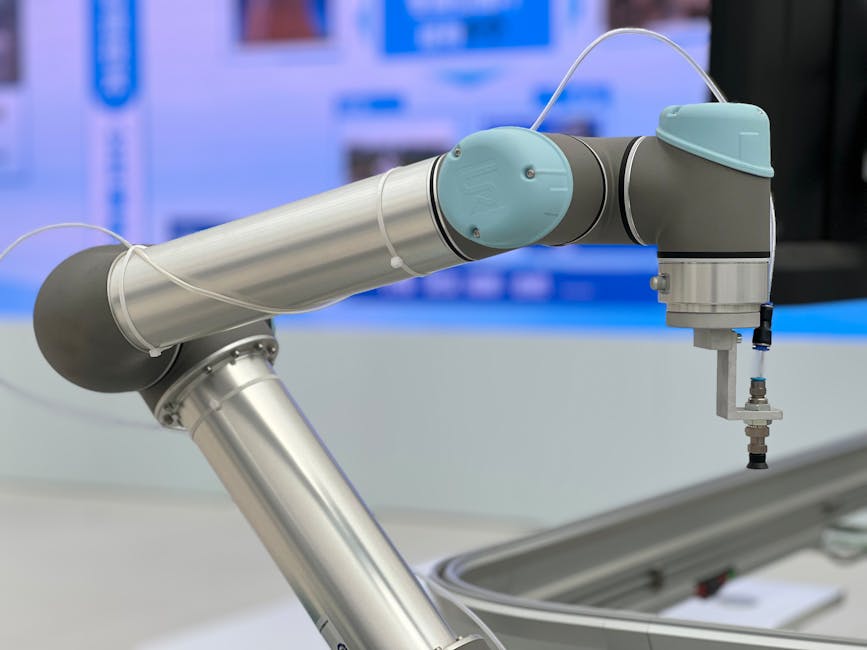
Technology from leaders like Bruderer and Minster has set the standard for these operations. These presses are built for "uptime," meaning they can run 24/7 with minimal maintenance, which is essential when you have a Just-In-Time (JIT) delivery schedule to meet. You can see how we integrate these technologies by exploring our Advanced Stamping Equipment and Technology.
Progressive Die Stamping for Custom high volume stamping
Progressive die stamping is the "marathon runner" of the stamping world. In this process, a coil of metal is fed into the press. The die has multiple "stations." As the metal moves through, each station performs a different task.
- Station 1: Punches a pilot hole.
- Station 2: Cuts the outer contour.
- Station 3: Bends a tab.
- Station 4: Finalizes the shape and ejects the part.
All of this happens simultaneously with every stroke of the press. This results in incredibly high throughput and is the preferred method for most mass production services.
Transfer and Four-Slide Stamping Methods
While progressive dies keep the part attached to the metal strip until the very end, Transfer Stamping uses robotic fingers to move individual parts from one die station to the next. This is ideal for larger parts or those that need to be turned over or manipulated in ways a strip won't allow.
Four-Slide (or Multi-Slide) Stamping is a different beast entirely. Instead of a vertical press motion, it uses four horizontal slides that strike the part from different angles. This is "scrap-less" or "low-scrap" production at its finest, perfect for intricate wire forms or small connectors with multiple bends. It offers incredible multi-axis forming capabilities that a standard press just can't match.
Material Selection and Quality Assurance
Choosing the right material is as much about the manufacturing process as it is about the final use of the part. Some metals "flow" better under pressure, while others might be prone to cracking if the bend is too sharp.
Material Suitability for High-Volume Stamping
| Material | Strength | Corrosion Resistance | Common High-Volume Uses |
|---|---|---|---|
| Aluminum | Medium | High | Automotive weight reduction, heat sinks |
| Stainless Steel | High | Excellent | Medical devices, exhaust components |
| Copper | Low | Medium | Electrical terminals, busbars |
| Brass | Medium | Medium | Decorative hardware, connectors |
| High-Strength Steel | Very High | Low (requires coating) | Safety-critical automotive brackets |
Our Material Expertise in Metal Stamping allows us to help you navigate these choices, ensuring the material you pick is compatible with high-speed production.
Ensuring Precision in Custom high volume stamping
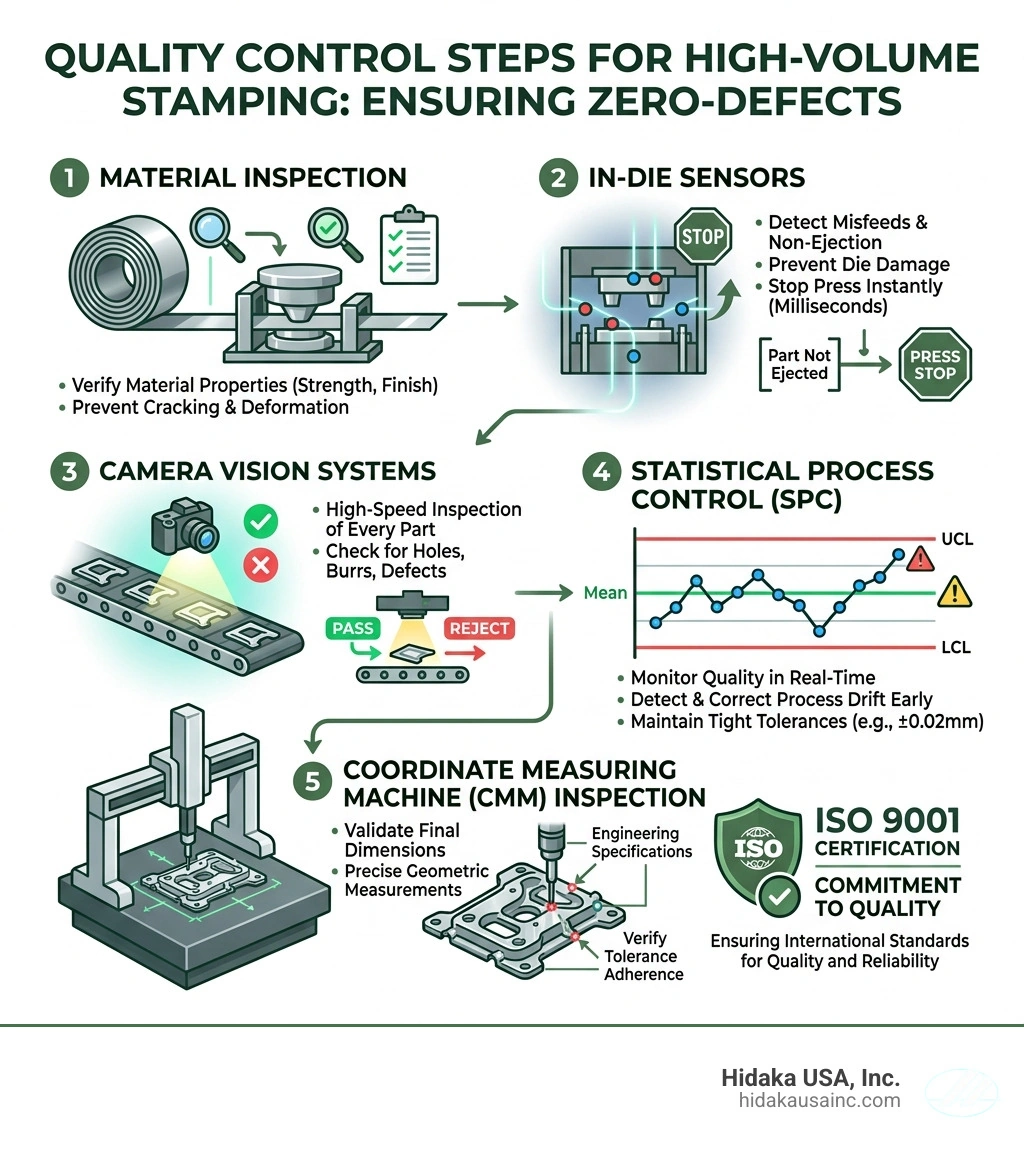
In high-volume production, "close enough" is never good enough. We often work with tolerances as tight as ±0.02mm. To maintain this across a million parts, we use Statistical Process Control (SPC). This involves taking regular measurements during the run and plotting them on a graph. If we see the dimensions starting to "drift"—perhaps because a die component is wearing down—we can stop and fix it before a single bad part is made.
This commitment to zero-defect quality is what prevents the assembly line shutdowns that keep OEM managers up at night. You can read more about our Quality Control and Precision Standards to see how we maintain these levels.
Advanced Monitoring and Certifications
Modern high-volume stamping is "smart." We use in-die sensors that can detect if a part didn't eject or if the metal strip didn't feed correctly. If a problem is detected, the press stops instantly—in milliseconds—to prevent damage to the expensive custom die.
Camera vision systems also act as high-speed inspectors, taking photos of every single part as it leaves the press to check for holes, burrs, or surface defects. To back this up, Hidaka USA maintains ISO 9001 certification, ensuring our management and production processes meet international standards for quality and reliability.
Frequently Asked Questions about High-Volume Stamping
What is the typical lead time for new high-volume tooling?
Tooling is the longest "lead time" item in any project. A simple single-hit die might take 2 to 4 weeks to design and build. However, a complex progressive die for a high-speed automotive part typically requires 4 to 8 weeks. This includes the design phase, the actual machining of the tool steel, and the "try-out" phase where we fine-tune the die to ensure the parts meet your specs. A "design freeze"—where you agree not to change the part shape—is essential before we start cutting steel!
How do companies handle design changes after tooling is built?
We get it—designs evolve. If a change is needed after the die is built, we often use modular die inserts. Instead of rebuilding the whole tool, we just replace the specific section (the "insert") that creates that feature. We perform a cost impact analysis and DFM (Design for Manufacturability) adjustment to see how the change affects the production speed and material waste.
Who owns the stamping dies in a high-volume partnership?
At Hidaka USA, we believe in transparency. Generally, the client pays for the custom tooling, and therefore, it remains your intellectual property. We store and maintain the dies on your behalf in our climate-controlled facility in Dublin, Ohio. Our maintenance protocols include regular sharpening and inspection after every run to ensure the tool is ready for the next "million-part" order.
Conclusion
At Hidaka USA, Inc., we've been helping the automotive and mass-transit industries "make millions" since 1989. From our 95,000-square-foot facility in Dublin, Ohio, we provide the engineering depth and press capacity needed for the most demanding custom high volume stamping projects.
Whether you are looking for a partner to handle your next high-speed automotive run or need expert guidance on transitioning from a prototype to a mass-produced assembly, our ISO 9001-certified team is ready to help. We combine American-made quality with global manufacturing standards to ensure your parts are delivered on time, every time, without breaking a sweat.
Ready to start your next high-volume project? Visit us at https://hidakausainc.com/ to learn more about our capabilities.