Why High Volume Stamping is the Engine of Auto Manufacturing


Why High-Volume Automotive Stamping Drives Modern Auto Manufacturing
Automotive stamping high volume is the process of producing large quantities of precision metal parts using automated stamping presses, progressive dies, and advanced coil-fed systems — and it is the backbone of every modern vehicle assembly line.
Key facts at a glance:
- What it is: Repeatedly forming sheet metal into exact shapes using high-speed presses, often thousands of parts per hour
- Why it matters: Assembly lines cannot stop — consistent, on-time part supply is critical
- Core benefit: Lower cost per part, tighter tolerances, and repeatable quality at scale
- Common parts made: Body panels, chassis frames, brackets, EV battery enclosures, drivetrain components
- Key technology: Progressive die stamping, servo presses, automated coil feeding, real-time in-die sensors
- Quality standard: IATF 16949 certification is the baseline requirement for automotive suppliers
Every vehicle on the road today contains dozens — sometimes hundreds — of stamped metal components. Without high-volume stamping, meeting the pace and precision demands of modern automotive assembly would simply not be possible. Even a brief production delay can cost an assembly plant thousands of dollars per minute.
I'm Yoshihiro Hidaka, founder of Hidaka USA, Inc., and I have spent over three decades in the automotive supply chain — beginning with prototypes and growing into full mass production — giving me direct, hands-on experience with the demands and disciplines of automotive stamping high volume. In the sections below, I'll break down exactly how this process works, what drives quality and consistency, and what manufacturers should look for in a long-term stamping partner.
Discover more about Automotive stamping high volume:
Defining Automotive Stamping High Volume and Its Strategic Importance
In the world of April 2026, the automotive industry moves at a speed that would baffle manufacturers from just a few decades ago. When we talk about automotive stamping high volume, we aren't just talking about making "a lot" of parts. We are talking about a strategic manufacturing pillar that enables the mass production of vehicles for a global market.

The most significant driver behind high-volume stamping is the concept of economies of scale. In metal stamping, the initial cost of designing and building a die is significant. However, once that "hard tooling" is perfected, the cost of producing each subsequent unit drops dramatically. When a program calls for millions of pieces over a multi-year platform lifespan, this unit cost reduction becomes the difference between a profitable vehicle launch and a financial struggle.
Beyond cost, the strategic importance lies in repeatability. A Tier 1 supplier or OEM needs the millionth part to be identical to the first. High-volume stamping provides this dimensional stability, ensuring that when parts reach the assembly plant, they fit perfectly into welding jigs and robotic assembly cells. This supports Just-in-Time (JIT) delivery—a system where parts arrive exactly when they are needed, reducing inventory overhead and keeping the factory floor lean. In an industry where downtime is the ultimate enemy, the speed and reliability of high-volume stamping lines are what keep the "Motor City" and its global counterparts humming.
Core Technologies Powering High-Volume Production
To achieve the force and speed required for automotive stamping high volume, we rely on heavy-duty machinery. The "stars" of the stamping floor are the presses, which can range from small 35-ton units to massive 1,500-ton giants with large-bed capacities.
Press Types and Capabilities
Different parts require different "touches." Here is how the primary press technologies compare:
| Press Type | Best For | Key Advantage |
|---|---|---|
| Mechanical Press | Large panels, structural parts | High speed and consistent stroke energy |
| Servo Press | Complex geometries, high-strength steels | Complete control over slide position and speed |
| Hydraulic Press | Deep drawing, heavy gauge forming | Consistent pressure throughout the entire stroke |
| Forging Press | Drivetrain and engine components | Massive tonnage for high-density metal flow |
Mechanical presses are the workhorses for high-speed panel stamping, often capable of producing thousands of parts per hour. However, as we move into 2026, servo technology has become increasingly vital. Servo presses allow us to "profile" the stroke—slowing down at the point of contact to prevent material tearing and speeding up during the rest of the cycle.
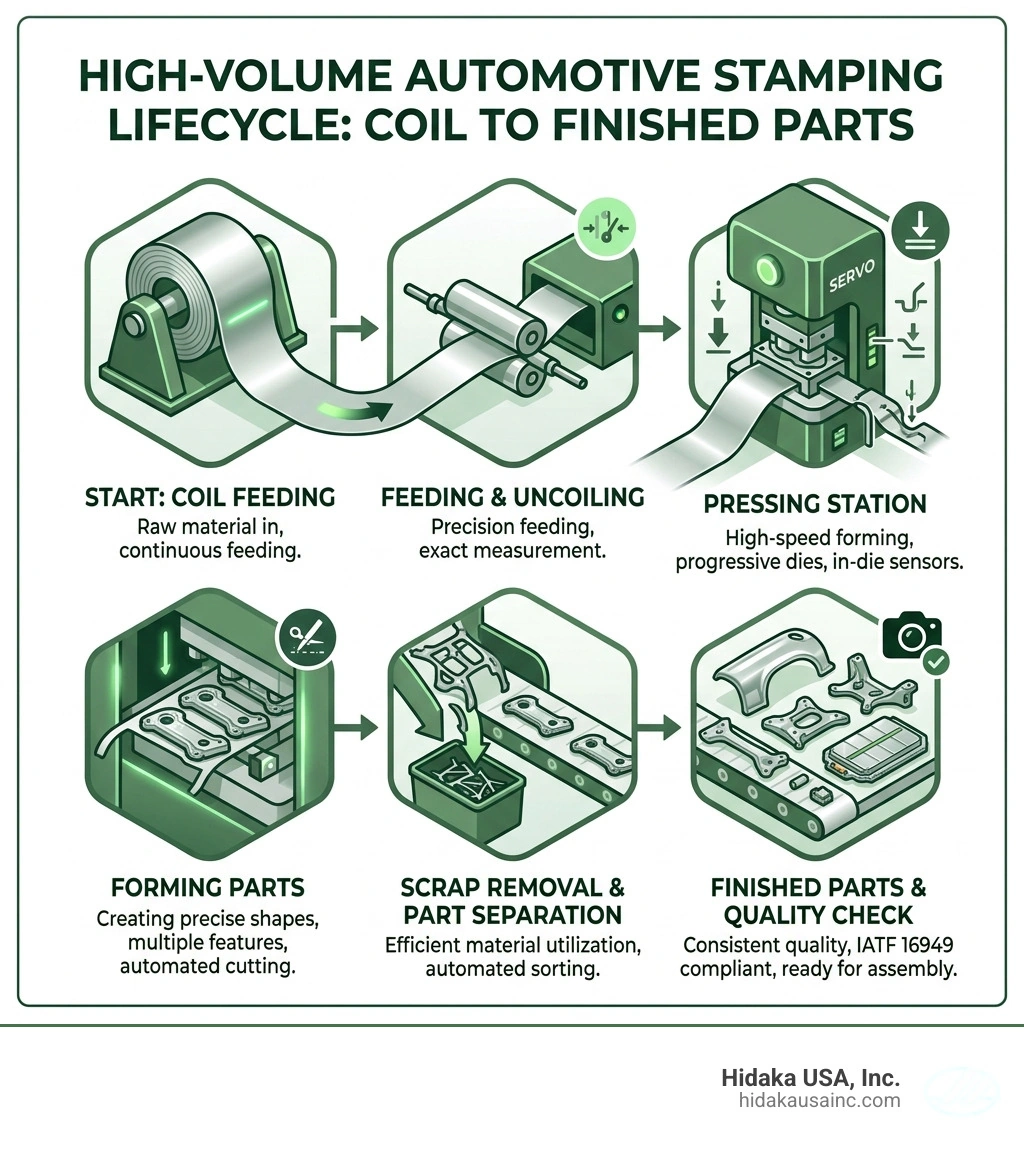
To keep these machines running, we utilize automated coil feeding systems. These lines unspool massive rolls of steel or aluminum, straighten the material to remove "coil set," and feed it into the press with laser-like precision. To minimize downtime, we implement quick-die-change (QDC) systems, which allow us to swap out multi-ton tools in minutes rather than hours.
The Role of Progressive Die Stamping in Automotive Stamping High Volume
If the press is the muscle, the progressive die is the brain. In progressive die stamping, a strip of metal is fed through a series of stations within a single tool. At each station, a different operation is performed—punching, coining, bending, or lancing—until a finished part emerges at the end of the line.
This method is the gold standard for automotive stamping high volume because it maximizes material utilization and operates at incredibly high speeds—sometimes up to 1,500 strokes per minute for smaller components. Because the part remains attached to the metal strip (the "carrier") until the final stage, the alignment remains perfect throughout the process, allowing for the creation of incredibly complex geometries in a single pass.
Automation and Industry 4.0 in Automotive Stamping High Volume
We have entered the era of the "Smart Factory." Modern high-volume lines are no longer just "dumb" iron; they are integrated ecosystems. Industry 4.0 technologies allow us to monitor production in real-time.
- In-die sensors: These detect if a part hasn't ejected or if a punch has broken, stopping the press instantly to prevent tool damage.
- Real-time monitoring: Using QR codes and IoT connectivity, we can track the exact "birth certificate" of a part, including the material batch and the specific press conditions during its manufacture.
- Predictive maintenance: AI algorithms analyze vibration and heat data from the presses to predict when a bearing might fail, allowing us to perform maintenance before a breakdown occurs.
- Robotic Transfer: Automated arms seamlessly move larger parts between press stations, ensuring safety and consistency that human operators simply cannot match over an eight-hour shift.
Materials and Components in the Modern Vehicle
The "menu" of materials used in automotive stamping high volume has evolved rapidly. While traditional mild steel was once the standard, the push for fuel efficiency and safety has introduced more advanced alloys.
- High-Strength Low-Alloy (HSLA) Steel: Provides a great balance of strength and formability for structural components.
- Ultra-High-Strength Steel (UHSS): Used for safety-critical reinforcements like A-pillars and B-pillars to protect passengers during collisions.
- Aluminum Alloys: Crucial for lightweighting. By replacing steel panels with aluminum, we can significantly reduce vehicle weight, which is essential for extending the range of Electric Vehicles (EVs).
- Stainless Steel: Primarily used for exhaust systems and components that must withstand high heat and corrosive environments.
- Copper and Brass: With the rise of electrification, we are stamping more copper busbars and electrical connectors than ever before.
Critical Components Produced via Automotive Stamping High Volume
What exactly are we making? If you stripped a car down to its skeleton, you would see the fruits of high-volume stamping everywhere:
- Chassis Frames and Crossmembers: The structural backbone of the vehicle.
- Body Panels: Fenders, hoods, and door skins that define the vehicle's aesthetic.
- Structural Brackets: Thousands of small connectors that hold everything from the radiator to the seats in place.
- EV Battery Enclosures: Large, complex housings that must be perfectly sealed to protect battery cells.
- Drivetrain Components: Gears, transmission housings, and engine mounts.
- Safety Reinforcements: Intrusion beams and bumper reinforcements designed to absorb impact energy.
Quality Standards and Operational Excellence
In the automotive world, "good enough" doesn't exist. A single defective part can lead to a massive recall or, worse, a safety failure. This is why IATF 16949 certification is the non-negotiable standard for any serious stamping partner. This standard, set by the International Automotive Task Force, goes beyond basic ISO 9001 requirements to focus specifically on defect prevention and waste reduction in the automotive supply chain.
To maintain these standards, we employ several layers of operational excellence:
- Zero-Defect Manufacturing: We aim for a "PPM" (parts per million) defect rate that is effectively zero.
- Poka-Yoke (Error Proofing): Designing the process so that it is physically impossible to make a mistake (e.g., a part that only fits into a gauge one way).
- Statistical Process Control (SPC): Monitoring the dimensions of parts in real-time to identify "trends" toward the edge of a tolerance limit before a bad part is even made.
- 3D CMM Inspection: Using Coordinate Measuring Machines to verify that complex geometries match the original CAD engineering designs down to the micron.
Frequently Asked Questions about High-Volume Stamping
What is the difference between progressive and transfer stamping for high volumes?
In progressive stamping, the part stays attached to a metal strip as it moves through the die. This is incredibly fast and ideal for smaller to medium-sized parts. In transfer stamping, individual blanks are cut first and then moved between stations by mechanical "fingers" or robots. Transfer stamping is better for very large parts (like door panels) or parts that need to be rotated or flipped during the process.
How does high-volume stamping support the transition to electric vehicles (EVs)?
EVs require two things: lightweighting and specialized electrical components. High-volume stamping allows us to mass-produce lightweight aluminum structures and ultra-strong battery enclosures at a price point that makes EVs affordable. Furthermore, the stamping of copper busbars and thermal management plates is essential for the high-voltage systems that power electric motors.
What should manufacturers look for in a high-volume stamping partner?
Look for a partner that offers a "cradle-to-grave" solution. This includes engineering support during the design phase (to ensure the part is actually "stampable"), prototyping capabilities to test the design, and the press tonnage (up to 1,000+ tons) to handle the eventual mass production. Most importantly, ensure they have the necessary quality certifications (ISO 9001, IATF 16949) and a proven track record of on-time delivery.
Conclusion
As we look toward the future of the automotive industry in 2026 and beyond, it is clear that automotive stamping high volume will remain the engine that drives manufacturing success. From the structural safety of traditional trucks to the complex battery architectures of the latest EVs, metal stamping provides the precision, speed, and cost-efficiency that no other process can match.
At Hidaka USA, Inc., we pride ourselves on being a premier partner in this journey. Since 1989, we have operated out of our Dublin, Ohio facilities, providing everything from initial 2D/3D laser-cut prototypes to full-scale mass production. Our 95,000-square-foot facility is equipped with the heavy-tonnage presses and advanced engineering tools needed to bring your most complex automotive designs to life.
Whether you are looking for a partner to help you navigate the challenges of lightweighting or you need a reliable supplier for safety-critical structural components, we are here to help.
- Learn more about our mass production services
- Explore our specialized prototyping capabilities
- Contact the Hidaka USA team today to discuss your next high-volume program.