The Complete Guide to Automotive Prototyping Best Practices


Why Automotive Prototyping Best Practices Matter in 2026
Automotive prototyping best practices are the foundation of every successful vehicle development program — and in 2026, getting them right has never been more critical.
Here is a quick overview of the most important best practices:
- Define clear objectives — Establish a Design Requirements Specification (DRS) before any prototype work begins.
- Freeze the design before building — Lock in specs, tolerances, and the bill of materials before cutting metal or printing parts.
- Match your process to your validation goal — Use CNC machining for structural testing, 3D printing for fast geometry checks, and vacuum casting for plastic part batches.
- Select materials that reflect production intent — Use aluminum alloys, engineering-grade steel, or production-equivalent polymers depending on the test objective.
- Apply Design for Manufacturability (DFM) principles early — Optimize CAD models to reduce unnecessary iterations and tooling risk.
- Test at multiple levels — Validate individual parts, then systems, then the full assembly under real-world conditions.
- Use parallel validation across teams — Simultaneous review by design, manufacturing, and testing departments can reduce development cycles by over 30%.
- Document every iteration — Maintain a Quality Control Check Sheet and record all dimensional deviations and test results.
A design flaw found before production tooling is committed costs a fraction of one discovered after — often the difference between a $10,000 fix and a $500,000 tooling change. The stakes are high, and the margin for error is narrow.
I'm Yoshihiro Hidaka, founder of Hidaka USA, Inc., with over three decades of hands-on experience in sheet metal fabrication and automotive prototyping best practices for OEMs and Tier 1 suppliers. The insights in this guide draw directly from that experience, and from the evolving demands we see from automotive manufacturers navigating tighter deadlines, EV transitions, and increasingly complex components.

Automotive prototyping best practices basics:
As of July 2026, the automotive industry is undergoing a massive shift. The rapid transition toward electric vehicles (EVs) and the integration of advanced driver-assistance systems (ADAS) have permanently altered traditional development timelines. In this environment, compressed R&D cycles are the new normal.
To stay competitive, we must balance speed with structural integrity. Rapid prototyping can reduce product development time by up to 30% and costs by nearly 40%. However, rushing the process without a structured framework can lead to critical failures. Understanding the rapid prototyping advantages and disadvantages helps engineering teams decide when to prioritize fast-turnaround plastic models and when to invest in heavy-duty metal prototypes.
Establishing a robust automotive rapid prototyping development process ensures that every iteration provides actionable data. This structured approach prevents minor design oversights from escalating into multi-million-dollar recalls or delayed vehicle launches.
Key Steps in the Automotive Rapid Prototyping Process
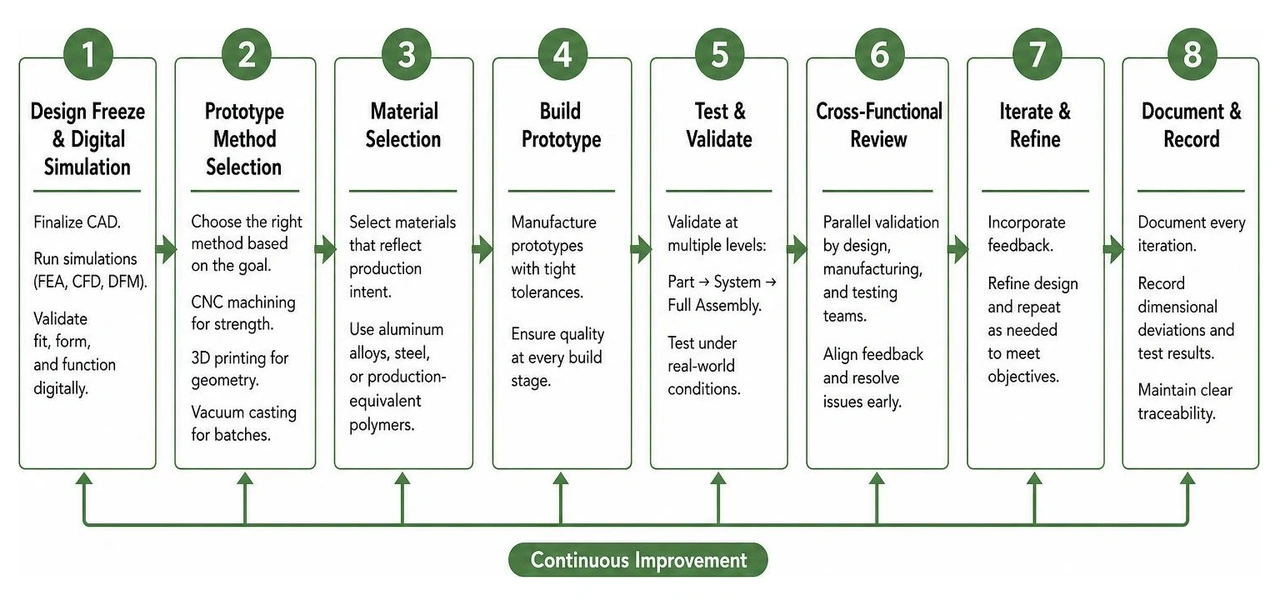
A successful prototyping program does not start on the shop floor; it starts on the screen. To optimize efficiency and minimize costs, we recommend a disciplined, step-by-step workflow.
Before manufacturing begins, we must categorize parts into Class A (vital, high-visibility, or structural components), Class B (structural under-the-hood parts), and Class C (generic brackets or fasteners). This classification allows us to apply appropriate manufacturing methods and avoid over-engineering simple parts.
By following structured essential steps before mass production, we bridge the gap between digital models and assembly-ready hardware. Once the physical parts are produced, knowing how to evaluate prototypes through rigorous dimensional and functional testing ensures they meet strict performance standards.
Step 1: Design Freeze and Digital Simulation
A critical best practice is establishing a "design freeze" before physical manufacturing begins. During this phase, we use advanced digital engineering tools like finite element analysis (FEA), computational fluid dynamics (CFD), and virtual reality (VR).
By walking through a digital twin of the vehicle in VR, our design teams can catch interference issues, check ergonomic reach, and evaluate blind spots before cutting a single piece of metal. This digital pre-work ensures that physical prototypes are built to validate performance rather than to fix basic geometric mistakes.
Step 2: Selecting Technologies for Automotive Prototyping Best Practices
Once the digital model is validated, we select the optimal manufacturing technology. The choice depends on where the component sits on the manufacturing readiness ladder.
For early-stage form and fit checks, 3D printing and vacuum casting offer rapid turnaround times. For functional, load-bearing, or high-temperature components, CNC machining and sheet metal fabrication are the industry standards. Understanding the full spectrum of rapid prototyping processes ensures we match the manufacturing method to the specific test objective.
Step 3: Assembly and Multi-Level Testing
Once the individual prototype parts are fabricated, we assemble them using the planned production sequence: body, chassis, powertrain, interior, and electronics.
Testing occurs at three distinct levels:
- Component level: Verifying the dimensional accuracy of individual parts using Coordinate Measuring Machines (CMM).
- System level: Evaluating sub-assemblies for noise, vibration, and harshness (NVH) and thermal cycling.
- Vehicle level: Testing the integrated system under simulated or real-world driving conditions to catch any geometric deformation or interface misalignment.
Materials and Technologies for High-Performance Automotive Prototypes
Selecting the right material is just as important as choosing the right manufacturing process. If a prototype is meant to undergo structural or fatigue testing, substituting production-grade metals with cheap plastics will yield dangerous false negatives.
For structural components, suspension brackets, and crash-test zones, we rely heavily on high-strength metals like Aluminum 6061-T6 (yield strength of 276 MPa), Aluminum 7075-T6 (yield strength of 503 MPa), and 4140 alloy steel. When learning how to prototype metal parts, engineering teams must focus on matching process to material in automotive development to ensure the physical prototype exhibits the exact mechanical properties required for safety validation.
Metal Fabrication and CNC Machining

For functional metal parts, rapid prototyping CNC machining is the gold standard. We utilize 5-axis CNC machining to eliminate datum-shift errors (which can add 0.02 mm to 0.05 mm of deviation per repositioning) and achieve tolerances as tight as ±0.01 mm.
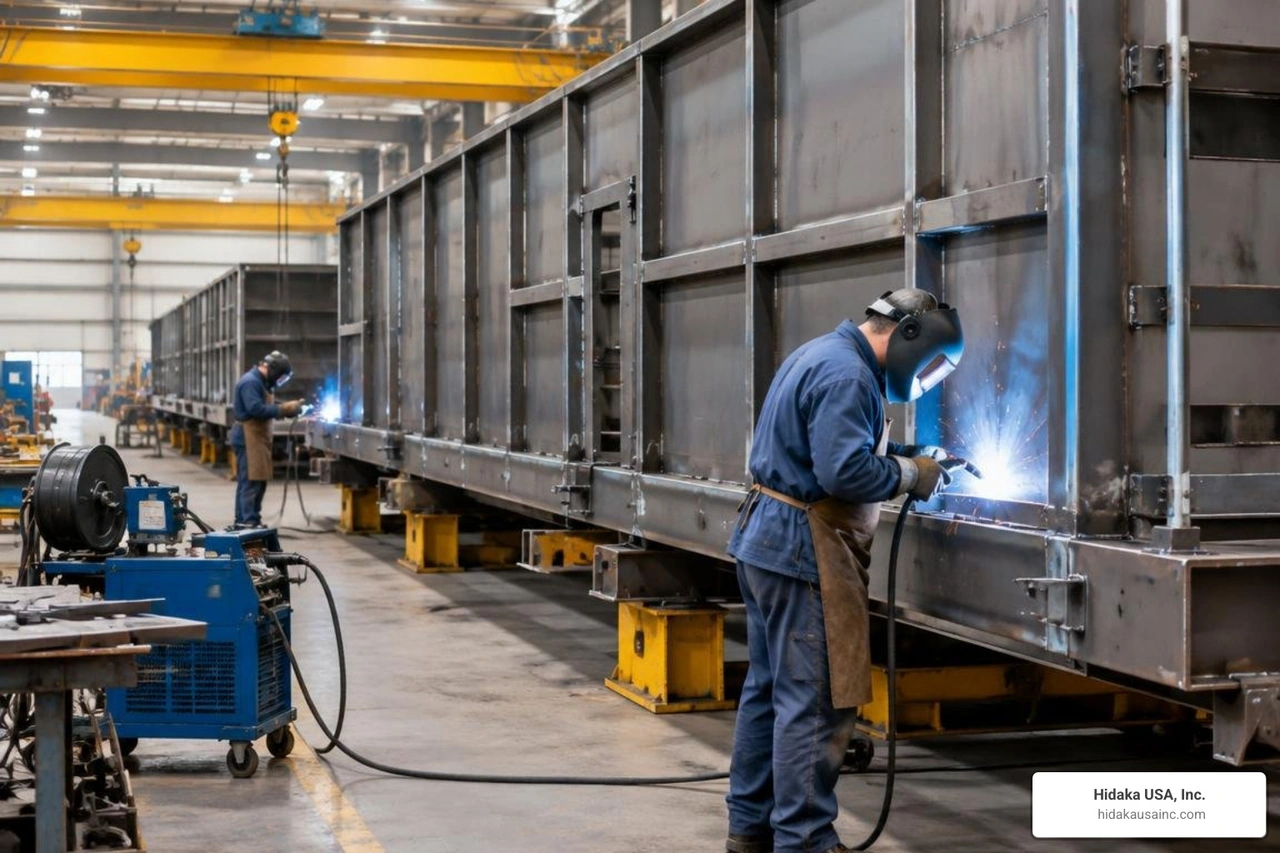
For structural body panels and brackets, we combine 3D laser cutting with hydraulic press forming. Utilizing flexible tooling and laser-measured alignment allows us to adjust to design modifications in hours rather than weeks, keeping development timelines on track.
Advanced Polymers and Additive Manufacturing
For non-structural interior components, sensor brackets, and ductwork, additive manufacturing processes like Selective Laser Sintering (SLS), Stereolithography (SLA), and Fused Deposition Modeling (FDM) are highly effective.
When prototyping under-hood electrical housings, we utilize high-performance polymers such as PEEK or flame-retardant, glass-filled nylons to ensure UL94 compliance and thermal resistance up to 150°C.
Automotive vs. Medical Device Prototyping: Key Differences
While both automotive and medical device prototyping demand extreme precision, their regulatory pathways and engineering priorities differ significantly.
In medical device development, the primary focus is on biocompatibility, sterility, and strict FDA regulatory pathways. Prototypes must prove they will not harm the human body over extended periods.
In the automotive sector, the focus shifts to crash safety, durability, and high-volume manufacturability under IATF 16949 and ISO 9001 standards. Automotive prototypes must survive extreme environmental conditions, millions of vibration cycles, and severe physical impacts. Maintaining rigorous quality control ISO standards throughout the automotive prototyping phase ensures that every part can be traceably validated before transitioning to mass production.
Overcoming Challenges in Modern Automotive Prototyping
Modern automotive prototyping is filled with technical hurdles, from managing tight tolerances to controlling R&D costs. Implementing smart prototyping cost reduction strategies — such as consolidating prototype runs to spread setup costs and specifying functional tolerances only where necessary — helps keep projects within budget without sacrificing quality.
Mitigating EV and ADAS Prototyping Risks

The rise of EVs and ADAS has introduced new prototyping challenges. EV battery enclosures must be lightweight, structurally rigid to protect cells during a crash, and shielded against electromagnetic interference (EMI).
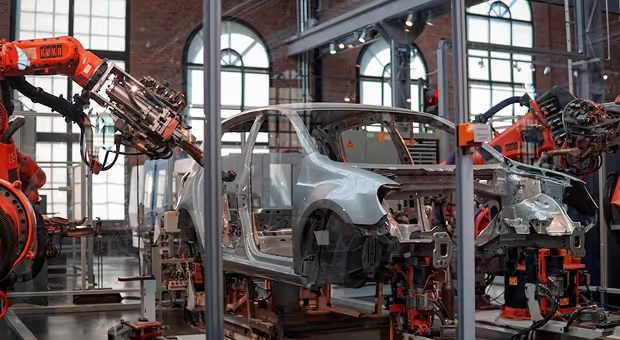
Furthermore, prototyping ADAS components requires micron-level sensor alignment. A fraction of a degree of misalignment on a radar or LiDAR bracket can throw off autonomous braking systems. We mitigate these risks by using high-precision CNC machining and laser-cut assemblies to guarantee perfect sensor positioning.
Implementing Automotive Prototyping Best Practices for Cross-Functional Collaboration
To avoid costly late-stage design changes, we utilize a parallel validation model. Instead of passing designs sequentially from department to department, representatives from design, manufacturing, quality control, and testing collaborate simultaneously.
By establishing a clear Design Requirements Specification (DRS) and a Quality Control Check Sheet early in the project, we ensure all teams are aligned. This collaborative approach, combined with innovative engineering solutions, reduces design rework by up to 60%.
Frequently Asked Questions about Automotive Prototyping
How do rapid prototyping techniques reduce time-to-market in the automotive industry?
Rapid prototyping compresses the development cycle by allowing engineers to quickly test physical models and identify design flaws early. Catching a defect during the prototype phase is significantly faster and cheaper than modifying hard production tooling. This iterative speed can reduce overall development time by up to 30%.
What role does digital engineering and simulation play in modern automotive prototyping?
Digital simulation (FEA, CFD, and digital twins) acts as a virtual testing ground. It allows us to analyze crash safety, aerodynamics, and thermal performance before physical parts are made. This ensures that the physical prototypes we build are already highly optimized, reducing the number of physical testing rounds required.
How should automotive prototyping processes be adapted for electric vehicles (EVs)?
Prototyping for EVs requires a strong focus on lightweight materials (like aluminum and carbon fiber) to maximize range, specialized battery enclosures that prevent thermal runaway, and robust electromagnetic shielding for sensitive high-voltage electronics.
Conclusion
Mastering automotive prototyping best practices is the key to delivering safe, reliable, and cost-effective vehicles to the market. By establishing clear objectives, utilizing digital simulations, selecting the right materials, and fostering cross-functional collaboration, manufacturers can confidently navigate the complexities of modern automotive engineering.
At Hidaka USA, Inc., based in Dublin, Ohio, we combine our ISO 9001 certified quality systems, AWS certified welding, and advanced 2D/3D laser cutting and hydraulic press capabilities to bring your automotive designs to life. Whether you need rapid metal prototypes or full-scale mass production, our team is here to support your engineering journey.
Ready to accelerate your next automotive program? Learn more about our Prototyping Services or contact us today to discuss your project requirements.