The Ultimate Guide to Prototype Design Consultation Services

What Are Advanced Prototype Engineering Services?
Advanced prototype engineering services are specialized processes that turn digital designs into functional, testable physical parts — bridging the gap between concept and full-scale production.
Here is a quick overview of what they include:
- Technologies used: CNC machining, 3D printing (FDM, SLA, SLS, DMLS, PolyJet), metal stamping, injection molding, waterjet cutting, and composite fabrication
- Materials covered: Metals, engineering plastics, urethanes, composites, and foams
- Industries served: Automotive, aerospace, defense, medical devices, renewable energy, and consumer products
- Key benefits: Faster development cycles, lower risk, design flexibility, and smoother transition to full production
- What sets them apart from basic prototyping: Advanced services produce functional, production-grade parts with integrated mechanics and electronics — not just visual models
Unlike basic prototyping, which focuses mainly on shape and appearance, advanced prototype engineering validates how a part actually performs under real-world conditions. This makes it a critical step for manufacturers who need confidence before committing to full production tooling and volume runs.
I'm Yoshihiro Hidaka, founder of Hidaka USA, Inc., and I have been delivering advanced prototype engineering services to the automotive industry since 1989, growing from a sheet metal prototype supplier into a full-service manufacturer serving multiple industries. In this guide, I'll walk you through everything you need to know to make the most of prototype engineering for your next project.
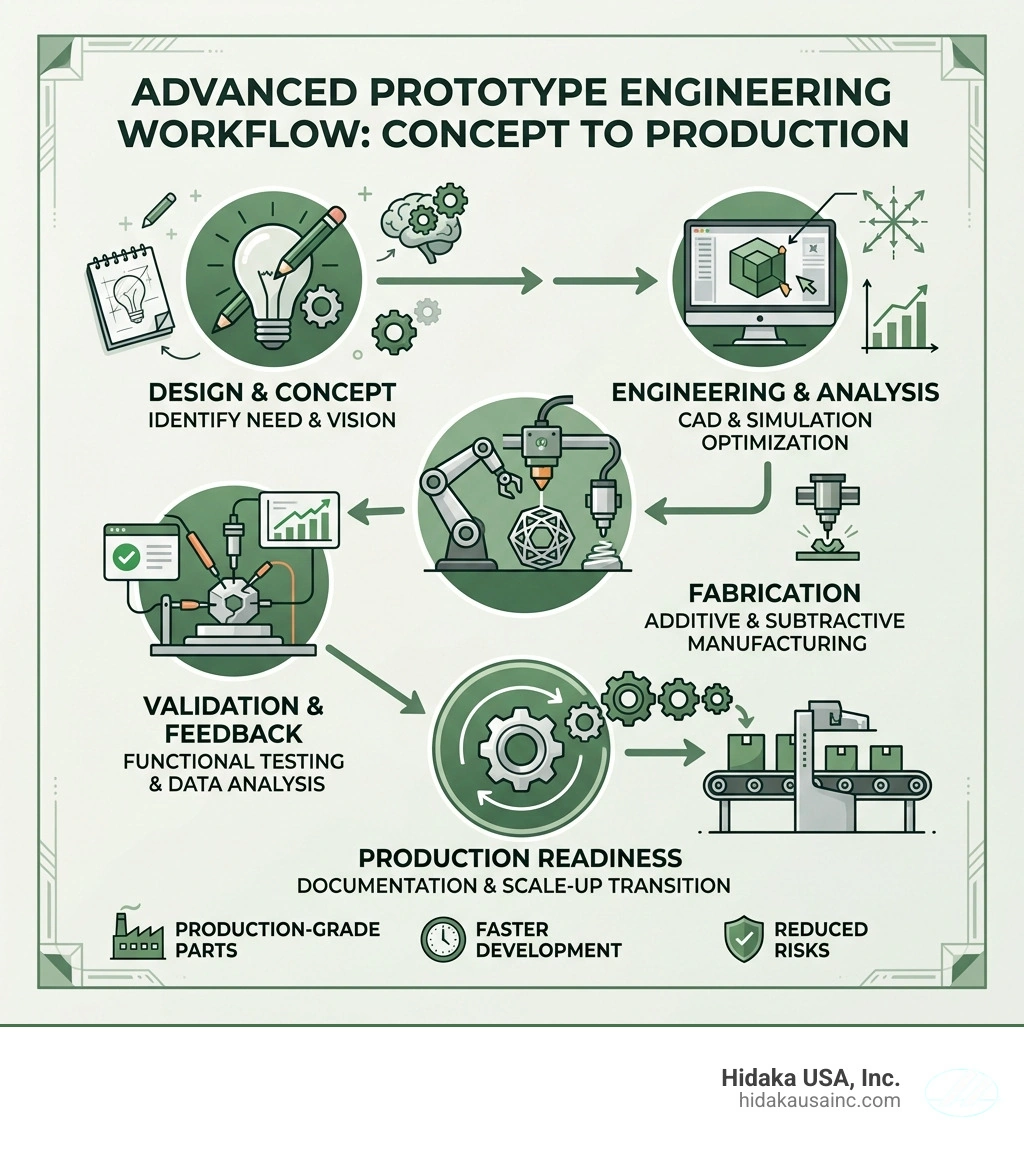
Advanced prototype engineering services terms simplified:
Core Technologies in Advanced Prototype Engineering Services
When we talk about "advanced" services, we are moving far beyond simple plastic models. In a professional facility like ours in Dublin, Ohio, we utilize a blend of additive and subtractive manufacturing to create parts that mirror the final product's strength, weight, and thermal properties.

At the heart of these services is the ability to manipulate materials with extreme precision. For instance, PRECISION PROTOTYPES AND FABRICATION SERVICES often involve a multidisciplinary approach where mechanics, materials science, and manufacturing constraints are considered simultaneously. This reduces the number of iterations needed, saving both time and resources.
In our 95,000-square-foot facility, we emphasize technologies that handle heavy-duty requirements:
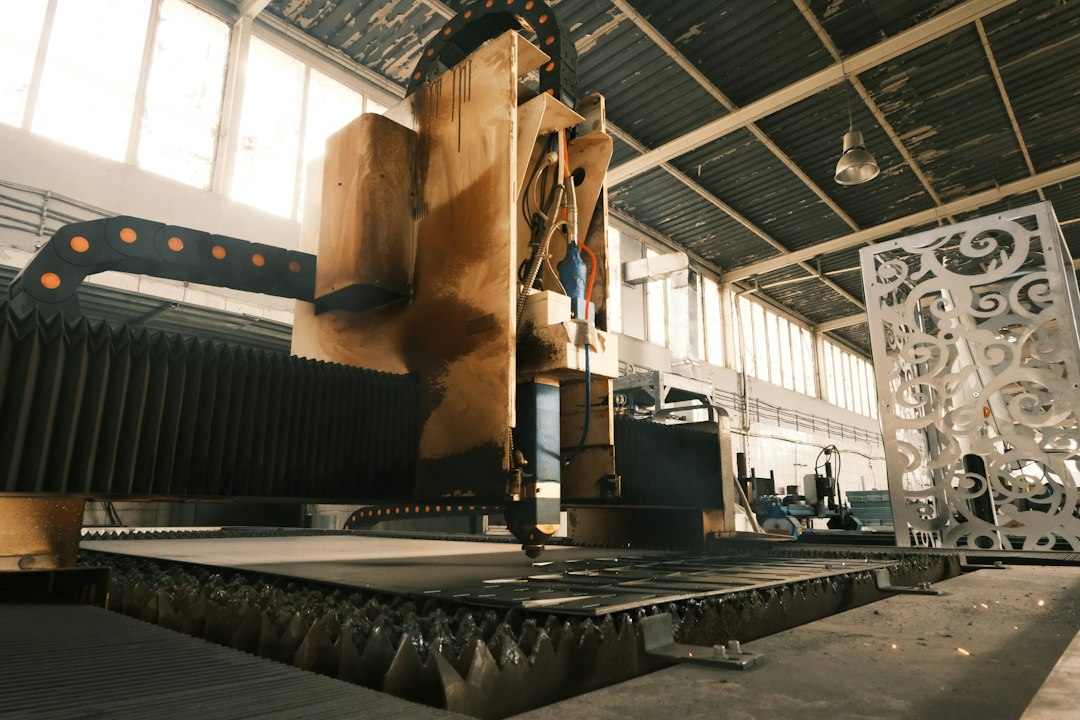
- 2D/3D Laser Cutting: Essential for complex geometries in sheet metal, allowing for clean edges and intricate patterns without the need for expensive custom dies in the early stages.
- Hydraulic Pressing: We use this to form metal parts that require the structural integrity of a stamped component, providing a "real-world" test of how the metal will behave during mass production.
- CNC Machining: Whether it’s 3-axis or 5-axis milling, this subtractive process carves parts out of solid blocks of metal or plastic, achieving tolerances as tight as ±0.001 inches.
Comparison of Primary Prototyping Methods
| Feature | 3D Printing (Additive) | CNC Machining (Subtractive) | Injection Molding (Bridge) |
|---|---|---|---|
| Speed | Extremely Fast (1-3 days) | Fast (3-10 days) | Moderate (2-4 weeks) |
| Material Choice | Limited (Polymers/Some Metals) | Vast (Almost any metal/plastic) | Wide (Production plastics) |
| Tolerance | Moderate | High (±0.001") | High |
| Best For | Concept & Form | Functional Testing | Market Validation |
Rapid Prototyping with Advanced Prototype Engineering Services
The term "Rapid Prototyping" is often used as an umbrella for various 3D printing technologies. In an advanced engineering context, the choice of technology depends entirely on the end-use environment:
- FDM (Fused Deposition Modeling): Great for early-stage concept validation where strength and durability are needed at a lower cost.
- PolyJet: This is the "high-def" version of 3D printing, capable of accuracies down to 0.014 millimeters. It’s perfect for prototypes that require multiple materials or colors in a single part.
- DMLS (Direct Metal Laser Sintering): This is how we create complex metal parts layer-by-layer. It’s a game-changer for aerospace and medical applications where traditional machining might be impossible.
- SLS (Selective Laser Sintering) & SLA (Stereolithography): SLS is excellent for durable, functional plastic parts without the need for support structures, while SLA provides the smooth finish required for visual models and light functional testing.
Precision Machining and Tooling
While 3D printing gets the headlines, subtractive manufacturing remains the backbone of advanced prototype engineering services. For industries like motorsports and railcar manufacturing, parts must withstand immense vibration and heat.
Using 5-axis routing and waterjet cutting allows us to work with "exotic" materials like billet aluminum, high-strength composites, and thick-gauge steel. Furthermore, developing "soft tooling" or prototype-grade metal stamping dies allows a company to test the manufacturing process itself, not just the part design. This ensures that when you move to a million-unit run, the physics of the metal forming are already proven.
Strategic Benefits of High-Fidelity Prototyping
Why invest in high-fidelity prototypes instead of just "winging it" to production? The answer lies in risk management.
When we provide advanced prototype engineering services, we aren't just making a part; we are performing a "Design for Manufacturability" (DFM) audit. By catching a design flaw in a $2,000 prototype, we prevent a $200,000 mistake in production tooling.
- Risk Mitigation: Testing a functional prototype in a "hot-fire" or high-stress environment reveals failures that software simulations might miss.
- Speed to Market: Paradoxically, spending more time in the prototype phase often gets you to market faster. By resolving assembly issues early, the transition to full-scale production is seamless.
- Stakeholder Visualization: It is much easier to secure funding or board approval when you can place a production-grade part in a stakeholder's hands.
- Market Validation: Small "pilot runs" of prototypes can be used for user testing or even limited market releases to gauge interest before a full launch.
Specialized Applications: From Medical Devices to Automotive
Different industries have vastly different requirements for their prototypes. In our local Ohio landscape, we see a heavy emphasis on the automotive and medical sectors.
In the medical field, the stakes are incredibly high. Organizations like the Mechanical Prototyping Core | Cleveland Clinic Research focus on developing devices that must meet stringent safety standards. Advanced prototyping here isn't just about the part; it's about the documentation and regulatory compliance that follows it.
For the automotive and mass-transit railcar industries, we focus on large-scale assemblies. This might include:
- Seat frame assemblies that must meet crash-test safety ratings.
- Instrument panels that require precise integration of electronics and plastics.
- Muffler and exhaust systems that must handle extreme thermal expansion.
Navigating Regulatory Compliance through Advanced Prototype Engineering Services
If you are developing an FDA Class I, II, or III medical device, your prototype isn't just a model; it's a piece of evidence for your regulatory submission. Advanced services provide the traceability and material certification required for these high-stakes industries.
At Hidaka USA, Inc., we maintain ISO 9001 certification and American Welding Society (AWS) certification. This means every weld and every cut is backed by a quality management system that ensures consistency. For our clients, this provides:
- Traceability: Knowing exactly where the material came from and who worked on it.
- Validation Testing: Ensuring the prototype meets the specific safety requirements of the industry.
- Material Certification: Providing the "birth certificate" for the metals and plastics used.
Transitioning from Prototype to Full-Scale Production
The ultimate goal of any prototype is to eventually stop being a prototype. This is where New Product Introduction (NPI) comes into play.
A major advantage of working with a vertically integrated partner is the "in-house" knowledge transfer. When the same team that engineered your prototype also handles your mass production, nothing is lost in translation. We use Industry 4.0 technologies, such as Visual Knowledge Share (VKS), to create digital work instructions based on the prototype build. This ensures that the assembly line workers follow the exact same high-quality steps that the prototype engineers perfected.
Vertical integration also enables Just-In-Time (JIT) delivery. By managing the supply chain and production under one roof in Dublin, Ohio, we can scale from a single prototype to a low-volume run of 500 parts, and eventually to full-scale mass production without the logistical headaches of switching vendors.
Frequently Asked Questions about Prototype Engineering
What is the difference between basic and advanced prototyping?
Basic prototyping is often "looks-like" prototyping. It uses materials like cardboard, foam, or basic 3D prints to show the size and shape of an object. Advanced prototype engineering services provide "works-like" and "is-like" prototypes. These are made from production-grade metals or plastics, feature integrated electronics, and are capable of undergoing rigorous functional testing, such as heat resistance or structural load bearing.
How long does the advanced prototyping process take?
The timeline varies based on complexity. A simple 3D printed component might be ready in as little as 24 to 48 hours. However, a complex assembly—such as a motorized railcar component or an automotive exhaust prototype involving CNC machining, laser cutting, and AWS-certified welding—typically takes anywhere from a few days to several weeks. The goal is to be fast, but never at the expense of the precision required for valid testing.
What certifications should a prototype engineering partner hold?
At a minimum, look for ISO 9001 certification, which ensures a high standard of quality management. If you are in the medical field, ISO 13485 is crucial. For those in heavy industry, automotive, or motorsports, AWS (American Welding Society) certification is vital to ensure that structural components are safe and reliable. These certifications prove that the partner has the rigorous quality control standards necessary to produce industrial-grade prototypes.
Conclusion
The journey from a "napkin sketch" to a finished product is filled with challenges, but advanced prototype engineering services provide the roadmap to navigate them. By leveraging the latest in 3D printing, CNC machining, and precision metal fabrication, businesses can iterate faster, reduce their financial risk, and ensure their products are ready for the rigors of the real world.
At Hidaka USA, Inc., we pride ourselves on bringing American-made quality and deep engineering expertise to every project. Whether you are developing a high-performance component for motorsports or a complex assembly for a mass-transit railcar, our Dublin, Ohio team is ready to help you bridge the gap from concept to production.
Ready to see your design come to life? Whether you need a single precision part or a full-scale assembly, we invite you to explore how our integrated engineering and manufacturing capabilities can accelerate your next project.
Start your prototyping journey with Hidaka USA, Inc.